Kirjojen hintavertailu – 12 859 829 kirjaa ja 27 kauppaa

Kirjailija

Joshua Gans

Kirjat ja teokset yhdessä paikassa: 16 kirjaa, julkaisuja vuosilta 2005–2025, suosituimpiin kuuluu Máquinas Predictivas (Prediction Machines Spanish Edition). Vertaile teosten hintoja ja tarkista saatavuus suomalaisista kirjakaupoista.

16 kirjaa

Kirjojen julkaisuvuodet: 2005–2025.

The Microeconomics of Artificial Intelligence
A comprehensive treatment of the microeconomics associated with the adoption and use of artificial intelligence. It is well-recognized that recent advances in AI are exclusively advances in statistical techniques for prediction. While this may facilitate automation, this result is secondary to AI's impact on decision-making. From an economics perspective, predictions have their first-order impacts on the efficiency of decision-making. In The Microeconomics of Artificial Intelligence, Joshua Gans examines AI as prediction that enhances and perhaps enables decision-making, focusing on the impacts that arise within firms or industries rather than broad economy-wide impacts on employment and productivity. He analyzes what the supply and production characteristics of AI are and what the drivers of the demand for AI prediction are. Putting these together, he explores how supply and demand conditions lead to a price for predictions and how this price is shaped by market structure. Finally, from a microeconomics perspective, he explores the key policy trade-offs for antitrust, privacy, and other regulations.
The Economics of Blockchain Consensus

The Economics of Blockchain Consensus

Joshua Gans

Springer International Publishing AG
2024
nidottu
Blockchain technologies have been rapidly adopted for the creation of cryptocurrencies and have been explored for a myriad of applications. While this is of important economic interest, the computer science behind how blockchains operate to provide security and provenance has been largely inaccessible to economists. This book is a bridge between the computer science and the economics of blockchains. The focus is on the value and the achievement of blockchain consensus; that is, how distributed and independent nodes are able to reach an agreement on what the current state of digital ledgers, that are the product of blockchains, are. The book shows that the goals of computer scientists in designing blockchains place very high weight on security beyond what an economist trained in game theory and mechanism design would require. It shows how blockchains can be redesigned to account for key economic trade-offs, and will be of interest to researchers and students of economics, financial technology and computer science, alongside policymakers.
The Economics of Blockchain Consensus

The Economics of Blockchain Consensus

Joshua Gans

Springer International Publishing AG
2023
sidottu
Blockchain technologies have been rapidly adopted for the creation of cryptocurrencies and have been explored for a myriad of applications. While this is of important economic interest, the computer science behind how blockchains operate to provide security and provenance has been largely inaccessible to economists. This book is a bridge between the computer science and the economics of blockchains. The focus is on the value and the achievement of blockchain consensus; that is, how distributed and independent nodes are able to reach an agreement on what the current state of digital ledgers, that are the product of blockchains, are. The book shows that the goals of computer scientists in designing blockchains place very high weight on security beyond what an economist trained in game theory and mechanism design would require. It shows how blockchains can be redesigned to account for key economic trade-offs, and will be of interest to researchers and students of economics, financial technology and computer science, alongside policymakers.
Power and Prediction

Power and Prediction

Ajay Agrawal; Joshua Gans; Avi Goldfarb

Harvard Business Review Press
2022
sidottu

Halvin toimitettuna 28,40 €

Disruption resulting from the proliferation of AI is coming. The authors of the bestselling Prediction Machines can help you prepare. Artificial intelligence (AI) has impacted many industries around the world—banking and finance, pharmaceuticals, automotive, medical technology, manufacturing, and retail. But it has only just begun its odyssey toward cheaper, better, and faster predictions that drive strategic business decisions. When prediction is taken to the max, industries transform, and with such transformation comes disruption. What is at the root of this? In their bestselling first book, Prediction Machines, eminent economists Ajay Agrawal, Joshua Gans, and Avi Goldfarb explained the simple yet game-changing economics of AI. Now, in Power and Prediction, they go deeper, examining the most basic unit of analysis: the decision. The authors explain that the two key decision-making ingredients are prediction and judgment, and we perform both together in our minds, often without realizing it. The rise of AI is shifting prediction from humans to machines, relieving people from this cognitive load while increasing the speed and accuracy of decisions. This sets the stage for a flourishing of new decisions and has profound implications for system-level innovation. Redesigning systems of interdependent decisions takes time—many industries are in the quiet before the storm—but when these new systems emerge, they can be disruptive on a global scale. Decision-making confers power. In industry, power confers profits; in society, power confers control. This process will have winners and losers, and the authors show how businesses can leverage opportunities, as well as protect their positions. Filled with illuminating insights, rich examples, and practical advice, Power and Prediction is the must-read guide for any business leader or policymaker on how to make the coming AI disruptions work for you rather than against you.
Prediction Machines

Prediction Machines

Ajay Agrawal; Joshua Gans; Avi Goldfarb

Harvard Business Review Press
2022
sidottu

Halvin toimitettuna 30,10 €

Named one of "The five best books to understand AI" by The EconomistThe impact AI will have is profound, but the economic framework for understanding it is surprisingly simple. Artificial intelligence seems to do the impossible, magically bringing machines to life—driving cars, trading stocks, and teaching children. But facing the sea change that AI brings can be paralyzing. How should companies set strategies, governments design policies, and people plan their lives for a world so different from what we know? In the face of such uncertainty, many either cower in fear or predict an impossibly sunny future. But in Prediction Machines, three eminent economists recast the rise of AI as a drop in the cost of prediction. With this masterful stroke, they lift the curtain on the AI-is-magic hype and provide economic clarity about the AI revolution as well as a basis for action by executives, policy makers, investors, and entrepreneurs. In this new, updated edition, the authors illustrate how, when AI is framed as cheap prediction, its extraordinary potential becomes clear:Prediction is at the heart of making decisions amid uncertainty. Our businesses and personal lives are riddled with such decisions. Prediction tools increase productivity—operating machines, handling documents, communicating with customers. Uncertainty constrains strategy. Better prediction creates opportunities for new business strategies to compete. The authors reset the context, describing the striking impact the book has had and how its argument and its implications are playing out in the real world. And in new material, they explain how prediction fits into decision-making processes and how foundational technologies such as quantum computing will impact business choices. Penetrating, insightful, and practical, Prediction Machines will help you navigate the changes on the horizon.
The Pandemic Information Solution

The Pandemic Information Solution

Joshua Gans

Endeavor Literary Press
2021
pokkari
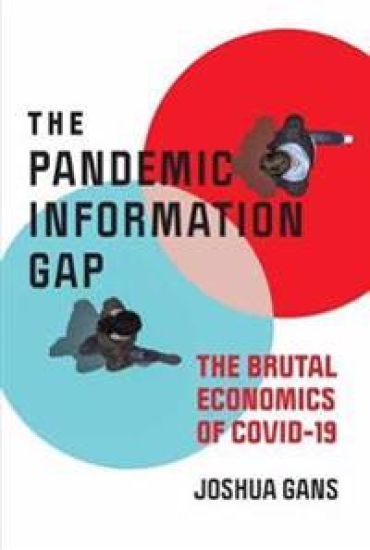
Covid-19 is a global pandemic inflicting large health and economic costs. In his previous book, The Pandemic Information Gap: The Brutal Economics of COVID-19 (MIT Press, 2020), economist Joshua Gans explains that those costs have been so large because governments and others have lacked the information needed to control the pandemic. Unless we know who is infectious, we can't break the chains of transmission, which results in the escalation of our problems. Pandemics, he writes, are information problems. Now, in this follow-up book, Gans outlines the solution to the information gap. By engaging in rapid, frequent screening, we can control the pandemic and restore normality. We can lower the number of cases, break chains of transmission, and make it safe for people to interact again. This will require changing our mindset about testing, gathering the right information, and matching that information to the right decisions. We have the ingredients to do all these things. We just need to put them together in a scalable and sustainable system. This book is a guide to the issues and trade-offs that policymakers and other key decision-makers need to grapple with and follow.
Innovation + Equality

Innovation + Equality

Joshua Gans

MIT Press
2020
nidottu
Artificial intelligence, genetics research, and materials science study have benefited society collectively and rewarded innovators handsomely- we get cool smartphones and technology moguls become billionaires. This contributes to a growing wealth gap; in the United States; the wealth controlled by the top 0.1 percent of households equals that of the bottom ninety percent. Is this the inevitable cost of an innovation-driven economy? Economist Joshua Gans and policy maker Andrew Leigh make the case that pursuing innovation does not mean giving up on equality--precisely the opposite. In this book, they outline ways that society can become both more entrepreneurial and more egalitarian through policies that promote both innovation and equality. If we encourage innovation in the right way, our future can look more like the cheerful techno-utopia of Star Trek than the dark techno-dystopia of The Terminator.
Pandemic Information Gap and the Brutal Economics of COVID-19
The COVID-19 pandemic has unleashed a firehose of information (much of it wrong) and an avalanche of opinions (many of them ill-founded). Most of us are so distracted by the everyday awfulness that we don't see the broader issues in play. In this book, economist Joshua Gans steps back from the short-term chaos to take a clear and systematic look at how economic choices are being made in response to COVID-19. He shows that containing the virus and pausing the economy--without letting businesses fail and people lose their jobs--are the necessary first steps.
Máquinas Predictivas (Prediction Machines Spanish Edition)

Máquinas Predictivas (Prediction Machines Spanish Edition)

Ajay Agrawal; Joshua Gans; Avi Goldfarb

Reverte Management International
2020
nidottu
La inteligencia artificial hace lo aparentemente imposible, trayendo m gicamente las m quinas a los coches que conducen la vida, intercambiando acciones y ense ando a los ni os. Pero enfrentar el cambio radical que traer la IA puede ser paralizante. C mo deber an las empresas establecer estrategias, los gobiernos dise ar pol ticas y las personas planificar sus vidas para un mundo tan diferente al que conocemos? Ante tal incertidumbre, muchos analistas se acobardan de miedo o predicen un futuro imposiblemente soleado. ///// Artificial intelligence does the seemingly impossible, magically bringing machines to life--driving cars, trading stocks, and teaching children. But facing the sea change that AI will bring can be paralyzing. How should companies set strategies, governments design policies, and people plan their lives for a world so different from what we know? In the face of such uncertainty, many analysts either cower in fear or predict an impossibly sunny future. But in Prediction Machines, three eminent economists recast the rise of AI as a drop in the cost of prediction. With this single, masterful stroke, they lift the curtain on the AI-is-magic hype and show how basic tools from economics provide clarity about the AI revolution and a basis for action by CEOs, managers, policy makers, investors, and entrepreneurs.
Prediction Machines: The Simple Economics of Artificial Intelligence

Prediction Machines: The Simple Economics of Artificial Intelligence

Ajay Agrawal; Joshua Gans; Avi Goldfarb

Audible Studios on Brilliance
2018
mp3 cd-levyllä
"What does AI mean for your business? Read this book to find out." (Hal Varian, Chief Economist, Google) Artificial intelligence does the seemingly impossible, magically bringing machines to life - driving cars, trading stocks, and teaching children. But facing the sea change that AI will bring can be paralyzing. How should companies set strategies, governments design policies, and people plan their lives for a world so different from what we know? In the face of such uncertainty, many analysts either cower in fear or predict an impossibly sunny future. But in Prediction Machines, three eminent economists recast the rise of AI as a drop in the cost of prediction. With this single, masterful stroke, they lift the curtain on the AI-is-magic hype and show how basic tools from economics provide clarity about the AI revolution and a basis for action by CEOs, managers, policy makers, investors, and entrepreneurs. When AI is framed as cheap prediction, its extraordinary potential becomes clear: Prediction is at the heart of making decisions under uncertainty. Our businesses and personal lives are riddled with such decisions. Prediction tools increase productivity - operating machines, handling documents, communicating with customers. Uncertainty constrains strategy. Better prediction creates opportunities for new business structures and strategies to compete. Penetrating, fun, and always insightful and practical, Prediction Machines follows its inescapable logic to explain how to navigate the changes on the horizon. The impact of AI will be profound, but the economic framework for understanding it is surprisingly simple. The accompanying reference guide is included as a PDF.
Prediction Machines

Prediction Machines

A. Agrawal; Joshua Gans; Avi Goldfarb

Harvard Business Review Press
2018
sidottu
“What does AI mean for your business? Read this book to find out." -- Hal Varian, Chief Economist, Google Artificial intelligence does the seemingly impossible, magically bringing machines to life--driving cars, trading stocks, and teaching children. But facing the sea change that AI will bring can be paralyzing. How should companies set strategies, governments design policies, and people plan their lives for a world so different from what we know? In the face of such uncertainty, many analysts either cower in fear or predict an impossibly sunny future. But in Prediction Machines, three eminent economists recast the rise of AI as a drop in the cost of prediction. With this single, masterful stroke, they lift the curtain on the AI-is-magic hype and show how basic tools from economics provide clarity about the AI revolution and a basis for action by CEOs, managers, policy makers, investors, and entrepreneurs. When AI is framed as cheap prediction, its extraordinary potential becomes clear. Prediction is at the heart of making decisions under uncertainty. Our businesses and personal lives are riddled with such decisions. Prediction tools increase productivity--operating machines, handling documents, communicating with customers. Uncertainty constrains strategy. Better prediction creates opportunities for new business structures and strategies to compete. Penetrating, fun, and always insightful and practical, Prediction Machines follows its inescapable logic to explain how to navigate the changes on the horizon. The impact of AI will be profound, but the economic framework for understanding it is surprisingly simple.
The Disruption Dilemma

The Disruption Dilemma

Joshua Gans

MIT Press
2017
pokkari
An expert in management takes on the conventional wisdom about disruption, looking at companies that proved resilient and offering managers tools for survival. "Disruption" is a business buzzword that has gotten out of control. Today everything and everyone seem to be characterized as disruptive-or, if they aren't disruptive yet, it's only a matter of time before they become so. In this book, Joshua Gans cuts through the chatter to focus on disruption in its initial use as a business term, identifying new ways to understand it and suggesting new tools to manage it. Almost twenty years ago Clayton Christensen popularized the term in his book The Innovator's Dilemma, writing of disruption as a set of risks that established firms face. Since then, few have closely examined his account. Gans does so in this book. He looks at companies that have proven resilient and those that have fallen, and explains why some companies have successfully managed disruption-Fujifilm and Canon, for example-and why some like Blockbuster and Encyclopedia Britannica have not. Departing from the conventional wisdom, Gans identifies two kinds of disruption: demand-side, when successful firms focus on their main customers and underestimate market entrants with innovations that target niche demands; and supply-side, when firms focused on developing existing competencies become incapable of developing new ones. Gans describes the full range of actions business leaders can take to deal with each type of disruption, from "self-disrupting" independent internal units to tightly integrated product development. But therein lies the disruption dilemma: A firm cannot practice both independence and integration at once. Gans shows business leaders how to choose their strategy so their firms can deal with disruption while continuing to innovate.
Principles of Economics

Principles of Economics

Stephen King; Libich; Joshua Gans; N. Mankiw; Martin Byford; Robin Stonecash

Cengage Australia
2014
nidottu
Show the power of economic tools, and the importance of economic ideas! The latest edition of this text continues to focus on important concepts and analyses necessary for students in an introductory economics course. In keeping with the authors? philosophy of showing students the power of economic tools and the importance of economic ideas, this edition pays careful attention to regional and global policies and economic issues ? such as climate change and resource taxation, the impacts of the ongoing global financial crisis, inflation, unemployment, interest rates, monetary and fiscal policy. Principles of Economics 6th edition combines microeconomics and macroeconomics into one volume for students who take a full year?s course. Each new print book includes access to online Student Resources CourseMate Express and Search Me! Economics. Aplia is also available for this book.
Principles of Macroeconomics

Principles of Macroeconomics

Robin Stonecash; N. Mankiw; Joshua Gans; Stephen King

Nelson Australia
2011
nidottu
Shortlisted for 2009 Australian Educational Publishing Awards. Showing the power of economic tools and the importance of economic ideas, this forth edition of Principles of Macroeconomics continues to focus on what is truly important for students to learn in their first macroeconomics course. With an engaging approach to the study of the economy, the text returns to applications and policy questions as often as possible, encouraging students to relate ecomonic theory to their own experiences. Designed for students in Australia and New Zealand, this new edition incorporates contemporary topics such as the effects of the US sub-prime market, increased trading with China and India, the RBA, interest rates and monetary policy. Comprehensively revised and updated, the text enables students to understand the important foundations of economic analysis in a practical real-world context.
Parentonomics

Parentonomics

Joshua Gans

MIT Press
2010
nidottu
What every parent needs to know about negotiating, incentives, outsourcing, and other strategies to solve the economic management problem that is parenting. Like any new parent, Joshua Gans felt joy mixed with anxiety upon the birth of his first child. Who was this blanket-swaddled small person and what did she want? Unlike most parents, however, Gans is an economist, and he began to apply the tools of his trade to raising his children. He saw his new life as one big economic management problem-and if economics helped him think about parenting, parenting illuminated certain economic principles. Parentonomics is the entertaining, enlightening, and often hilarious fruit of his "research." Incentives, Gans shows us, are as risky in parenting as in business. An older sister who is recruited to help toilet train her younger brother for a share in the reward given for each successful visit to the bathroom, for example, could give the trainee drinks of water to make the rewards more frequent. (Economics later offered another, better toilet training solution: outsourcing. For their third child, Gans and his wife put it in the hands of professionals-the day care providers.) Gans gives us the parentonomic view of delivery (if the mother shares her pain by yelling at the father, doesn't it really create more aggregate pain?), sleep (the screams of a baby are like an offer: "I'll stop screaming if you give me attention"), food (a question of marketing), travel ("the best thing you can say about traveling with children is that they are worse than baggage"), punishment (and threat credibility), birthday party time management, and more. Parents: if you're reading Parentonomics in the presence of other people, you'll be unable to keep yourself from reading the funny parts out loud. And if you're reading it late at night and wake a child with your laughter-well, you'll have some guidelines for negotiating a return to bed.
Core Economics for Managers

Core Economics for Managers

Joshua Gans

Cengage Australia
2005
nidottu
In this engaging text Joshua Gans turns economic teaching on its head. Specifically aimed at the management or MBA student, Core Economics for Managers covers the essentials but does so in ways that build on and reinforce the student’s work experiences Beginning with the tools of decision-making, this book does not shy away from the complexities of managerial decisions but embraces them to consider both uncertainty and strategic interaction in a readily accessible way. This allows the student to move with ease to considering the principles of negotiated exchange and how prices are formed when parties interact face to face rather than anonymously in markets. This provides a natural way of talking about competition and the gains from cooperation. The traditional topics of economics and competitive strategy can then be introduced by considering pricing; that is, how a firm chooses its price, how a firm can innovate in pricing, how prices are constrained by competition and how prices can act as signals for investment. Finally, with all of these tools in hand, the student can seamlessly move on to topics of contracting, outsourcing, the provision of incentives and the building of relationships. No other single book covers this multitude of topics in such an accessible way. Gone are unnecessary jargon from economics and strategy. All that remains is the core. And that core can be taken with the student back into their studies and commercial life.