
Kirjojen hintavertailu – 12 903 725 kirjaa ja 27 kauppaa

Kirjailija

Joyce de Coninck

Kirjat ja teokset yhdessä paikassa: 3 kirjaa, julkaisuja vuosilta 2018–2026, suosituimpiin kuuluu The Eu's Human Rights Responsibility Gap: Deconstructing Human Rights Impunity of International Organisations. Vertaile teosten hintoja ja tarkista saatavuus suomalaisista kirjakaupoista.

3 kirjaa

Kirjojen julkaisuvuodet: 2018–2026.

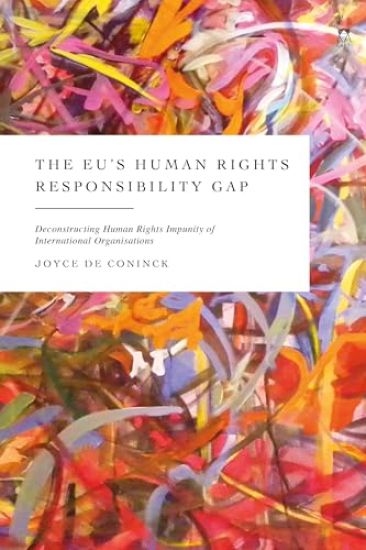
The Eu's Human Rights Responsibility Gap: Deconstructing Human Rights Impunity of International Organisations
Can the EU be held legally responsible for its contributions to human rights harms in its Integrated Border Management policy? Or do systemic legal design flaws in the EU's human rights responsibility regime give rise to a significant responsibility gap? This book delves into these pressing questions, offering a transversal analysis of applicable legal frameworks under international and EU law. Divided into three parts, the book first analyses the international and EU human rights responsibility frameworks, revealing both 'normative incongruency' as well as 'liability incongruency'. Part two applies these frameworks to specific illustrations within the four tiers of the EU's Integrated Border Management, exposing the critical points where responsibility falters. Building on these findings and drawing from shared responsibility and relationality theories, part three briefly introduces 'Relational Human Rights Responsibility' as an alternative method to ascertaining human rights responsibility of the EU specifically, and international organisations more generally.

The EU’s Human Rights Responsibility Gap

The EU’s Human Rights Responsibility Gap

Joyce De Coninck

BLOOMSBURY PUBLISHING PLC
2024
sidottu
Can the EU be held legally responsible for its contributions to human rights harms in its Integrated Border Management policy? Or do systemic legal design flaws in the EU's human rights responsibility regime give rise to a significant responsibility gap? This book delves into these pressing questions, offering a transversal analysis of applicable legal frameworks under international and EU law. Divided into three parts, the book first analyses the international and EU human rights responsibility frameworks, revealing both ‘normative incongruency’ as well as ‘liability incongruency’. Part two applies these frameworks to specific illustrations within the four tiers of the EU’s Integrated Border Management, exposing the critical points where responsibility falters. Building on these findings and drawing from shared responsibility and relationality theories, part three briefly introduces 'Relational Human Rights Responsibility' as an alternative method to ascertaining human rights responsibility of the EU specifically, and international organisations more generally.
European Yearbook on Human Rights 2018

European Yearbook on Human Rights 2018

Lize Glas; Filippo Fontanelli; Theodor Rathgeber; Monika Mayrhofer; Agnieszka Szklanna; Vladislava Stoyanova; Hans-Peter Folz; Alma Stankovic; Adina Portaru; David Reichel; Mathieu Leluup; Claudia Elion; Jean P. Froehly; Gregor Fischer; Joyce De Coninck; Johanna Pruessing; Ewa Sapiezynska; Jacopo Leone; Christian Strohal; Stefan Kieber; Mathilde Duhaâ; Miroslaw Wyrzykowski; Danaé Coquelet; Ajla van Heel; Elspeth Guild; Gareth Davies; Kanstantsin Dzehtsiarou

Intersentia Ltd
2018
nidottu
Both in Europe and around the world, 2017 has been another difficult year for the protection of human rights. Examples of the increased pressure on the European human rights system are apparent: the attack on the independence of the judiciary in Poland, which was responded to by the first time initiation of the rule of law procedure by the European Commission; the increasing human rights issues arising from European migration policy; Russia's suspension of its financial contribution to the Council of Europe and Turkey's lowering of its contribution; and the difficulties in appointing key human rights positions in the Organization for Security and Cooperation in Europe. Split into its customary four parts and complemented by book reviews of recent publications on human rights in Europe, the tenth volume of the European Yearbook on Human Rights brings together renowned scholars to analyse some of the most pressing and topical human rights issues being faced in Europe today.