Kirjojen hintavertailu – 12 903 725 kirjaa ja 27 kauppaa
Kirjailija
Jude P. Dougherty
Kirjat ja teokset yhdessä paikassa: 12 kirjaa, julkaisuja vuosilta 2000–2024, suosituimpiin kuuluu The Psychology of Character. Vertaile teosten hintoja ja tarkista saatavuus suomalaisista kirjakaupoista.
Becoming What We Are is a collection of essays and reviews written in the last decade by the late Jude Dougherty, which covey a perspective on contemporary events and literature, written from a classical and Christian perspective. These essays convey a worldview much in need of restating when, according to Dougherty, Western society seems to have lost its bearings, in its legislative assemblies and in its judicial systems as well. Dougherty writes as a philosopher, specifically as one who has devoted most of his life to the study of metaphysics. In these pages Dougherty examines the Jacobians, the empirical world of Hume, Locke and Hobbes, and Kant, the metaphysics of Plato, Aristotle, the Stoics and Aquinas that opens one to God and provides one with a moral compass, and critiques the work of Karl Marx, Sigmund Freud and John Dewey. Becoming What We Are spends some time inquiring into the character of a few great men viz. George Washington, Charles De Gaulle and Moses Maimonides. Dougherty draws upon and shows respect for numerous contemporary authors who are engaged in research and analysis similar to his. The intent is, with the aid of others to restate some ancient but neglected truths. But more than that to show that true science is possible, that nature and human nature yield to human enquiry, that science is not to be confused with description and prediction.
How we became what we are. There are many explanations. One plausible account is found in the work of Rudolph Allers who writes about the European intellectual landscape from 1850 to the opening decades of the twentieth century... Allers is not alone in recognizing that a true account of human nature may await the recovery of classical antiquity. From Plato and Aristotle, modernity may learn that the immaterial or spiritual component of human nature is not empirically discerned but reasoned to from empirical evidence. - from the translation by Jude Dougherty
In the face of growing skepticism and relativism, ""believe in reason"" is the central message in Pope John Paul II's Fides et Ratio. Only by the two wings of reason and faith together can the human spirit soar. The current work, Ratio et Fides, is its philosophical counterpart. It is not a watered-down introduction but a ""leading-into"" the heart of philosophic thinking. Firmly rooted in the phenomenological description of an ordinary artifact, a mailbox, the book uses the principles involved in the description to examine key figures in the history of thought. We focus on three areas: the Soul, Morality, and God. We consider seven thinkers. Plato and Aristotle, who founded the tradition, were taken up by Augustine and Aquinas in developing their theologies. Descartes launched the distinctively modern tradition, culminating in Hegel's systematic presentation of the whole Western tradition, philosophical and religious. More recently, Heidegger approached that tradition in terms of its hidden ground in the Mystery of Being, recalling us to meditative thinking as the secular counterpart to prayer. Armed with this background, students will be able to approach with profit the Fathers of the Church and major theologians and philosophers, past and recent. ""Rooted in a lifetime of reflection of, and teaching of, the philosophical tradition, Robert Wood's Ratio et Fides is an accessible and engaging presentation of philosophical themes directly relevant to the study of theology. The occasion for its composition is Wood's teaching of seminarians for whom it is an indispensable guide, but the audience here is much wider, including all those reflective believers who desire to anchor their thinking, their prayer, and their active lives in a tradition of wisdom about life's most important questions."" --Thomas Hibbs, Honors College Dean and Distinguished Professor of Ethics and Culture, Baylor University ""More than an introduction to philosophy for students of theology, this is also a probing study of some of the great texts of the tradition, shaped by a constant sense that profound philosophical work finds itself in kinship with theology. Wood is a careful reader and thinker, and moves easily from text to text without his reader ever being in doubt about the nature of each step. His thinking is Catholic and it is catholic, as indeed is reason itself, according to a central thrust of the book. Strongly recommended for students of theology and philosophy, and their teachers."" --Jeffrey Bloechl, Department of Philosophy, Boston College Robert E. Wood is Professor of Philosophy in the Institute of Philosophic Studies at the University of Dallas. He has written ninety articles and eight books, his most recent being The Beautiful, the True, and the Good: Studies in the History of Thought, a collection of papers from 1966 to 2012. He is a past president of the American Catholic Philosophical Association and for twenty years was the editor of American Catholic Philosophical Quarterly.
In his newest work, distinguished philosopher Jude P. Dougherty challenges contemporary empiricisms and other accounts of science that reduce it to description and prediction. Dougherty argues that a philosophy of science is but a part of one’s overarching metaphysical outlook, itself painstakingly derived from considerations of nature, law, intelligibility, causality, and inference. This book critically examines several well-known philosophical positions from a time-transcending Aristotelian point of view. It defends an Aristotelian or “realist” interpretation of science, employing the textual Aristotle as commented upon and amplified through the centuries. The book shows that although modernity has offered a significant challenge, only a realist interpretation of science is compatible with the advances made in theoretical physics since the late-nineteenth and early-twentieth century. Dougherty discusses the so-called “sciences of man,” their starting points, and limitations.
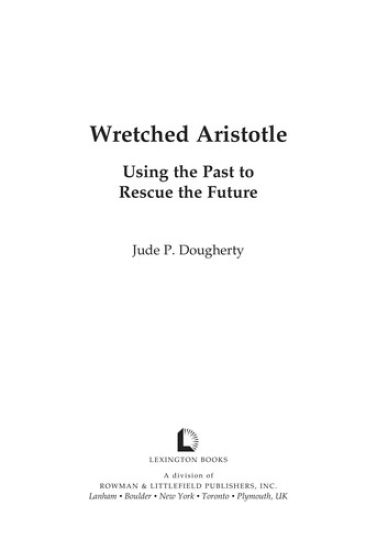
About eighty-five years ago, philosophers and literary intellectuals as diverse as Edmund Husserl, George Santayana, and Paul ValZry, aware of the declining influence of Christianity, spoke of 'the crisis of Western civilization.' In Wretched Aristotle: Using the Past to Rescue the Future, Jude P. Dougherty offers an intriguing reexamination of this crisis in contemporary times. Situating his argument in the context of ongoing debate concerning the nature of the public philosophy that underpins ideas of freedom, Dougherty identifies the essential features of Western culture through a series of interrelated essays. Each essay reinforces the idea that modernity cannot be understood apart from its break with classical antiquity. Wretched Aristotle offers a refreshing historical approach to this issue that will make it appealing to those interested in the mutual influence of science and culture and the role of religion in culture.
About eighty-five years ago, philosophers and literary intellectuals as diverse as Edmund Husserl, George Santayana, and Paul Valéry, aware of the declining influence of Christianity, spoke of "the crisis of Western civilization." In Wretched Aristotle: Using the Past to Rescue the Future, Jude P. Dougherty offers an intriguing reexamination of this crisis in contemporary times. Situating his argument in the context of ongoing debate concerning the nature of the public philosophy that underpins ideas of freedom, Dougherty identifies the essential features of Western culture through a series of interrelated essays. Each essay reinforces the idea that modernity cannot be understood apart from its break with classical antiquity. Wretched Aristotle offers a refreshing historical approach to this issue that will make it appealing to those interested in the mutual influence of science and culture and the role of religion in culture.
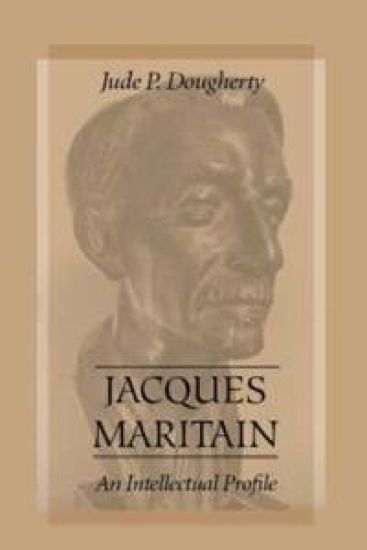
Jacques Maritain, one of the most influential philosophers of the 20th century, was a preeminent interpreter of the thought of Thomas Aquinas and author of more than 50 books in metaphysics, the philosophy of science, aesthetics and social and political philosophy. A giant in his field, he combined his Catholic faith and wide-ranging intellect to address contemporary issues and the many facets of the human experience. In this book, Jude P. Dougherty shares his lifetime interest in and study of Maritain with readers. He offers a complete introduction to Maritain, highlighting Maritain's many contributions to philosophy. Throughout, the reader gains a clear sense of Maritain the man, his relationships with other notable figures of his time, and his engagement in many of the debates of the 20th century. Dougherty's essays offer an appreciation of the perennial value of Maritain's intellect. He follows Maritain's philosophical journey from his early critique on the metaphysics of Henri Bergson to the publication of ""L'Eglise du Christ"" in 1973. Accessible to readers new to Maritain's work and to the Thomistic tradition, this book should be welcomed by seasoned scholars too.
An examination of the nature of religion from a philosophical perspective. In successive chapters classical, mediaeval and modern authors are canvassed for their views. Even among those who find no evidence for the existence of God, we encounter discussions of the nature of religion and its function in society. This study begins in antiquity with Socrates, Plato, Cicero and Seneca. It then moves through Augustine to the Middle Ages as represented by Averroes and Aquinas. By so proceeding, the author offers the reader insight into the nature and logic of religion as conceived before and after the advent of Christianity. Subsequent investigation leads to a consideration of the work of David Hume, Immanuel Kant and G. W. F. Hegel, in whose philosophies we find not only an account of the logic of religion but an appreciation of its implications in the practical order, and of Sigmund Freud's negative assessment of religion in ""The Future of an Illusion"". Although the focus of this study is primarily Western religion, attention is also paid to selected oriental modes of thought, some properly called ""religion"" in the Western sense, others more akin to philosophy than religion. Throughout history the cultural implications of religion are apparent. In this work, readers should find philosophical observations on the nature of belief, worship, ritual, sacrifice, doctrine, theology and community.
Investigates the classical roots of Western culture and its religious sources in order to find its underlying intellectual and spiritual commitments. The essays are written from a single vantage point - one associated with Thomas Aquinas, though their natural law outlook is far older.