Kirjojen hintavertailu – 12 903 724 kirjaa ja 27 kauppaa

Kirjailija

Judea Pearl

Kirjat ja teokset yhdessä paikassa: 9 kirjaa, julkaisuja vuosilta 1997–2026, suosituimpiin kuuluu The Book of Why: The New Science of Cause and Effect. Vertaile teosten hintoja ja tarkista saatavuus suomalaisista kirjakaupoista.

9 kirjaa

Kirjojen julkaisuvuodet: 1997–2026.

The Book of Why: The New Science of Cause and Effect

The Book of Why: The New Science of Cause and Effect

Judea Pearl; Dana MacKenzie

BASIC BOOKS
2026
nidottu
The "extraordinary" (Science Friday), "illuminating" (New York Times) argument for how understanding causality has revolutionized science and will revolutionize artificial intelligence "Correlation is not causation." This mantra, chanted by scientists for more than a century, once led to a virtual prohibition on causal talk. Today, with causal analysis taking center stage in AI and other applications, the old taboos are a thing of the past. The causal revolution, instigated by Judea Pearl and others, established causality on a firm scientific basis. Pearl showed how intuitive models can interface with data to help answer causal questions, such as whether a drug will cure an illness or, counterfactually, whether an illness would have persisted absent the drug. These models provide a blueprint for causal AI to learn and take responsibility for its mistakes. Updated with a new introduction and summary of recent advances, The Book of Why outlines the basics of cause and effect for lay readers and scientists alike, providing tools to explore the observable world and worlds that might have been.

Coexistence and Other Fighting Words: Selected Writings of Judea Pearl, 2002-2025
The "essential" (Bari Weiss) book on Jewish identity and Zionophobia, "which should be required reading" (Bernard-Henri L vy). Catalyzed by the kidnapping and murder of his son, Wall Street Journal reporter Daniel Pearl, world-renowned computer scientist and philosopher Dr. Judea Pearl has been a relentless advocate for reason and understanding in writings and talks spanning the first quarter of the twenty-first century. Best known for his groundbreaking work on artificial intelligence, Dr. Pearl turned his power of analysis to an anatomy of the hate that took his son's life, the Arab-Israeli conflict, the story of Israel, antisemitism, and other related subjects. In Coexistence and Other Fighting Words, Dr. Pearl collects the best of his work, offering an indispensable guide to some of the most pressing issues of our time.
The Book of Why: The New Science of Cause and Effect

The Book of Why: The New Science of Cause and Effect

Judea Pearl; Dana MacKenzie

BASIC BOOKS
2020
nidottu

Halvin toimitettuna 22,70 €

The "extraordinary" (Science Friday), "illuminating" (New York Times) argument for how understanding causality has revolutionized science and will revolutionize artificial intelligence "Correlation is not causation." This mantra, chanted by scientists for more than a century, has led to a virtual prohibition on causal talk. Today, that taboo is dead. The causal revolution, instigated by Judea Pearl and his colleagues, has cut through a century of confusion and established causality -- the study of cause and effect -- on a firm scientific basis. His work explains how we can know easy things, like whether it was rain or a sprinkler that made a sidewalk wet; and how to answer hard questions, like whether a drug cured an illness. Pearl's work enables us to know not just whether one thing causes another: it lets us explore the world that is and the worlds that could have been. It shows us the essence of human thought and key to artificial intelligence. Anyone who wants to understand either needs The Book of Why.
Book of Why

Book of Why

Judea Pearl; Dana Mackenzie

Penguin
2019
pokkari

Halvin toimitettuna 18,70 €

'Correlation does not imply causation.' This mantra was invoked by scientists for decades in order to avoid taking positions as to whether one thing caused another, such as smoking and cancer and carbon dioxide and global warming. But today, that taboo is dead. The causal revolution, sparked by world-renowned computer scientist Judea Pearl and his colleagues, has cut through a century of confusion and placed cause and effect on a firm scientific basis. Now, Pearl and science journalist Dana Mackenzie explain causal thinking to general readers for the first time, showing how it allows us to explore the world that is and the worlds that could have been. It is the essence of human and artificial intelligence. And just as Pearl's discoveries have enabled machines to think better, The Book of Why explains how we can think better.
Miksi

Miksi

Judea Pearl; Dana Mackensie

Terra Cognita
2018
nidottu

Halvin toimitettuna 44,90 €

“Korrelaatio ei ole kausaatio.” Tiedemiehet ovat hokeneet tätä mantraa yli vuosisadan ja se johti käytännössä kieltoon puhua kausaatiosta. Nyt kielto on kumottu. Tekoälytutkija Judea Pearlin johtama kausaatiomullistus on selvittänyt pitkään kestäneen hämmennyksen tiedon luonteesta ja vakiinnuttanut kausaalisuuden tieteellisen tutkimuksen keskipisteeseen. Tässä kirjassa Pearl kertoo, miksi tekojemme seurausten kuvitteluna ilmenevä kausaalinen ajattelu on ihmisenä olemisen suurimpia lahjoja. Sen ansiosta osaamme vastata kysymyksiin, jotka olivat tiedemiesten ulottumattomissa sukupolvien ajan. Paransiko lääke sairauden? Sortaako työnantaja joitakin työhön hakijoita? Onko ilmaston lämpeneminen lämpöaallon syy? Kausaalisuuden tutkimuksen syvällisimmät seuraukset ovat kuitenkin tekoälyn alalla. Nykyään koneoppiminen luottaa korrelaatioon, ei kausaatioon. Kausaalinen ajattelu muuttaa tietokoneet todellisiksi tiedemiehiksi. Ja koska kausaalinen ajattelu paljastaa syyllisyyden, tietokoneista ehkä tulee moraalisia toimijoita. Judea Pearl on tietojenkäsittelytieteen professori University of California, Los Angelesissa. Hän sai Turing-palkinnon tässä kirjassa kuvatusta työstä vuonna 2011.
Causal Inference in Statistics

Causal Inference in Statistics

Judea Pearl; Madelyn Glymour; Nicholas P. Jewell

Wiley-Blackwell
2016
nidottu

Halvin toimitettuna 38,20 €

CAUSAL INFERENCE IN STATISTICS A Primer Causality is central to the understanding and use of data. Without an understanding of cause–effect relationships, we cannot use data to answer questions as basic as "Does this treatment harm or help patients?" But though hundreds of introductory texts are available on statistical methods of data analysis, until now, no beginner-level book has been written about the exploding arsenal of methods that can tease causal information from data. Causal Inference in Statistics fills that gap. Using simple examples and plain language, the book lays out how to define causal parameters; the assumptions necessary to estimate causal parameters in a variety of situations; how to express those assumptions mathematically; whether those assumptions have testable implications; how to predict the effects of interventions; and how to reason counterfactually. These are the foundational tools that any student of statistics needs to acquire in order to use statistical methods to answer causal questions of interest. This book is accessible to anyone with an interest in interpreting data, from undergraduates, professors, researchers, or to the interested layperson. Examples are drawn from a wide variety of fields, including medicine, public policy, and law; a brief introduction to probability and statistics is provided for the uninitiated; and each chapter comes with study questions to reinforce the readers understanding.
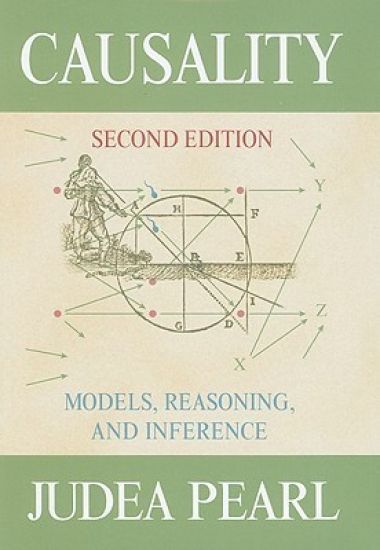
Causality

Causality

Judea Pearl

Cambridge University Press
2009
sidottu

Halvin toimitettuna 77,50 €

Written by one of the preeminent researchers in the field, this book provides a comprehensive exposition of modern analysis of causation. It shows how causality has grown from a nebulous concept into a mathematical theory with significant applications in the fields of statistics, artificial intelligence, economics, philosophy, cognitive science, and the health and social sciences. Judea Pearl presents and unifies the probabilistic, manipulative, counterfactual, and structural approaches to causation and devises simple mathematical tools for studying the relationships between causal connections and statistical associations. Cited in more than 2,100 scientific publications, it continues to liberate scientists from the traditional molds of statistical thinking. In this revised edition, Judea Pearl elucidates thorny issues, answers readers' questions, and offers a panoramic view of recent advances in this field of research. Causality will be of interest to students and professionals in a wide variety of fields. Dr Judea Pearl has received the 2011 Rumelhart Prize for his leading research in Artificial Intelligence (AI) and systems from The Cognitive Science Society.
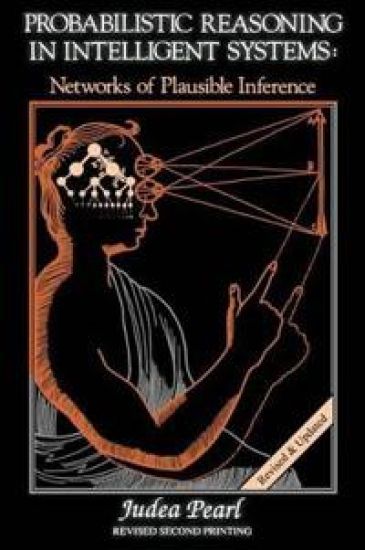
Probabilistic Reasoning in Intelligent Systems

Probabilistic Reasoning in Intelligent Systems

Judea Pearl

Morgan Kaufmann Publishers In
1997
nidottu
Probabilistic Reasoning in Intelligent Systems is a complete and accessible account of the theoretical foundations and computational methods that underlie plausible reasoning under uncertainty. The author provides a coherent explication of probability as a language for reasoning with partial belief and offers a unifying perspective on other AI approaches to uncertainty, such as the Dempster-Shafer formalism, truth maintenance systems, and nonmonotonic logic. The author distinguishes syntactic and semantic approaches to uncertainty--and offers techniques, based on belief networks, that provide a mechanism for making semantics-based systems operational. Specifically, network-propagation techniques serve as a mechanism for combining the theoretical coherence of probability theory with modern demands of reasoning-systems technology: modular declarative inputs, conceptually meaningful inferences, and parallel distributed computation. Application areas include diagnosis, forecasting, image interpretation, multi-sensor fusion, decision support systems, plan recognition, planning, speech recognition--in short, almost every task requiring that conclusions be drawn from uncertain clues and incomplete information. Probabilistic Reasoning in Intelligent Systems will be of special interest to scholars and researchers in AI, decision theory, statistics, logic, philosophy, cognitive psychology, and the management sciences. Professionals in the areas of knowledge-based systems, operations research, engineering, and statistics will find theoretical and computational tools of immediate practical use. The book can also be used as an excellent text for graduate-level courses in AI, operations research, or applied probability.