Kirjojen hintavertailu – 12 903 725 kirjaa ja 27 kauppaa

Kirjailija

Judith Bessant

Kirjat ja teokset yhdessä paikassa: 12 kirjaa, julkaisuja vuosilta 2003–2026, suosituimpiin kuuluu Discovering Risk. Vertaile teosten hintoja ja tarkista saatavuus suomalaisista kirjakaupoista.

12 kirjaa

Kirjojen julkaisuvuodet: 2003–2026.

The Precarious Generation

The Precarious Generation

Judith Bessant; Rys Farthing; Rob Watts

Routledge
2018
nidottu
This book draws on a wealth of evidence including young people’s own stories, to document how they are now faring in increasingly unequal societies like America, Britain, Australia, France and Spain. It points to systematic generational inequality as those born since 1980 become the first generation to have a lower standard of living than previous generations. While governments and experts typically explain this by referring to globalization, new technologies, or young people’s deficits, the authors of this book offer a new political economy of generations, which identifies the central role played by governments promoting neoliberal policies that exacerbate existing social inequalities based on age, ethnicity, gender and class. The book is a must read for social science students, human service workers and policy-makers and indeed for anyone interested in understanding the impact of government policy over the last 40 years on young people.

The Precarious Generation

The Precarious Generation

Judith Bessant; Rys Farthing; Rob Watts

Routledge
2017
sidottu
This book draws on a wealth of evidence including young people’s own stories, to document how they are now faring in increasingly unequal societies like America, Britain, Australia, France and Spain. It points to systematic generational inequality as those born since 1980 become the first generation to have a lower standard of living than previous generations. While governments and experts typically explain this by referring to globalization, new technologies, or young people’s deficits, the authors of this book offer a new political economy of generations, which identifies the central role played by governments promoting neoliberal policies that exacerbate existing social inequalities based on age, ethnicity, gender and class. The book is a must read for social science students, human service workers and policy-makers and indeed for anyone interested in understanding the impact of government policy over the last 40 years on young people.

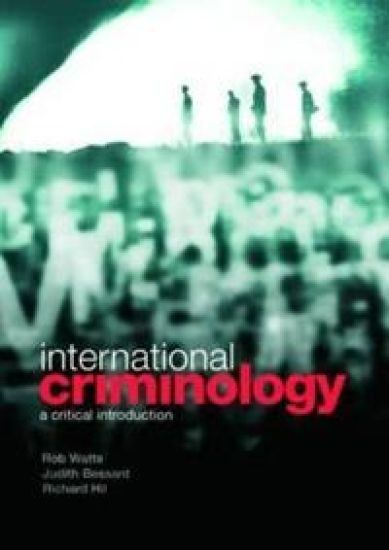
International Criminology

International Criminology

Rob Watts; Judith Bessant; Richard Hil

Routledge
2008
sidottu
International Criminology is an easy-access critical introduction to how conventional criminologists in the international arena think about and research crime. By using examples from the US, UK and Australia, the authors outline key ideas, vocabulary, assumptions and findings of the discipline while opening up a set of critical underlying issues and problems. From theoretical traditions to historical perspectives; contemporary criminology to reflexive criminology; this all encompassing text covers it all. This is the most valuable introduction to international criminology available for undergraduates and works as a superb refresher for more experienced students.
International Criminology

International Criminology

Rob Watts; Judith Bessant; Richard Hil

Routledge
2008
nidottu
International Criminology is an easy-access critical introduction to how conventional criminologists in the international arena think about and research crime. By using examples from the US, UK and Australia, the authors outline key ideas, vocabulary, assumptions and findings of the discipline while opening up a set of critical underlying issues and problems. From theoretical traditions to historical perspectives; contemporary criminology to reflexive criminology; this all encompassing text covers it all. This is the most valuable introduction to international criminology available for undergraduates and works as a superb refresher for more experienced students.
Discovering Risk

Discovering Risk

Judith Bessant; Richard Hil; Rob Watts

Peter Lang Publishing Inc
2003
nidottu
Anxiety about unemployment, homelessness, poverty and crime has always been around. Today, governments, experts and the media spend a lot of time talking about people at risk, the measurement and prediction of risk factors, encouraging resiliency and the need for early intervention. What are the politics, origins and meanings behind risk talk? Is the discovery and management of risk factors capable of offering real solutions? This lively, provocative book asks these questions by examining youth employment, homelessness and juvenile crime. It is a must-read for policy makers, human service workers, researchers and anyone interested in the key social issues of our time.
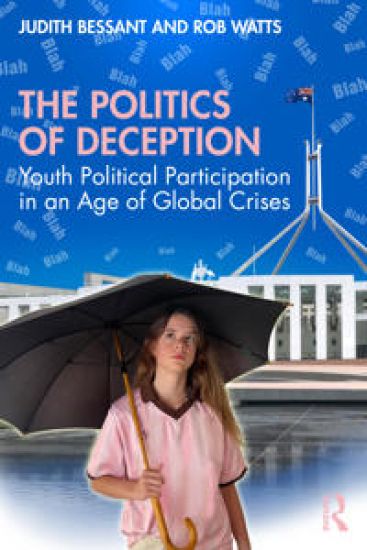
The Politics of Deception

The Politics of Deception

Judith Bessant; Rob Watts

TAYLOR FRANCIS LTD
2026
nidottu
In a time of global crises, governments, international agencies and various experts claim to promote political participation that is inclusive of children and young people. This book details how these claims tend to be deceptive. The Politics of Deception demonstrates how youth parliaments, youth councils and youth roundtables are governance exercises not just designed and tightly managed by adults but limited by them. Informed by adultist ways of seeing, young people are represented as vulnerable and citizens-in-waiting and cannot be taken seriously as political agents. Parallel to these formal initiatives, large numbers of young people are recognising the interconnected nature of the crises that mark our time, mobilising politically in diverse ways, from street marches to digital action, to strategic litigation and even ‘lying flats’ to push for equality, social justice and planetary survival. Animated by optimism and recognition that intergenerational solidarity is essential for creating a future in which humans and ‘more-than humans’ can flourish, Judith Bessant and Rob Watts illustrate how youth participation, as it is commonly practised, is deeply political, deceptive, highly contested and too often informed by outdated and harmful representations of young people. This volume is for young people, researchers, policymakers, parents and educators wanting to better understand what is happening in the world and who appreciate the value of recognising young people’s political capacity and right to help shape the world.
The Politics of Deception

The Politics of Deception

Judith Bessant; Rob Watts

TAYLOR FRANCIS LTD
2026
sidottu
In a time of global crises, governments, international agencies and various experts claim to promote political participation that is inclusive of children and young people. This book details how these claims tend to be deceptive. The Politics of Deception demonstrates how youth parliaments, youth councils and youth roundtables are governance exercises not just designed and tightly managed by adults but limited by them. Informed by adultist ways of seeing, young people are represented as vulnerable and citizens-in-waiting and cannot be taken seriously as political agents. Parallel to these formal initiatives, large numbers of young people are recognising the interconnected nature of the crises that mark our time, mobilising politically in diverse ways, from street marches to digital action, to strategic litigation and even ‘lying flats’ to push for equality, social justice and planetary survival. Animated by optimism and recognition that intergenerational solidarity is essential for creating a future in which humans and ‘more-than humans’ can flourish, Judith Bessant and Rob Watts illustrate how youth participation, as it is commonly practised, is deeply political, deceptive, highly contested and too often informed by outdated and harmful representations of young people. This volume is for young people, researchers, policymakers, parents and educators wanting to better understand what is happening in the world and who appreciate the value of recognising young people’s political capacity and right to help shape the world.
Making-Up People: Youth, Truth and Politics
This book is about modern politics and young people. Judith Bessant revises some long-standing myths about children and young people’s politics. She highlights the huge gap between the many ways young people and politics are talked about and how they have long been politically active. Bessant draws on a relational historical sociology to show how since the nineteenth century certain historical dynamics, political interests and social imaginaries have enabled social scientists, writers, political leaders and policymakers to imagine and ‘make up’ different kinds of young people. Given these representations of childhood, adolescence and youth, everyone knows that young people are cognitively immature, inexperienced, morally under-developed and lack good judgement. For these reasons they cannot possibly be allowed to engage in the serious, grown-up business of politics. Yet in just one of the many contradictions, young people are criticised by many of their elders for being politically apathetic and disengaged from politics. Many think recent global warming movements largely led by quite young people are a novel phenomenon. Yet young people have been at the forefront of political movements of all kinds since the French Revolution. Since the 1960s, children and young people increasingly played a major, if sometimes obscured, role in civil rights, anti-war, anti-globalisation, anti-austerity and global-warming movements. This accessible book is rich in theoretical and historical insight that is sure to appeal to sociologists, historians, youth studies scholars and political scientists, as well as to the general reader.
Making-Up People: Youth, Truth and Politics
This book is about modern politics and young people. Judith Bessant revises some long-standing myths about children and young people’s politics. She highlights the huge gap between the many ways young people and politics are talked about and how they have long been politically active. Bessant draws on a relational historical sociology to show how since the nineteenth century certain historical dynamics, political interests and social imaginaries have enabled social scientists, writers, political leaders and policymakers to imagine and ‘make up’ different kinds of young people. Given these representations of childhood, adolescence and youth, everyone knows that young people are cognitively immature, inexperienced, morally under-developed and lack good judgement. For these reasons they cannot possibly be allowed to engage in the serious, grown-up business of politics. Yet in just one of the many contradictions, young people are criticised by many of their elders for being politically apathetic and disengaged from politics. Many think recent global warming movements largely led by quite young people are a novel phenomenon. Yet young people have been at the forefront of political movements of all kinds since the French Revolution. Since the 1960s, children and young people increasingly played a major, if sometimes obscured, role in civil rights, anti-war, anti-globalisation, anti-austerity and global-warming movements. This accessible book is rich in theoretical and historical insight that is sure to appeal to sociologists, historians, youth studies scholars and political scientists, as well as to the general reader.
The Great Transformation

The Great Transformation

Judith Bessant

Routledge
2019
nidottu
While artificial intelligence (AI), robots, bio-technologies and digital media are transforming work, culture, and social life, there is little understanding of or agreement about the scope and significance of this change. This new interpretation of the ‘great transformation’ uses history and evolutionary theory to highlight the momentous shift in human consciousness taking place. Only by learning from recent crises and rejecting technological determinism will governments and communities redesign social arrangements that ensure we all benefit from the new and emerging technologies. The book documents the transformations under way in financial markets, entertainment, and medicine, affecting all aspects of work and social life. It draws on historical sociology and co-evolutionary theory arguing that the radical evolution of human consciousness and social life now under way is comparable with, if not greater than, the agrarian revolution (10000 BCE), the explosion of science, philosophy, and religion in the Axial Age (600 BCE), and the recent Industrial Revolution. Turning to recent major socio-economic crisis, and asking what can be learnt from them, the answer is we cannot afford this time around to repeat the failures of elites and theoretical systems such as economics to attend appropriately to radical change. We need to think beyond the constraints of determinist and reductionist explanations and embrace the idea of deep freedom. This book will appeal to educators, social scientists, policy-makers, business leaders, and students. It concludes with social design principles that can inform deliberative processes and new social arrangements that ensure everyone benefits from the affordances of the new and emerging technologies.
The Great Transformation

The Great Transformation

Judith Bessant

Routledge
2018
sidottu
While artificial intelligence (AI), robots, bio-technologies and digital media are transforming work, culture, and social life, there is little understanding of or agreement about the scope and significance of this change. This new interpretation of the ‘great transformation’ uses history and evolutionary theory to highlight the momentous shift in human consciousness taking place. Only by learning from recent crises and rejecting technological determinism will governments and communities redesign social arrangements that ensure we all benefit from the new and emerging technologies. The book documents the transformations under way in financial markets, entertainment, and medicine, affecting all aspects of work and social life. It draws on historical sociology and co-evolutionary theory arguing that the radical evolution of human consciousness and social life now under way is comparable with, if not greater than, the agrarian revolution (10000 BCE), the explosion of science, philosophy, and religion in the Axial Age (600 BCE), and the recent Industrial Revolution. Turning to recent major socio-economic crisis, and asking what can be learnt from them, the answer is we cannot afford this time around to repeat the failures of elites and theoretical systems such as economics to attend appropriately to radical change. We need to think beyond the constraints of determinist and reductionist explanations and embrace the idea of deep freedom. This book will appeal to educators, social scientists, policy-makers, business leaders, and students. It concludes with social design principles that can inform deliberative processes and new social arrangements that ensure everyone benefits from the affordances of the new and emerging technologies.
Talking Policy

Talking Policy

Judith Bessant

Allen Unwin
2005
nidottu
When we catch a bus, visit a doctor, borrow a book from the library or enrol in a course we benefit from the social policies of government. Talking Policy explains how the myriad programs and services we take for granted are developed and delivered, and how this fits into the political process. There is a human and political aspect to social policy-making; it's not all rational solutions to measurable problems. The authors explain how issues come to be defined as social problems, and offer an account of the historical development of social policy and the welfare state in Australia. They also outline the competing political and philosophical ideas which influence the different ways in which governments respond to social inequality and needs in the community. With detailed case studies from variety of areas of social policy making, Talking Policy is a valuable introduction to this complex and important field.'Talking Policy is an informative, insightful book that is also absorbing and challenging.'Lois Bryson, Emeritus Professor, University of Newcastle'With a commitment to reinvigorate policy debate, the authors make a convincing case that at its heart policy-making is about competing ethical visions, that ideas count, and that words serve as tools in this political and contested activity.'Associate Professor, Carol Bacchi, University of Adelaide