Kirjojen hintavertailu – 12 859 827 kirjaa ja 27 kauppaa

Kirjailija

Judith Shapiro

Kirjat ja teokset yhdessä paikassa: 9 kirjaa, julkaisuja vuosilta 1984–2024, suosituimpiin kuuluu Son of the Revolution. Vertaile teosten hintoja ja tarkista saatavuus suomalaisista kirjakaupoista.

9 kirjaa

Kirjojen julkaisuvuodet: 1984–2024.

China's Environmental Challenges

China's Environmental Challenges

Judith Shapiro

JOHN WILEY AND SONS LTD
2024
sidottu
China’s huge environmental challenges affect not only the health and well-being of China but the very future of the planet. In this fully revised and updated third edition of her acclaimed book, noted scholar of Chinese environmentalism Judith Shapiro explores China’s struggle to achieve the ‘ecological civilization’ championed by Xi Jinping since 2017. Drawing on six core analytical concepts - globalization, governance, national identity, civil society, environmental justice, and extractivism - Shapiro ably demonstrates the multifaceted and complex nature of this struggle. China’s precipitous economic growth has carried a heavy cost in air and water pollution, soil contamination, and loss of habitat for the biodiversity upon which human life depends. But its quest for sustainability has been further hampered by authoritarian governance patterns, soaring middle class consumption, the need to provide employment and safety nets for a population of more than one billion, and a manufacturing sector thirsty to secure global resources and sell to new markets. Transformation to a more sustainable development model is still possible. But, as Shapiro persuasively argues, this will require humility, creativity, and a rejection of business as usual. China – and the planet – are at a pivotal moment.
China's Environmental Challenges

China's Environmental Challenges

Judith Shapiro

JOHN WILEY AND SONS LTD
2024
nidottu
China’s huge environmental challenges affect not only the health and well-being of China but the very future of the planet. In this fully revised and updated third edition of her acclaimed book, noted scholar of Chinese environmentalism Judith Shapiro explores China’s struggle to achieve the ‘ecological civilization’ championed by Xi Jinping since 2017. Drawing on six core analytical concepts - globalization, governance, national identity, civil society, environmental justice, and extractivism - Shapiro ably demonstrates the multifaceted and complex nature of this struggle. China’s precipitous economic growth has carried a heavy cost in air and water pollution, soil contamination, and loss of habitat for the biodiversity upon which human life depends. But its quest for sustainability has been further hampered by authoritarian governance patterns, soaring middle class consumption, the need to provide employment and safety nets for a population of more than one billion, and a manufacturing sector thirsty to secure global resources and sell to new markets. Transformation to a more sustainable development model is still possible. But, as Shapiro persuasively argues, this will require humility, creativity, and a rejection of business as usual. China – and the planet – are at a pivotal moment.
China Goes Green

China Goes Green

Yifei Li; Judith Shapiro

Polity Press
2020
nidottu
What does it mean for the future of the planet when one of the world’s most durable authoritarian governance systems pursues “ecological civilization”? Despite its staggering pollution and colossal appetite for resources, China exemplifies a model of state-led environmentalism which concentrates decisive political, economic, and epistemic power under centralized leadership. On the face of it, China seems to embody hope for a radical new approach to environmental governance. In this thought-provoking book, Yifei Li and Judith Shapiro probe the concrete mechanisms of China’s coercive environmentalism to show how ‘going green’ helps the state to further other agendas such as citizen surveillance and geopolitical influence. Through top-down initiatives, regulations, and campaigns to mitigate pollution and environmental degradation, the Chinese authorities also promote control over the behavior of individuals and enterprises, pacification of borderlands, and expansion of Chinese power and influence along the Belt and Road and even into the global commons. Given the limited time that remains to mitigate climate change and protect millions of species from extinction, we need to consider whether a green authoritarianism can show us the way. This book explores both its promises and risks.
China Goes Green

China Goes Green

Yifei Li; Judith Shapiro

Polity Press
2020
sidottu
What does it mean for the future of the planet when one of the world’s most durable authoritarian governance systems pursues “ecological civilization”? Despite its staggering pollution and colossal appetite for resources, China exemplifies a model of state-led environmentalism which concentrates decisive political, economic, and epistemic power under centralized leadership. On the face of it, China seems to embody hope for a radical new approach to environmental governance. In this thought-provoking book, Yifei Li and Judith Shapiro probe the concrete mechanisms of China’s coercive environmentalism to show how ‘going green’ helps the state to further other agendas such as citizen surveillance and geopolitical influence. Through top-down initiatives, regulations, and campaigns to mitigate pollution and environmental degradation, the Chinese authorities also promote control over the behavior of individuals and enterprises, pacification of borderlands, and expansion of Chinese power and influence along the Belt and Road and even into the global commons. Given the limited time that remains to mitigate climate change and protect millions of species from extinction, we need to consider whether a green authoritarianism can show us the way. This book explores both its promises and risks.
Community of Scholars, Community of Teachers

Community of Scholars, Community of Teachers

Judith Shapiro

Prickly Paradigm Press, LLC
2016
nidottu
Academics routinely engage with colleagues in the research community as a critical part of their work. But, although many researchers are also dedicated teachers, teaching tends to be seen as a private matter between a teacher and his or her students. But why shouldn’t faculty members feel a similar impulse to be aware of what their colleagues are doing in the area of teaching? What do we miss when the conversation, especially at major research universities, is focused almost exclusively on research? In this revised and expanded collection of essays, Judith Shapiro, former president of Barnard College, issues an impassioned clarion call for a renewed focus on the role of community in teaching. When faculty members feel that they are not only a community of scholars, but also a community of teachers, teaching becomes more engaging for both students and teachers. Encouraging high-quality conversation about the pedagogical approaches that have proven most effective also puts the contributions of virtual, online communication into proper perspective and brings into clearer focus the advantages of a liberal arts education. With an argument that is controversial and sure to spark discussion and debate, Community of Scholars, Community of Teachers shows how higher education can become even more of a true community.
Women of the Forest

Women of the Forest

Yolanda Murphy; Robert Murphy; R. Brian Ferguson; William Balée; Janet Chernela; Judith Shapiro; Orna Johnson; Thomas Gregor

Columbia University Press
2004
sidottu
When it originally appeared, this groundbreaking ethnography was one of the first works to focus on gender in anthropology. The thirtieth anniversary edition of Women of the Forest reconfirms the book's importance for contemporary studies on gender and life in the Amazon. The book covers Yolanda and Robert Murphy's year of fieldwork among the Mundurucu people of Brazil in 1952. The Murphy's ethnographic analysis takes into account the historical, ecological, and cultural setting of the Mundurucu, including the mythology surrounding women, women's work and household life, marriage and child rearing, the effects of social change on the female role, sexual antagonism, and the means by which women compensate for their low social position. The new foreword-written collectively by renowned anthropologists who were all students of the Murphys-is both a tribute to the Murphys and a critical reflection on the continued relevance of their work today.
Women of the Forest

Women of the Forest

Yolanda Murphy; Robert Murphy; R. Brian Ferguson; William Balée; Janet Chernela; Judith Shapiro; Orna Johnson; Thomas Gregor

Columbia University Press
2004
pokkari
When it originally appeared, this groundbreaking ethnography was one of the first works to focus on gender in anthropology. The thirtieth anniversary edition of Women of the Forest reconfirms the book's importance for contemporary studies on gender and life in the Amazon. The book covers Yolanda and Robert Murphy's year of fieldwork among the Mundurucu people of Brazil in 1952. The Murphy's ethnographic analysis takes into account the historical, ecological, and cultural setting of the Mundurucu, including the mythology surrounding women, women's work and household life, marriage and child rearing, the effects of social change on the female role, sexual antagonism, and the means by which women compensate for their low social position. The new foreword-written collectively by renowned anthropologists who were all students of the Murphys-is both a tribute to the Murphys and a critical reflection on the continued relevance of their work today.
Mao's War against Nature

Mao's War against Nature

Judith Shapiro

Cambridge University Press
2001
sidottu
Judith Shapiro, in clear and compelling prose, relates the great, untold story of the devastating impact of Chinese politics on China’s environment during the Mao years. Maoist China provides an example of extreme human interference in the natural world in an era in which human relationships were also unusually distorted. Under Mao, the traditional Chinese ideal of ‘harmony between heaven and humans’ was abrogated in favor of Mao’s insistence that ‘People Will Conquer Nature’. Mao and the Chinese Communist Party’s ‘war’ to bend the physical world to human will often had disastrous consequences both for human beings and the natural environment. Mao’s War Against Nature argues that the abuse of people and the abuse of nature are often linked. Shapiro’s account, told in part through the voices of average Chinese citizens and officials who lived through and participated in some of the destructive campaigns, is both eye-opening and heartbreaking.
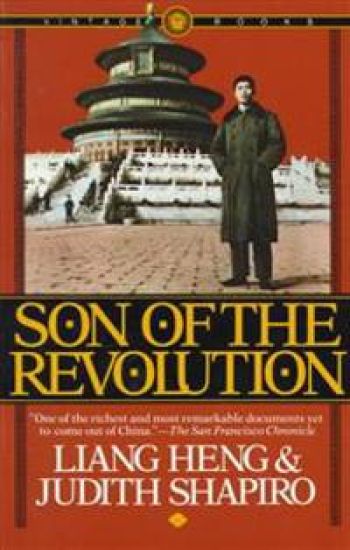
Son of the Revolution

Son of the Revolution

Liang Heng; Judith Shapiro

Vintage Books
1984
pokkari
An autobiography of a young Chinese man whose childhood and adolescence were spent in Mao's China during the Cultural Revolution. "An Oriental Tom Jones." -- NewsweekLiang Heng was born in 1954 in Changsha, a large city in Central China. His parents were intellectuals -- his father a reporter on a major provincial newspaper, his mother a ranking cadre in the local police. This is Liang Heng's own story of growing up in the turmoil of the Great Cultural Revolution. His story is unique, but at the same time it is in many ways typical of those millions of young Chinese who have been tested almost beyond endurance in recent years. In his words we hear an entire generation speaking." A poignant inside look at what happened to ordinary citizens when the movement that ousted Chiang Kaishek's totalitarianism turned against itself. Liang helps Americans understand the past that China's leaders must overcome to cope with the future."-- The Chicago Sun-Times"Three stories in one -- first, a graphic, I-was-there account of what it was like to grow up during the Cultural Revolution; second, a cliffhanger love story with a happy ending; and third, a poignant analysis of how Chinese people have tried and failed, and tried again, to break out of their past. Each of these accounts is worth reading on its own." -- The New York Review of Books"A significant event in our understanding of China...compelling, detailed, and devastating."-- The New Republic