Kirjojen hintavertailu – 12 859 828 kirjaa ja 27 kauppaa
Kirjailija
Jules Verne
Kirjat ja teokset yhdessä paikassa: 4 171 kirjaa, julkaisuja vuosilta 1864–2026, suosituimpiin kuuluu Karpaattien linna (mp3-cd). Vertaile teosten hintoja ja tarkista saatavuus suomalaisista kirjakaupoista.
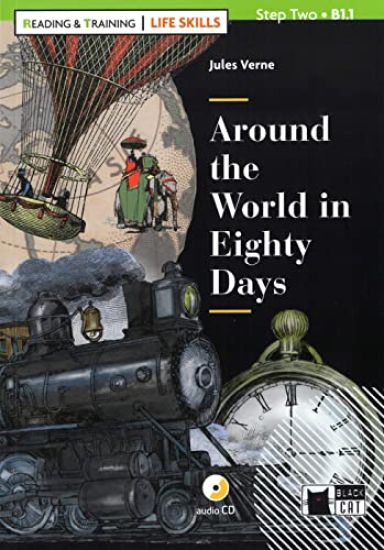
The story starts in London on Tuesday, October 1, 1872. Fogg is a rich English gentleman and bachelor living in solitude at Number 7 Savile Row, Burlington Gardens. Despite his wealth, Fogg lives a modest life with habits carried out with mathematical precision. Very little can be said about his social life other than that he is a member of the Reform Club. Later on that day, in the Reform Club, Fogg gets involved in an argument over an article in The Daily Telegraph, stating that with the opening of a new railway section in India, it is now possible to travel around the world in 80 days. He accepts a large wager from his fellow club members, which he will receive if he makes it around the world in 80 days. During the trip, they come across a procession in which a young Indian woman, Aouda, is to be sacrificed by the process of suttee the next day by Brahmins. Since the young woman is drugged and is obviously not going voluntarily, the travellers decide to rescue her...
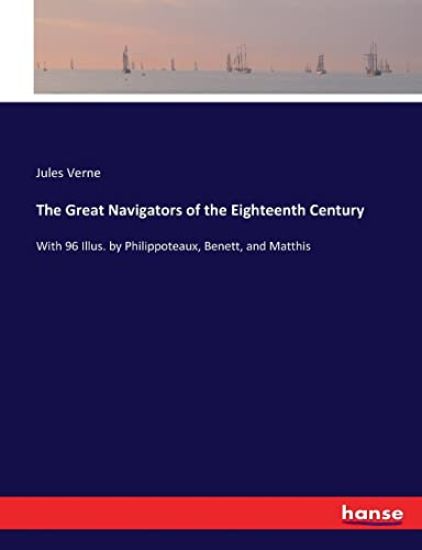
The Great Navigators of the Eighteenth Century - With 96 Illus. by Philippoteaux, Benett, and Matthis is an unchanged, high-quality reprint of the original edition of 1880. Hansebooks is editor of the literature on different topic areas such as research and science, travel and expeditions, cooking and nutrition, medicine, and other genres. As a publisher we focus on the preservation of historical literature. Many works of historical writers and scientists are available today as antiques only. Hansebooks newly publishes these books and contributes to the preservation of literature which has become rare and historical knowledge for the future.
When Phileas Fogg takes on the challenge to travel around the world in eighty days, he knows that it's a tall order. Little does he know what is waiting for him along the way ... Accompanied by his servant Passepartout, he sets out on the journey of a lifetime. But with a deluded policeman in hot pursuit, and an Indian princess to rescue, how can the dashing Phileas possibly make it back to London in time? TreeTops Greatest Stories offers children some of the worlds best loved tales in a collection of timeless classics. Top children's authors and talented illustrators work together to bring to life our literary heritage for a new generation, engaging and delighting children. The books are carefully levelled, making it easy to match every child to the right book. Each book contains inside cover notes to help children explore the content, supporting their reading development. Teaching notes on Oxford Owl offer cross-curricular links and activities to support guided reading, writing, speaking and listening. This pack provides 6 copies of the same title.
ON the 26th of July, 1864, a magnificent yacht was steaming along the North Channel at full speed, with a strong breeze blowing from the N. E. The Union Jack was flying at the mizzen-mast, and a blue standard bearing the initials E. G., embroidered in gold, and surmounted by a ducal coronet, floated from the topgallant head of the main-mast. The name of the yacht was the DUNCAN, and the owner was Lord Glenarvan, one of the sixteen Scotch peers who sit in the Upper House, and the most distinguished member of the Royal Thames Yacht Club, so famous throughout the United Kingdom. Lord Edward Glenarvan was on board with his young wife, Lady Helena, and one of his cousins, Major McNabbs. The DUNCAN was newly built, and had been making a trial trip a few miles outside the Firth of Clyde. She was returning to Glasgow, and the Isle of Arran already loomed in the distance, when the sailor on watch caught sight of an enormous fish sporting in the wake of the ship. Lord Edward, who was immediately apprised of the fact, came up on the poop a few minutes after with his cousin, and asked John Mangles, the captain, what sort of an animal he thought it was. "Well, since your Lordship asks my opinion," said Mangles, "I think it is a shark, and a fine large one too." "A shark on these shores " "There is nothing at all improbable in that," returned the captain. "This fish belongs to a species that is found in all latitudes and in all seas. It is the 'balance-fish, ' or hammer-headed shark, if I am not much mistaken. But if your Lordship has no objections, and it would give the smallest pleasure to Lady Helena to see a novelty in the way of fishing, we'll soon haul up the monster and find out what it really is." "What do you say, McNabbs? Shall we try to catch it?" asked Lord Glenarvan. "If you like; it's all one to me," was his cousin's cool reply. "The more of those terrible creatures that are killed the better, at all events," said John Mangles, "so let's seize the chance, and it will not only give us a little diversion, but be doing a good action." "Very well, set to work, then," said Glenarvan.
To go around the world...in such a short time and with the means of transport currently available, was not only impossible, it was madness. The latest edition of the classic novel from Jules Verne, featuring Phileas Fogg and his quest to circumnavigate the world in 80 days to win a bet. Following an argument at the Reform Club over the opening of a new railway section in India, Fogg agrees to the outlandish bet. Setting off at 8:45pm on Wednesday, 2nd October, Fogg must return no later than Saturday, 21 December. What follows is one of the most famous journeys in fictional history. Around the World in Eighty Days gripped audiences on its publication and remains hugely popular, combining exploration, adventure and a thrilling race against time. The Legend Classics series:Around the World in Eighty DaysThe Adventures of Huckleberry FinnThe Importance of Being EarnestAlice's Adventures in WonderlandThe MetamorphosisThe Railway ChildrenThe Hound of the BaskervillesFrankensteinWuthering HeightsThree Men in a BoatThe Time MachineLittle WomenAnne of Green GablesThe Jungle BookThe Yellow Wallpaper and Other StoriesDraculaA Study in ScarletLeaves of GrassThe Secret GardenThe War of the WorldsA Christmas CarolStrange Case of Dr Jekyll and Mr HydeHeart of DarknessThe Scarlet LetterThis Side of ParadiseOliver TwistThe Picture of Dorian GrayTreasure IslandThe Turn of the ScrewThe Adventures of Tom SawyerEmmaThe TrialA Selection of Short Stories by Edgar Allan PoeGrimm Fairy TalesThe AwakeningMrs DallowayGulliver’s TravelsThe Castle of OtrantoSilas MarnerHard Times
Originally published in 1873, Around the World in Eighty Days is a classic adventure novel by the French writer Jules Verne. In the story, Phileas Fogg of London and his newly employed French valet Passepartout attempt to circumnavigate the world in 80 days on a 20,000 wager (the approximate equivalent of 2 million in 2016) set by his friends at the Reform Club. Around the World in Eighty Days is one of Verne's most acclaimed works.
ON the 26th of July, 1864, a magnificent yacht was steaming along the North Channel at full speed, with a strong breeze blowing from the N. E. The Union Jack was flying at the mizzen-mast, and a blue standard bearing the initials E. G., embroidered in gold, and surmounted by a ducal coronet, floated from the topgallant head of the main-mast. The name of the yacht was the DUNCAN, and the owner was Lord Glenarvan, one of the sixteen Scotch peers who sit in the Upper House, and the most distinguished member of the Royal Thames Yacht Club, so famous throughout the United Kingdom. Lord Edward Glenarvan was on board with his young wife, Lady Helena, and one of his cousins, Major McNabbs. The DUNCAN was newly built, and had been making a trial trip a few miles outside the Firth of Clyde. She was returning to Glasgow, and the Isle of Arran already loomed in the distance, when the sailor on watch caught sight of an enormous fish sporting in the wake of the ship. Lord Edward, who was immediately apprised of the fact, came up on the poop a few minutes after with his cousin, and asked John Mangles, the captain, what sort of an animal he thought it was. "Well, since your Lordship asks my opinion," said Mangles, "I think it is a shark, and a fine large one too." "A shark on these shores " "There is nothing at all improbable in that," returned the captain. "This fish belongs to a species that is found in all latitudes and in all seas. It is the 'balance-fish, ' or hammer-headed shark, if I am not much mistaken. But if your Lordship has no objections, and it would give the smallest pleasure to Lady Helena to see a novelty in the way of fishing, we'll soon haul up the monster and find out what it really is." "What do you say, McNabbs? Shall we try to catch it?" asked Lord Glenarvan. "If you like; it's all one to me," was his cousin's cool reply. "The more of those terrible creatures that are killed the better, at all events," said John Mangles, "so let's seize the chance, and it will not only give us a little diversion, but be doing a good action." "Very well, set to work, then," said Glenarvan
From the Earth to the Moon (French: De la terre la lune) is an 1865 novel by Jules Verne. It tells the story of the Baltimore Gun Club, a post-American Civil War society of weapons enthusiasts, and their attempts to build an enormous Columbiad space gun and launch three people-the Gun Club's president, his Philadelphian armor-making rival, and a French poet-in a projectile with the goal of a moon landing. The story is also notable in that Verne attempted to do some rough calculations as to the requirements for the cannon and, considering the comparative lack of any data on the subject at the time, some of his figures are surprisingly close to reality. However, his scenario turned out to be impractical for safe manned space travel since a much longer muzzle would have been required to reach escape velocity while limiting acceleration to survivable limits for the passengers. The character of Michel Ardan, the French member of the party in the novel, was inspired by the real-life photographer F lix Nadar.
A Trip Round the World in a Flying Machine is an unchanged, high-quality reprint of the original edition of 1887. Hansebooks is editor of the literature on different topic areas such as research and science, travel and expeditions, cooking and nutrition, medicine, and other genres. As a publisher we focus on the preservation of historical literature. Many works of historical writers and scientists are available today as antiques only. Hansebooks newly publishes these books and contributes to the preservation of literature which has become rare and historical knowledge for the future.
Dick Sand; or, a Captain at Fifteen - A Novel is an unchanged, high-quality reprint of the original edition of 1878. Hansebooks is editor of the literature on different topic areas such as research and science, travel and expeditions, cooking and nutrition, medicine, and other genres. As a publisher we focus on the preservation of historical literature. Many works of historical writers and scientists are available today as antiques only. Hansebooks newly publishes these books and contributes to the preservation of literature which has become rare and historical knowledge for the future.