Kirjojen hintavertailu – 12 859 828 kirjaa ja 27 kauppaa

Kirjailija

Julia Clancy-Smith

Kirjat ja teokset yhdessä paikassa: 3 kirjaa, julkaisuja vuosilta 2013–2025, suosituimpiin kuuluu The Deys and Beys of Tunis, 1666–1922. Vertaile teosten hintoja ja tarkista saatavuus suomalaisista kirjakaupoista.

3 kirjaa

Kirjojen julkaisuvuodet: 2013–2025.

The Deys and Beys of Tunis, 1666–1922

The Deys and Beys of Tunis, 1666–1922

Leïla Temime Blili; Julia Clancy-Smith

AMERICAN UNIVERSITY IN CAIRO PRESS
2025
sidottu
A foundational text on the early modern history of Tunis that places Tunisian history firmly within Ottoman historyThe Tunisian historiography of the modern era has broadly centered on a narrative of three successive powers: the pashas, first, followed by the deys (the "symbolic uncles" of the Turkish militia), who were in turn deposed by the beys (native civil rulers arising out of Hafsid times). This approach has provided all the components of a national narrative: it has posited the decline of the pasha’s authority as a consequence of the Tunisian province’s autonomy, and has framed the wars between deys and beys as a conflict of identity between the Turks and the locals. While this linear story is seductive in its apparent coherence, it leaves several questions in the shadows, in particular, the interference of several external forces in the affairs of the province: most notably, the Ottoman Empire. The Regency of Tunis was effectively controlled by the Ottomans who had reactivated a former Hafsid institution, the mhalla. A kind of itinerant power, the mhalla succeeded in allowing the Ottomans to establish peace through the creation of tax regulations and matrimonial alliances with the tribes. Thus, the Regency of Tunis was able to distinguish itself from other imperial provinces through the founding of a monarchical house symbolically linked to the Empire and, at the same time, socially anchored in its territory. Relying on local sources in Tunisian archives, Leïla Blili places the Regency of Tunis firmly within the Ottoman Empire, revealing the complex connections between the imperial center and its far-flung province, and challenging the long-standing theory of Tunisian autonomy. Blili's examination of social continuity during moments of intense political turbulence restores the place of women in the narrative of state formation, underlining the significance of the matrimonial politics of sovereigns and the crucial political and social roles women played in the regency.
Tunisian Revolutions

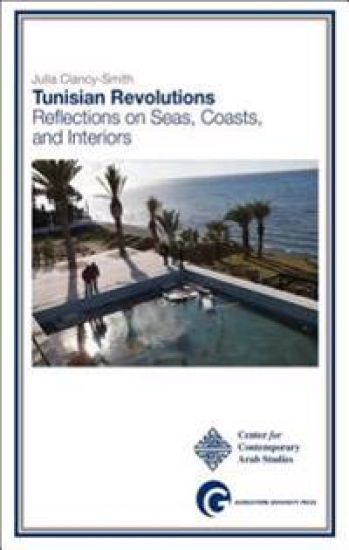
Tunisian Revolutions

Julia Clancy-Smith

Georgetown University Press
2014
pokkari
In December 2010 an out-of-work Tunisian street vendor, Mohamed Bouazizi, set himself on fire and precipitated the Arab Spring. Popular interpretations of Bouazizi's self-immolation presented economic and political oppression by the Ben Ali regimes as the root causes of widespread social despair that triggered the Tunisian revolution. Yet as Julia Clancy-Smith points out, Tunisia's long history of organized political activism and protest movements suggests a far more complicated set of processes. Proposing a conceptual framework of "coastalization" vs. "interiorization," Clancy-Smith examines Tunisia's last two centuries and demonstrates how geographical and environmental and social factors also lie behind that country's modern political history. Within this framework Clancy-Smith explores how Tunisia's coast became a Mediterranean playground for transnational elites, a mecca of tourism, while its interior agrarian regions suffered increasing neglect and marginalization. This distinction has had a profound impact on the fate of Tunisia and has manifested itself in divisive debates over politics, the state, and religion as well as women's socio-legal status that have led to a series of mass civic actions culminating in revolution. Clancy-Smith proposes a fresh historical lens through which to view the relationship between spacial displacements, regionalization, and transnationalism. Georgetown Shorts-longer than an article, shorter than a book-deliver timely works of peer-reviewed scholarship in a fast-paced, agile environment. They present new ideas and original texts that are easily and widely available to students, scholars, libraries, and general readers.
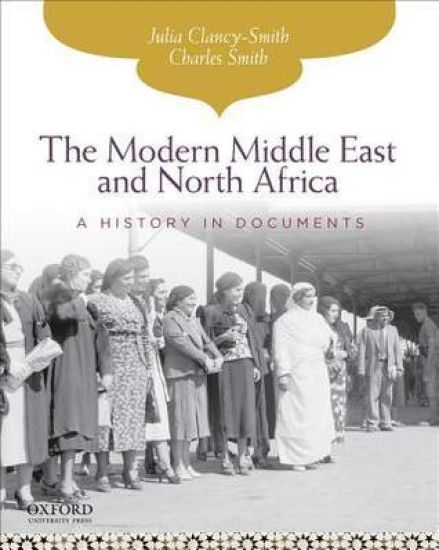
The Modern Middle East and North Africa

The Modern Middle East and North Africa

Julia Clancy-Smith; Charles Smith

Oxford University Press
2013
pokkari
Winner of the Middle East Studies Association 2013 Undergraduate Education Award Utilizing a mix of documents--including photographs, posters, diaries, diplomatic records, archival sources, and literary works--The Modern Middle East and North Africa: A History in Documents is structured around an underlying theme of unity in diversity. This theme helps to offset students' stereotypical image of the Middle East and North Africa as an undifferentiated, monolithic, and unchanging part of the world inhabited mainly by terrorists and religious fanatics. Compiled and edited by two prominent historians, Julia Clancy-Smith and Charles Smith, the book's approach offers a compromise between conventional political and diplomatic histories and those focusing on social and cultural history. The authors demonstrate how the Middle East and North Africa have participated in and shaped the grand currents of global history during the past two centuries. Headnotes, extended captions, sidebars, introductory essays, and a robust photo program (including a documentary picture essay devoted to women and gender) provide an essential context framing the documents.