Kirjojen hintavertailu – 12 859 819 kirjaa ja 27 kauppaa
Kirjailija
Julia Flutter
Kirjat ja teokset yhdessä paikassa: 6 kirjaa, julkaisuja vuosilta 2004–2025, suosituimpiin kuuluu Empowering Teacher Professionalism: Collegiality and Practical Wisdom in Education. Vertaile teosten hintoja ja tarkista saatavuus suomalaisista kirjakaupoista.
This book explores the transformative potential of 'collegial practical wisdom' (phronēsis) as a foundation stone for teacher professionalism. Reconceptualising Aristotle's practical wisdom as a values-led interweaving of research, professional knowledge and theory, Julia Flutter takes us on a voyage of exploration to map a future course for change. This study uses an innovative, New Materialist methodology to produce a conceptual mapping of collegial practical wisdom for teacher professionalism and is presented as three 'charts'. The first is an autoethnographic study of the author's 30 year research career, working alongside teachers, students and policy makers. The second chart delves into the literature to explore theory, research, policy and practice relating to practical wisdom and teacher professionalism. The third chart looks at published narratives by teachers and researchers working collaboratively in ways that demonstrate collegial practical wisdom in action. These charts are brought together as a cartographic research assemblage to trace the complex, entangled threads identified across the journey. The conclusion proposes recommendations for creating a power-grid of collegial practical wisdom to generate an empowered teaching profession.
Robin Alexander; Michael Armstrong; Julia Flutter; Linda Hargreaves; David Harrison; Wynne Harlen; Elizabeth Hartley-Brewer; Ruth Kershner; John MacBeath; Berry Mayall; Stephanie Northen; Gillian Pugh; Colin Richards; David Utting
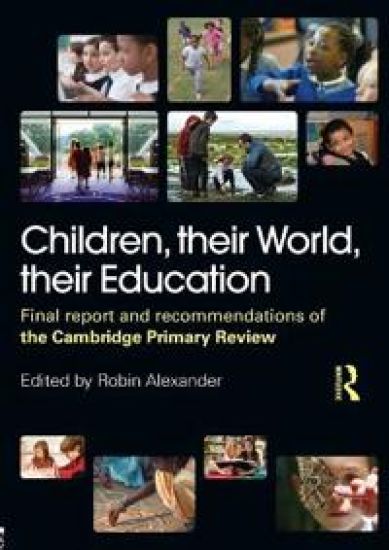
Children, their World, their Education is the definitive text for students, teachers, researchers, educational leaders and all who are interested in primary education. As the culmination of the Cambridge Primary Review, the most comprehensive enquiry into English primary education for half a century, its publication provoked instant and dramatic headlines. Widespread support from teachers and eminent public figures demonstrated that the book had identified the issues that really mattered. Ministerial unease showed that here were findings that politicians could not ignore. But Children, their World, their Education is much more than a report. It is an unrivalled educational compendium that systematically covers the issues that are central to the daily work of students, teachers and heads. For trainee teachers on undergraduate and postgraduate courses it effectively maps the territory of primary education and provides the context, information and insight which are essential to the development of classroom skill. Its vast range of carefully evaluated evidence makes it a core resource for those undertaking research and advanced study. Its direct engagement with the policy process during a period of unprecedented change makes it an indispensable tool for policy analysis. It places England’s education system in the global context, and combines evidence on recent developments with a vision of how primary education should be. Part 1 sets the scene and tracks primary education policy since the 1960s. Part 2 examines children’s development and learning, their needs and aspirations, and their lives in a diverse society and fragile world. Part 3 explores what goes on in schools, from the vital early years to educational aims and values, the curriculum, pedagogy and classroom practice, assessment, standards and school organisation. Part 4 deals with the system as a whole: educational ages and stages, the work and training of primary teachers, school leadership, local authorities, funding, governance and policy. Part 5 pulls everything together with 78 conclusions and 75 recommendations for policy and practice. Companion volume: The Cambridge Primary Review Research Surveys, edited by Robin Alexander with Christine Doddington, John Gray, Linda Hargreaves and Ruth Kershner. The Cambridge Primary Review is supported by Esmée Fairbairn Foundation: www.primaryreview.org.uk.
Consulting Pupils considers the potential benefits and implications of talking to students about teaching and learning in school, exploring its impact at different levels. Key issues included are:* the importance of engaging young learners in a focused dialogue about learning* the role of pupil consultation in helping schools to develop new directions for improvement* the wider implications of pupil consultation and participation in teaching the principles of citizenship and democracy. Through examples of pupil consultation initiatives in primary and secondary schools, the authors demonstrate how an agenda for change based on pupils' perspectives on teaching and learning can be used to improve classroom practice. Part of the What's In It For Schools series aimed at making educational policy issues relevant to practitioners, this book will be a valuable resource for practitioners, students and researchers interested in exploring pupils' perspectives on teaching and learning.
This fascinating book focuses on those who are most affected by changes in education policy and systems—the pupils. It draws on empirical evidence from a number of research projects and distils this into a compelling account of contemporary schooling from the pupils' perspective. Jean Rudduck calls for a shift in the way we currently view young people at school and sets out a case for radically rethinking aspects of school organization, relationships and practice. Her research confirms that we need to see pupils differently, to re-assess their capabilities and reflect on what they are capable of being and doing.
This fascinating book focuses on those who are most affected by changes in education policy and systems-the pupils. It draws on empirical evidence from a number of research projects and distils this into a compelling account of contemporary schooling from the pupils' perspective. Jean Rudduck calls for a shift in the way we currently view young people at school and sets out a case for radically rethinking aspects of school organization, relationships and practice. Her research confirms that we need to see pupils differently, to re-assess their capabilities and reflect on what they are capable of being and doing.