Kirjojen hintavertailu – 12 903 725 kirjaa ja 27 kauppaa

Kirjailija

Julian Lincoln Simon

Kirjat ja teokset yhdessä paikassa: 8 kirjaa, julkaisuja vuosilta 1998–2019, suosituimpiin kuuluu Population and Development in Poor Countries. Vertaile teosten hintoja ja tarkista saatavuus suomalaisista kirjakaupoista.

8 kirjaa

Kirjojen julkaisuvuodet: 1998–2019.

The Economics of Population Growth

The Economics of Population Growth

Julian Lincoln Simon

PRINCETON UNIVERSITY PRESS
2019
sidottu
Comparison with stationary and very fast rates of population growth shows modern population grwoth to have long-run positive effects on the standards of living. This is Julian Simon's contention, and he provides support for its validity in both more and less-developed countries. He notes that since each person constitutes a burden in the short run, whether population growth is judged good or bad depends on the importance the short run is accorded relative to the long run. The author first analyzes empirical data, formulating his conclusions using simulation models. He then reviews our knowledge of the effect of economic level upon population growth. A final section of his book considers the framework of welfare economics and values within which population policy decisions are now made. He finds that the implications of policy decisions can prove inconsistent with the values that prompt their recommendation. Originally published in 1977. The Princeton Legacy Library uses the latest print-on-demand technology to again make available previously out-of-print books from the distinguished backlist of Princeton University Press. These editions preserve the original texts of these important books while presenting them in durable paperback and hardcover editions. The goal of the Princeton Legacy Library is to vastly increase access to the rich scholarly heritage found in the thousands of books published by Princeton University Press since its founding in 1905.

The Economics of Population Growth

The Economics of Population Growth

Julian Lincoln Simon

Princeton University Press
2019
pokkari
Comparison with stationary and very fast rates of population growth shows modern population grwoth to have long-run positive effects on the standards of living. This is Julian Simon's contention, and he provides support for its validity in both more and less-developed countries. He notes that since each person constitutes a burden in the short run, whether population growth is judged good or bad depends on the importance the short run is accorded relative to the long run. The author first analyzes empirical data, formulating his conclusions using simulation models. He then reviews our knowledge of the effect of economic level upon population growth. A final section of his book considers the framework of welfare economics and values within which population policy decisions are now made. He finds that the implications of policy decisions can prove inconsistent with the values that prompt their recommendation. Originally published in 1977. The Princeton Legacy Library uses the latest print-on-demand technology to again make available previously out-of-print books from the distinguished backlist of Princeton University Press. These editions preserve the original texts of these important books while presenting them in durable paperback and hardcover editions. The goal of the Princeton Legacy Library is to vastly increase access to the rich scholarly heritage found in the thousands of books published by Princeton University Press since its founding in 1905.

Population and Development in Poor Countries

Population and Development in Poor Countries

Julian Lincoln Simon

Princeton University Press
2016
sidottu
Making the case that population growth does not hinder economic progress and that it eventually raises standards of living, Julian Simon became one of the most controversial figures in economics during the past decade. This book gathers a set of articles--theoretical, empirical, and policy analyses--written over the past twenty years, which examine the effects of population increase on various aspects of economic development in less-developed economies. The studies show that within a century, or even a quarter of a century, the positive benefits of additional people counterbalance the short-run costs. The process is as follows: increased numbers of consumers, and the resultant increase of total income, expand the demand for raw materials and finished products. The resulting actual and expected shortages force up prices of the natural resources. The increased prices trigger the search for new ways to satisfy the demand, and sooner or later new sources and innovative substitutes are found. These new discoveries lead to cheaper natural resources than existed before this process began, leaving humanity better off than if the shortages had not appeared. Originally published in 1992. The Princeton Legacy Library uses the latest print-on-demand technology to again make available previously out-of-print books from the distinguished backlist of Princeton University Press. These editions preserve the original texts of these important books while presenting them in durable paperback and hardcover editions. The goal of the Princeton Legacy Library is to vastly increase access to the rich scholarly heritage found in the thousands of books published by Princeton University Press since its founding in 1905.

Population and Development in Poor Countries

Population and Development in Poor Countries

Julian Lincoln Simon

Princeton University Press
2014
pokkari
Making the case that population growth does not hinder economic progress and that it eventually raises standards of living, Julian Simon became one of the most controversial figures in economics during the past decade. This book gathers a set of articles--theoretical, empirical, and policy analyses--written over the past twenty years, which examine the effects of population increase on various aspects of economic development in less-developed economies. The studies show that within a century, or even a quarter of a century, the positive benefits of additional people counterbalance the short-run costs. The process is as follows: increased numbers of consumers, and the resultant increase of total income, expand the demand for raw materials and finished products. The resulting actual and expected shortages force up prices of the natural resources. The increased prices trigger the search for new ways to satisfy the demand, and sooner or later new sources and innovative substitutes are found. These new discoveries lead to cheaper natural resources than existed before this process began, leaving humanity better off than if the shortages had not appeared. Originally published in 1992. The Princeton Legacy Library uses the latest print-on-demand technology to again make available previously out-of-print books from the distinguished backlist of Princeton University Press. These editions preserve the original texts of these important books while presenting them in durable paperback and hardcover editions. The goal of the Princeton Legacy Library is to vastly increase access to the rich scholarly heritage found in the thousands of books published by Princeton University Press since its founding in 1905.

The Great Breakthrough and Its Cause

The Great Breakthrough and Its Cause

Julian Lincoln Simon; Richard A. Easterlin

The University of Michigan Press
2001
sidottu
One of Julian Simon's last works-in-progress--cut short just before completion by his death in early 1998--The Great Breakthrough and Its Cause explores the question of why human progress accelerated in Western Europe starting around 1750. Why did life expectancy, the household consumption level, speeds of travel and communication, the literacy rate, and other aspects of the standard of living leap above those in the previous centuries and millennia? What forces caused this extraordinary development to occur when it did--or even to occur at all--rather than centuries or millennia earlier or later? Simon answers this question by arguing persuasively that the total quantity of humanity--and the nexus of human numbers with technology--has been the main driving force behind what he calls "Sudden Modern Progress." Further, he continues, if population numbers had risen more rapidly than they did, the "Great Breakthrough" would have occurred earlier. He also asserts that institutional changes, phenomena often credited for human progress, are from a very long-run perspective a result of population growth. And finally, he seeks to refute two seeming counterexamples, China and India, that reached high population densities prior to the modern period without accelerated growth in consumer welfare. In his inimitable style, Simon meticulously backs up his arguments with extensive use of a wide variety of data. Along the way, he also takes on the arguments of other writers on the subject of population growth and progress, such as Joel Mokyr and Eric Jones. Completed and polished by Timur Kuran, this exploration into the great explosion of consumer welfare will stimulate, challenge, and foster high-level intellectual debate on the question of human progress. It will be of particular interest to demographers, economic historians, and a broad array of social scientists. The late Julian Simon was most recently Professor of Business Administration, University of Maryland, College Park.
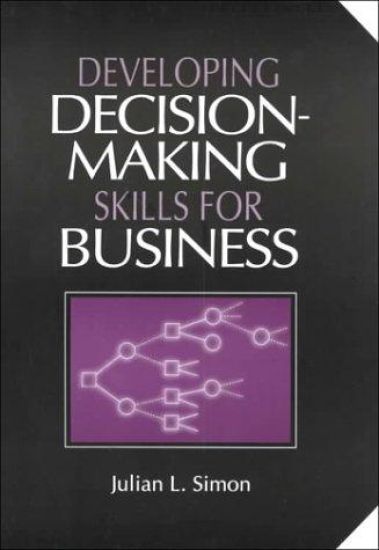
Developing Decision-Making Skills for Business
This practical resource shows business professionals how to improve their decision-making skills and enhance their ability to develop effective interpersonal relationships with co-workers and clients. The book covers a wide range of topics -- identifying tastes and preferences, personal skill assessment, cost-benefit analysis, risk and uncertainty, multi-tasking, human resource management, time constraints, data collection, and more. Designed to help busy professionals make the most effective use of time and energy, it will also be useful in the study of organizational behavior and business psychology.
The Economic Consequences of Immigration

The Economic Consequences of Immigration

Julian Lincoln Simon

The University of Michigan Press
1999
nidottu
Immigration remains an emotional and fiercely debated subject, yet it continues to receive little attention from economists. In a newly available, updated edition, this pathbreaking book offers an objective and comprehensive inquiry into the economic consequences of immigration into the United States and concludes that immigration is, on the whole, beneficial to U. S. natives. It also covers a wide range of data, spanning long stretches of history, that indicate experience in Canada and Australian is similar. The findings are relevant to most developed countries. Updated to reflect Simon's most recent work on immigration and with a new foreword by the author of Fresh Blood: The New American Immigrants, this theoretical, empirical study systematically examines each of the significant economic mechanisms by which immigrants affect natives. These include the transfer-and-tax system, production capital, human capital, physical infrastructure, productivity, environmental externalities, and unemployment. In Simon's inimitable style--both analytically sophisticated and accessible--The Economic Consequences of Immigration debunks many of the suppositions still at large, demonstrating that immigrants displace fewer jobs than they create, are better educated than the majority of U. S. workers, and are no more of a drain on the welfare system than the general population. This important book is ideal for courses on labor and population and is useful as a reference book to researchers and journalists examining the many issues surrounding immigration. The late Julian L. Simon was Professor of Business Administration, University of Maryland, College Park, and Adjunct Scholar at the Cato Institute. From reviews of the first edition:"Julian Simon has given us not only the best and most comprehensive book ever written on the economic consequences of immigration but a book that deals directly with the public-policy issues. It is an essential book not only for economists but for policymakers as the nation continues to debate who and how many shall come through the golden door inthe months and years to come." --Reason"One is tempted to use the word 'monumental' for this study of the effects of immigration. . . It would be hard to find any source of information on which the author has not drawn." --Kenneth E. Boulding, Social Science Quarterly
The Ultimate Resource 2

The Ultimate Resource 2

Julian Lincoln Simon

Princeton University Press
1998
pokkari
Arguing that the ultimate resource is the human imagination coupled to the human spirit, Julian Simon led a vigorous challenge to conventional beliefs about scarcity of energy and natural resources, pollution of the environment, the effects of immigration, and the "perils of overpopulation." The comprehensive data, careful quantitative research, and economic logic contained in the first edition of The Ultimate Resource questioned widely held professional judgments about the threat of overpopulation, and Simon's celebrated bet with Paul Ehrlich about resource prices in the 1980s enhanced the public attention--both pro and con--that greeted this controversial book. Now Princeton University Press presents a revised and expanded edition of The Ultimate Resource. The new volume is thoroughly updated and provides a concise theory for the observed trends: Population growth and increased income put pressure on supplies of resources. This increases prices, which provides opportunity and incentive for innovation. Eventually the innovative responses are so successful that prices end up below what they were before the shortages occurred. The book also tackles timely issues such as the supposed rate of species extinction, the "vanishing farmland crisis," and the wastefulness of coercive recycling. In Simon's view, the key factor in natural and world economic growth is our capacity for the creation of new ideas and contributions to knowledge. The more people alive who can be trained to help solve the problems that confront us, the faster we can remove obstacles, and the greater the economic inheritance we shall bequeath to our descendants. In conjunction with the size of the educated population, the key constraint on human progress is the nature of the economic-political system: talented people need economic freedom and security to bring their talents to fruition.