Kirjojen hintavertailu – 12 903 725 kirjaa ja 27 kauppaa

Kirjailija

Julian Schwinger

Kirjat ja teokset yhdessä paikassa: 17 kirjaa, julkaisuja vuosilta 1998–2025, suosituimpiin kuuluu Classical Electrodynamics. Vertaile teosten hintoja ja tarkista saatavuus suomalaisista kirjakaupoista.

17 kirjaa

Kirjojen julkaisuvuodet: 1998–2025.

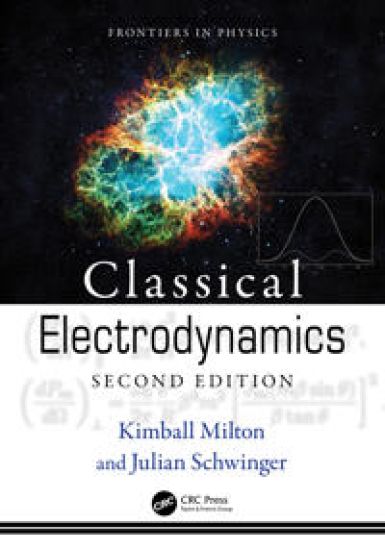
Classical Electrodynamics

Classical Electrodynamics

Julian Schwinger

TAYLOR FRANCIS LTD
2025
nidottu
Classical Electrodynamics captures Schwinger's inimitable lecturing style, in which everything flows inexorably from what has gone before. This anniversary edition offers a refreshing update while still maintaining Schwinger’s voice. The book provides the student with a thorough grounding in electrodynamics in particular, and in classical field theory in general. An essential resource for both physicists and their students, the book includes a Reader's Guide, which describes the major themes in each chapter, suggests a possible path through the book, and identifies topics for inclusion in, and exclusion from, a given course, depending on the instructor's preference. Carefully constructed problems complement the material of the text. Classical Electrodynamics should be of great value to all physicists, from first-year graduate students to senior researchers, and to all those interested in electrodynamics, field theory, and mathematical physics. The original text for the graduate classical electrodynamics course was left unfinished upon Julian Schwinger's death in 1994, but was completed by his former students and co-authors, who have brilliantly recreated the excitement of Schwinger's novel approach. This anniversary edition has been revised by one of those original co-authors, Kimball Milton.
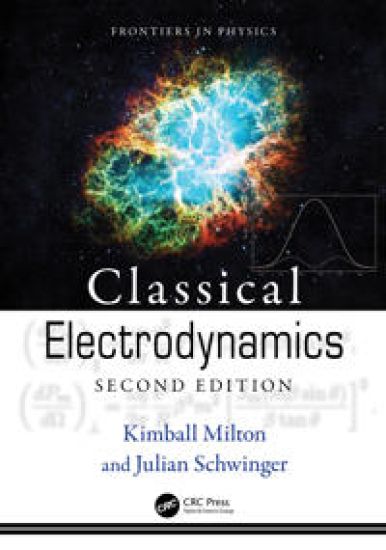
Classical Electrodynamics

Classical Electrodynamics

Julian Schwinger

TAYLOR FRANCIS LTD
2024
sidottu
Classical Electrodynamics captures Schwinger's inimitable lecturing style, in which everything flows inexorably from what has gone before. This anniversary edition offers a refreshing update while still maintaining Schwinger’s voice. The book provides the student with a thorough grounding in electrodynamics in particular, and in classical field theory in general. An essential resource for both physicists and their students, the book includes a Reader's Guide, which describes the major themes in each chapter, suggests a possible path through the book, and identifies topics for inclusion in, and exclusion from, a given course, depending on the instructor's preference. Carefully constructed problems complement the material of the text. Classical Electrodynamics should be of great value to all physicists, from first-year graduate students to senior researchers, and to all those interested in electrodynamics, field theory, and mathematical physics. The original text for the graduate classical electrodynamics course was left unfinished upon Julian Schwinger's death in 1994, but was completed by his former students and co-authors, who have brilliantly recreated the excitement of Schwinger's novel approach. This anniversary edition has been revised by one of those original co-authors, Kimball Milton.

Particles, Sources, And Fields, Volume 2
This classic book (volume two of three volumes) is almost exclusively concerned with quantum electrodynamics. As such, it is retrospective in its subject matter. The topics discussed range from anomalous magnetic moments and vacuum polarization, in a variety of applications, to the energy level displacements in hydrogenic atoms, with occasional excursions into nuclear and high-energy physics. Based as it is upon the conceptually and computationally simple foundations of source theory, little in the way of formal mathematical apparatus is required, and thus most of the book is devoted to the working out of physical problems.
Particles, Sources, And Fields, Volume 1
This classic, the first of three volumes, presents techniques that emphasize the unity of high-energy particle physics with electrodynamics, gravitational theory, and many-particle cooperative phenomena. What emerges is a theory intermediate in position between operator field theory and S-matrix theory, which rejects the dogmas of each and gains thereby a calculational ease and intuitiveness that make it a worthy contender to displace the earlier formulations.
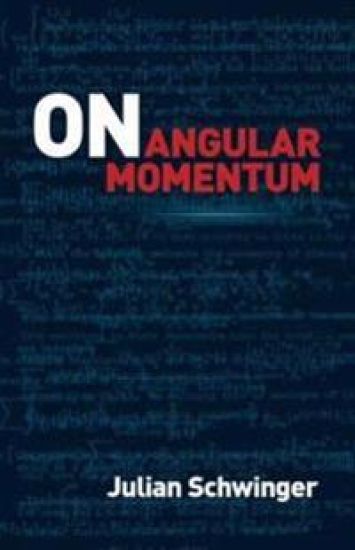
On Angular Momentum

On Angular Momentum

Julian Schwinger

Dover Publications Inc.
2015
nidottu
A concise treatment of angular momentum by an important American physicist, this major work was first published under the auspices of the United States Atomic Energy Commission in 1952 and is finally available to a general audience of students and professionals in the field. Advanced undergraduates and graduate students of physics will particularly benefit from its teachings. One of the most prominent American physicists of the twentieth century, Julian Schwinger (1918-94) taught at Harvard, MIT, and UCLA, among other institutions. In addition to his many other awards, Schwinger, jointly with Richard Feynman and Shinichiro Tomonaga, received the Nobel Prize in Physics in 1965 for his work in quantum electrodynamics.
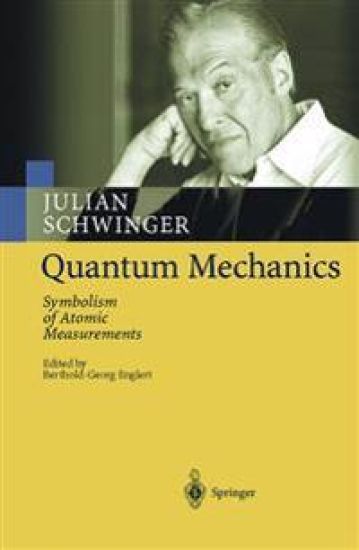
Quantum Mechanics

Quantum Mechanics

Julian Schwinger

Springer-Verlag Berlin and Heidelberg GmbH Co. K
2011
nidottu
Julian Schwinger had plans to write a textbook on quantum mechanics since the 1950s when he was teaching the subject at Harvard University regularly. * t Roger Newton remembers: [A] group of us (Stanley Deser, Dick Arnowitt, Chuck Zemach, Paul Martin and I forgot who else) wrote up lecture notes on his Quantum Mechanics course but he never wanted them published because he "had not yet found the perfect way to do quantum mechanics. " The only text of those days that got published eventually - following a sug­ gestion by, and with the help of, Robert Kohler:!: - were the notes to the lectures that Schwinger presented at Les Houches in 1955. The book was reissued in 1991, with this Special Preface by Schwinger [3]: The first two chapters of this book are devoted to Quantum Kine­ matics. In 1985 I had the opportunity to review that development in connection with the celebration of the 100th anniversary of Hermann Weyl's birthday. [ . . . ] In presenting my lecture [4] I felt the need to alter only one thing: the notation. Lest one think this rather triv­ ial, recall that the ultimate abandonment, early in the 19th century, of Newton's method of fluxions in favor of the Leibnizian calculus, stemmed from the greater flexibility of the latter's notation.
Electromagnetic Radiation: Variational Methods, Waveguides and Accelerators

Electromagnetic Radiation: Variational Methods, Waveguides and Accelerators

Kimball A. Milton; Julian Schwinger

Springer-Verlag Berlin and Heidelberg GmbH Co. K
2010
nidottu
Julian Schwinger was already the world’s leading nuclear theorist when he joined the Radiation Laboratory at MIT in 1943, at the ripe age of 25. Just 2 years earlier he had joined the faculty at Purdue, after a postdoc with OppenheimerinBerkeley,andgraduatestudyatColumbia. Anearlysemester at Wisconsin had con?rmed his penchant to work at night, so as not to have to interact with Breit and Wigner there. He was to perfect his iconoclastic 1 habits in his more than 2 years at the Rad Lab. Despite its deliberately misleading name, the Rad Lab was not involved in nuclear physics, which was imagined then by the educated public as a esoteric science without possible military application. Rather, the subject at hand was the perfection of radar, the beaming and re?ection of microwaves which had already saved Britain from the German onslaught. Here was a technology which won the war, rather than one that prematurely ended it, at a still incalculable cost. It was partly for that reason that Schwinger joined this e?ort, rather than what might have appeared to be the more natural project for his awesome talents, the development of nuclear weapons at Los Alamos. He had got a bit of a taste of that at the “Metallurgical Laboratory” in Chicago, and did not much like it. Perhaps more important for his decision to go to and stay at MIT during the war was its less regimented and isolated environment.
Electromagnetic Radiation: Variational Methods, Waveguides and Accelerators

Electromagnetic Radiation: Variational Methods, Waveguides and Accelerators

Kimball A. Milton; Julian Schwinger

Springer-Verlag Berlin and Heidelberg GmbH Co. K
2006
sidottu
Julian Schwinger was already the world’s leading nuclear theorist when he joined the Radiation Laboratory at MIT in 1943, at the ripe age of 25. Just 2 years earlier he had joined the faculty at Purdue, after a postdoc with OppenheimerinBerkeley,andgraduatestudyatColumbia. Anearlysemester at Wisconsin had con?rmed his penchant to work at night, so as not to have to interact with Breit and Wigner there. He was to perfect his iconoclastic 1 habits in his more than 2 years at the Rad Lab. Despite its deliberately misleading name, the Rad Lab was not involved in nuclear physics, which was imagined then by the educated public as a esoteric science without possible military application. Rather, the subject at hand was the perfection of radar, the beaming and re?ection of microwaves which had already saved Britain from the German onslaught. Here was a technology which won the war, rather than one that prematurely ended it, at a still incalculable cost. It was partly for that reason that Schwinger joined this e?ort, rather than what might have appeared to be the more natural project for his awesome talents, the development of nuclear weapons at Los Alamos. He had got a bit of a taste of that at the “Metallurgical Laboratory” in Chicago, and did not much like it. Perhaps more important for his decision to go to and stay at MIT during the war was its less regimented and isolated environment.
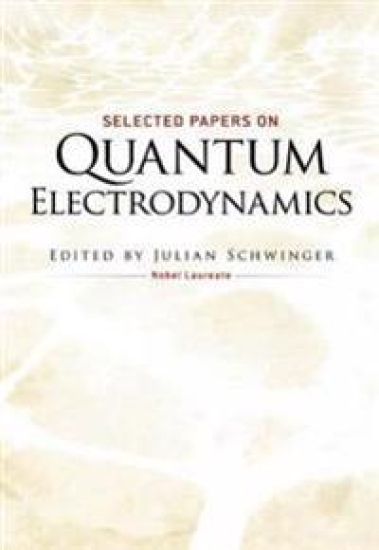
Selected Papers on Quantum Electrodynamics

Selected Papers on Quantum Electrodynamics

Julian Schwinger

Dover Publications Inc.
2003
nidottu
This historical, monumental collection of 34 papers on quantum electrodynamics features writings by the 20th century's leading physicists: Dyson, Fermi, Feynman, Foley, Oppenheimer, Pauli, Weisskopf, and others. Twenty-nine are in English, three in German, one each in French and Italian. Edited by Julian Schwinger, the 1965 Nobel Prize winner for his pioneering work in this very topic.
Quantum Mechanics

Quantum Mechanics

Julian Schwinger

Springer-Verlag Berlin and Heidelberg GmbH Co. K
2001
sidottu
Julian Schwinger had plans to write a textbook on quantum mechanics since the 1950s when he was teaching the subject at Harvard University regularly. * t Roger Newton remembers: [A] group of us (Stanley Deser, Dick Arnowitt, Chuck Zemach, Paul Martin and I forgot who else) wrote up lecture notes on his Quantum Mechanics course but he never wanted them published because he "had not yet found the perfect way to do quantum mechanics. " The only text of those days that got published eventually - following a sug­ gestion by, and with the help of, Robert Kohler:!: - were the notes to the lectures that Schwinger presented at Les Houches in 1955. The book was reissued in 1991, with this Special Preface by Schwinger [3]: The first two chapters of this book are devoted to Quantum Kine­ matics. In 1985 I had the opportunity to review that development in connection with the celebration of the 100th anniversary of Hermann Weyl's birthday. [ . . . ] In presenting my lecture [4] I felt the need to alter only one thing: the notation. Lest one think this rather triv­ ial, recall that the ultimate abandonment, early in the 19th century, of Newton's method of fluxions in favor of the Leibnizian calculus, stemmed from the greater flexibility of the latter's notation.
Particles, Sources, And Fields, Volume 2

Particles, Sources, And Fields, Volume 2

Julian Schwinger

Westview Press Inc
1998
nidottu
This classic book (volume two of three volumes) is almost exclusively concerned with quantum electrodynamics. As such, it is retrospective in its subject matter. The topics discussed range from anomalous magnetic moments and vacuum polarization, in a variety of applications, to the energy level displacements in hydrogenic atoms, with occasional excursions into nuclear and high-energy physics. Based as it is upon the conceptually and computationally simple foundations of source theory, little in the way of formal mathematical apparatus is required, and thus most of the book is devoted to the working out of physical problems.
Particles, Sources, And Fields, Volume 1

Particles, Sources, And Fields, Volume 1

Julian Schwinger

Westview Press Inc
1998
nidottu
This classic, the first of three volumes, presents techniques that emphasize the unity of high-energy particle physics with electrodynamics, gravitational theory, and many-particle cooperative phenomena. What emerges is a theory intermediate in position between operator field theory and S-matrix theory, which rejects the dogmas of each and gains thereby a calculational ease and intuitiveness that make it a worthy contender to displace the earlier formulations.
Particles, Sources, And Fields, Volume 3

Particles, Sources, And Fields, Volume 3

Julian Schwinger

Westview Press Inc
1998
nidottu
An extension of Dr. Schwinger's two previous classic works, this volume contains four sections in addition to the previous sections of Electrodynamics II, which were concerned with the two-particle problem, and applications to hydrogenic atoms, positronium, and muonium.
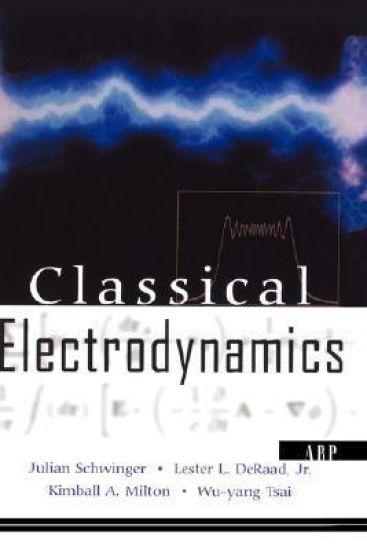
Classical Electrodynamics

Classical Electrodynamics

Julian Schwinger; Lester L. Deraad Jr.; Kimball Milton; Wu-Yang Tsai

Westview Press Inc
1998
sidottu
Classical Electrodynamics captures Schwinger's inimitable lecturing style, in which everything flows inexorably from what has gone before. Novel elements of the approach include the immediate inference of Maxwell's equations from Coulomb's law and (Galilean) relativity, the use of action and stationary principles, the central role of Green's functions both in statics and dynamics, and, throughout, the integration of mathematics and physics. Thus, physical problems in electrostatics are used to develop the properties of Bessel functions and spherical harmonics. The latter portion of the book is devoted to radiation, with rather complete treatments of synchrotron radiation and diffraction, and the formulation of the mode decomposition for waveguides and scattering. Consequently, the book provides the student with a thorough grounding in electrodynamics in particular, and in classical field theory in general, subjects with enormous practical applications, and which are essential prerequisites for the study of quantum field theory. An essential resource for both physicists and their students, the book includes a ? Reader's Guide,? which describes the major themes in each chapter, suggests a possible path through the book, and identifies topics for inclusion in, and exclusion from, a given course, depending on the instructor's preference. Carefully constructed problems complement the material of the text, and introduce new topics. The book should be of great value to all physicists, from first-year graduate students to senior researchers, and to all those interested in electrodynamics, field theory, and mathematical physics. The text for the graduate classical electrodynamics course was left unfinished upon Julian Schwinger's death in 1994, but was completed by his coauthors, who have brilliantly recreated the excitement of Schwinger's novel approach.