

Kirjailija
Juliana Spahr
Kirjat ja teokset yhdessä paikassa: 17 kirjaa, julkaisuja vuosilta 2001–2027, suosituimpiin kuuluu Ars Poeticas. Vertaile teosten hintoja ja tarkista saatavuus suomalaisista kirjakaupoista.
17 kirjaa
Kirjojen julkaisuvuodet: 2001–2027.

Crowd Control
Claire Grossman; Juliana Spahr; Stephanie Young
Columbia University Press
2026
pokkari
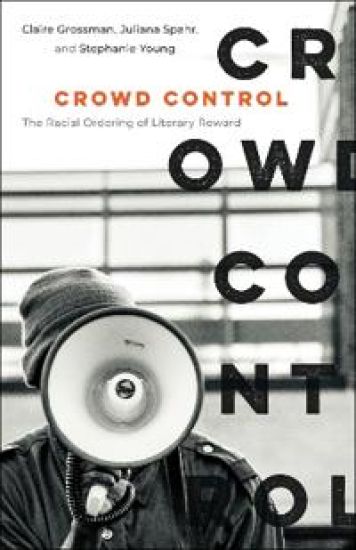
From the race riots of 1919 to the Black Lives Matter movement, anxieties about Black uprising have influenced literary funding and prestige in the United States. Across many decades, grants and prizes have shaped the broader ecosystem of US literature, working in tandem to reroute Black militancy and define literary excellence as white. Even as the field diversified in the twenty-first century, prestige institutions raised barriers to entry and imposed new constraints on writers of color. Crowd Control tells the story of how efforts to contain Black resistance led to the invention of American literary excellence. It brings together archival research and comprehensive data on literary prize demographics with readings of works by Claude McKay, Langston Hughes, William Styron, Claudia Rankine, and others to offer a material account of how US literature has imagined—and managed—protest. Because literature was thought to mollify, redirect, or cast public doubt on militant resistance, moments of mass protest consistently have been followed by targeted support for Black writers. Tracing the evolution of the institutions that reward writers across more than a century, this book unveils the hidden connection between literary funding and social control.
Crowd Control
Claire Grossman; Juliana Spahr; Stephanie Young
Columbia University Press
2026
sidottu
From the race riots of 1919 to the Black Lives Matter movement, anxieties about Black uprising have influenced literary funding and prestige in the United States. Across many decades, grants and prizes have shaped the broader ecosystem of US literature, working in tandem to reroute Black militancy and define literary excellence as white. Even as the field diversified in the twenty-first century, prestige institutions raised barriers to entry and imposed new constraints on writers of color. Crowd Control tells the story of how efforts to contain Black resistance led to the invention of American literary excellence. It brings together archival research and comprehensive data on literary prize demographics with readings of works by Claude McKay, Langston Hughes, William Styron, Claudia Rankine, and others to offer a material account of how US literature has imagined—and managed—protest. Because literature was thought to mollify, redirect, or cast public doubt on militant resistance, moments of mass protest consistently have been followed by targeted support for Black writers. Tracing the evolution of the institutions that reward writers across more than a century, this book unveils the hidden connection between literary funding and social control.
Lyric meditations on writing poetry in a time of ecological crisis and right wing populism_x000D_ _x000D_ During the time of an increasingly powerful alt-right which was also the time when species extinction was ever increasing, Juliana Spahr sat down to read Brecht. She was looking for an answer to Brecht's question about the dark times, about whether there will also be singing during the dark times. The answer that Brecht provides is that yes, that poets will sing of the dark times. In the six ars poeticas that Spahr writes, she sings of the dark times but also of coral, the pop song's possible liberation, and the love of comrades. She writes not only of the rich history of what politics and poetry have done with each other, but what they might yet do together._x000D_ _x000D_ [Sample Poem]_x000D_ _x000D_ from ARS POETICA 1: CORAL _x000D_ _x000D_ To write poetry after Castle Bravo._x000D_ Then to write poetry after 1500 feet._x000D_ After high-quality steel frame buildings_x000D_ not completely collapsed, except_x000D_ all panels and roofs blown in._x000D_ After 2,000 feet._x000D_ After reinforced concrete buildings collapsed_x000D_ or standing but badly damaged._x000D_ After 3,500 feet._x000D_ After church buildings completely destroyed._x000D_ After brick walls severely cracked._x000D_ After 4,400 feet._x000D_ After 5,300 feet._x000D_ After roof tiles bubbled and melted._x000D_ After 6,500 feet._x000D_ After mass distortion of large steel buildings._x000D_ To write the Cold War and doves._x000D_ The Cold War and tapeworms._x000D_ The Cold War and sails of ships._x000D_ The Cold War and the steel of bridges._x000D_ To write poetry after that._x000D_ To write in a world with few nutrients,_x000D_ one that rocks back and forth._x000D_ The same beginning in both the sea and the land._x000D_ To write poetry that knows a hard, cup-shaped skeleton._x000D_ And then poetry that knows_x000D_ the long, stinging tentacles capturing._x000D_ Knows the water._x000D_ The Atlantic and the Pacific._x000D_ The connections between._x000D_ The one moving into the other._x000D_ To develop poetry in the stomach_x000D_ that then exits through the mouth_x000D_ which is the anus._x000D_ To write poetry in the blue_x000D_ that is the absence of green._x000D_ Light penetration._x000D_ Whorls of tentacles._x000D_ The slime earth too._x000D_ Hunters and farmers._x000D_ Shallow water._x000D_ Few nutrients._x000D_ High fecundity._x000D_ Rapid growth._x000D_ Multiarmed morphology and tube feet._x000D_ To write tube feet._x000D_ To write the exact place._x000D_ Seaward slope place._x000D_ Sea terrace place._x000D_ Algal ridge place._x000D_ Coral algal zone place._x000D_ Seaward reef flat place._x000D_ Islet or interisland reef crest place._x000D_ Lagoon reef flat place._x000D_ Lagoon terrace place._x000D_ Lagoon floor or basin place._x000D_ Coral knolls, pinnacle and patch reefs place._x000D_ To write poetry after.

Under Occupy Wall Street-demonstrationerne og -besættelserne i Oakland deltager den amerikanske digter Juliana Spahr aktivt. I digtsamlingen Den vinter ulven kom fra 2015 beskriver hun bl.a. oplevelsen af at være demonstrant, kvinde og mor. Særligt i bogens tre prosa-afsnit fortælles der om den revolutionære gnist, der tændes, omsorgen for hinanden og frustrationerne mod politiet og de lænestolsrevolutionære. De mere prosaiske og indignerede beskrivelser gennemskæres af en mere økopoetisk Spahr, der kredser om solidaritet på tværs af dyrearter og naturkatastrofer, det kunstige og kemiskes indfiltring i naturlige liv. Uden at forfalde til revolutionsromantik fastholder Spahr et credo om at opgør med status quo er uundgåeligt, og hun er frygtløs i sin omgang med sprog og former, som når hun pendulerer uforstyrret mellem at fortælle om en olieudslipskatastrofe på jambisk pentameter, cut-ups af wikipedia-opslag om vandområder, og moderlig paranoia om brystmælk og kemikalier. Med Den vinter ulven kom stirrer Spahr direkte ind i det enogtyvende århundredes politiske og økologiske katastrofe og fastholder troen på individets og sammenholdets agens og potentiale.
Digtsamlingen Denne forbindelse mellem alle med lunger skrives i afmagt over de amerikanske invasioner i Afghanistan (2001) og Irak (2003), mens digteren Juliana Spahr selv befinder sig isoleret midt ude på Stillehavet i Hawaii. Bogen kontrasterer og sammenfletter det intimt private med det globale perspektiv, hvor død og ødelæggelse siver ind i soveværelset på lige fod med den kærlighed og det håb, som eksisterer i den luft vi alle indånder. Igennem hele bogen er den sproglige betydningsdannelse og syntaks i konstant bevægelse, når overskrifter fra sladderblade fletter sig sammen med dagbogsnotater, Sapho-fragmenter og botaniske opslagsværker i en kontinuerligt fremadskridende bevægelse, der til tider giver mindelser om den dansk digter Inger Christensen (1935-2009). Samtidig fremstiller Spahr alle de virkeligheder, der sameksisterer, og de mikro- og makrokonflikter der konstant gennemløber den private såvel som den sociale dimension, mens hun nægter at forfalde til apati og kynisme. @font-face {font-family:"Cambria Math"; panose-1:2 4 5 3 5 4 6 3 2 4; mso-font-charset:0; mso-generic-font-family:roman; mso-font-pitch:variable; mso-font-signature:-536870145 1107305727 0 0 415 0;}@font-face {font-family:Calibri; panose-1:2 15 5 2 2 2 4 3 2 4; mso-font-charset:0; mso-generic-font-family:swiss; mso-font-pitch:variable; mso-font-signature:-536859905 -1073732485 9 0 511 0;}p. MsoNormal, li. MsoNormal, div. MsoNormal {mso-style-unhide:no; mso-style-qformat:yes; mso-style-parent:""; margin:0cm; mso-pagination:widow-orphan; font-size:12.0pt; font-family:"Calibri",sans-serif; mso-ascii-font-family:Calibri; mso-ascii-theme-font:minor-latin; mso-fareast-font-family:Calibri; mso-fareast-theme-font:minor-latin; mso-hansi-font-family:Calibri; mso-hansi-theme-font:minor-latin; mso-bidi-font-family:"Times New Roman"; mso-bidi-theme-font:minor-bidi; mso-fareast-language:EN-US;}p {mso-style-priority:99; mso-margin-top-alt:auto; margin-right:0cm; mso-margin-bottom-alt:auto; margin-left:0cm; mso-pagination:widow-orphan; font-size:12.0pt; font-family:"Times New Roman",serif; mso-fareast-font-family:"Times New Roman";}. MsoChpDefault {mso-style-type:export-only; mso-default-props:yes; font-family:"Calibri",sans-serif; mso-ascii-font-family:Calibri; mso-ascii-theme-font:minor-latin; mso-fareast-font-family:Calibri; mso-fareast-theme-font:minor-latin; mso-hansi-font-family:Calibri; mso-hansi-theme-font:minor-latin; mso-bidi-font-family:"Times New Roman"; mso-bidi-theme-font:minor-bidi; mso-fareast-language:EN-US;}div. WordSection1 {page:WordSection1;}

Eftersom luften och sakerna som fanns i luften, och landet och sakerna som fanns på land var så underbara, så detaljrika och så färgstarka, var deras små hjärnor oförmögna att föreställa sig att de kunde försvinna. Eller vad det innebar att en så stor del av detta underbara redan hade gått förlorat. I Förvandlingen från 2007 flyttar tre vänner och älskare från det amerikanska fastlandet till Hawaii, och får i öns ekologiska och koloniala historia syn på sig själva. Det som sedan följer är en med författarens egna ord ”nästan sann” berättelse om några år under den turbulenta Clinton-Bush-eran – en berättelse om invasiva klängväxter och rubbade mikroklimat, om expansionistiska språk och förhäxande rökplymer, och om två torn som en dag störtade samman.

Åh hur kan mönstret upphöra. Allt jag vet är att jag inte skulle komma upp ur sängen alls utan er i mitt liv. Och allt jag vet är att mina band till er inte är unika. Denna förbindelse mellan alla med lungor skrevs efter 11 september 2001, som ett svar på de geopolitiska händelser som ägde rum i dess efterföljd. Boken, som snabbt blev en modern klassiker, är på samma gång en antikrigsdikt och ett antiantropocentriskt, planetärt kärleksbrev. Dikterna zoomar in och ut, rör sig i nyhetsflödet, går under huden, sedan ut i rymden och tillbaka igen. Juliana Spahr skriver sig genom sinnena, genom det lyriska, genom världen, hon växlar mellan lokalt och globalt, offentligt och privat, individuellt och socialt. Och hela tiden hänger allting samman.
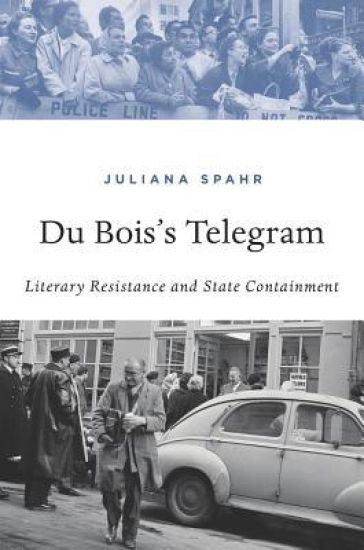
In 1956 W. E. B. Du Bois was denied a passport to attend the Présence Africaine Congress of Black Writers and Artists in Paris. So he sent the assembled a telegram. “Any Negro-American who travels abroad today must either not discuss race conditions in the United States or say the sort of thing which our State Department wishes the world to believe.” Taking seriously Du Bois’s allegation, Juliana Spahr breathes new life into age-old questions as she explores how state interests have shaped U. S. literature. What is the relationship between literature and politics? Can writing be revolutionary? Can art be autonomous, or is escape from nations and nationalisms impossible? Du Bois’s Telegram brings together a wide range of institutional forces implicated in literary production, paying special attention to three eras of writing that sought to defy political orthodoxies by contesting linguistic conventions: avant-garde modernism of the early twentieth century; social-movement writing of the 1960s and 1970s; and, in the twenty-first century, the profusion of English-language works incorporating languages other than English. Spahr shows how these literatures attempted to assert their autonomy, only to be shut down by FBI harassment or coopted by CIA and State Department propagandists. Liberal state allies such as the Ford and Rockefeller foundations made writers complicit by funding multiculturalist works that celebrated diversity and assimilation while starving radical anti-imperial, anti-racist, anti-capitalist efforts. Spahr does not deny the exhilarations of politically engaged art. But her study affirms a sobering reality: aesthetic resistance is easily domesticated.
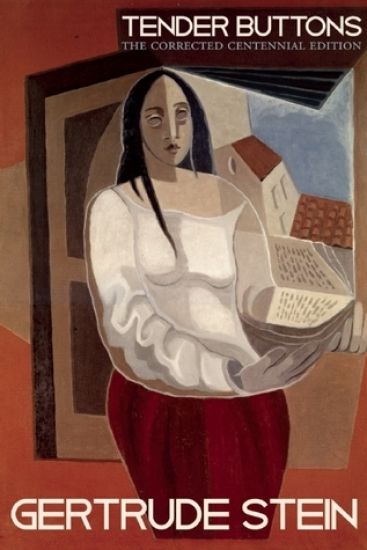
Tender Buttons
Gertrude Stein; Juliana Spahr
City Lights Books
2014
pokkari
Halvin toimitettuna 19,50 €
The MLA Committee on Scholarly Editions has awarded Tender Buttons: The Corrected Centennial Edition its seal designating it an MLA Approved Edition. 2014 marks the one hundredth anniversary of the original publication of Gertrude Stein's groundbreaking modernist classic, Tender Buttons. This centennial edition is the first and only version to incorporate Stein's own handwritten corrections?found in a first-edition copy at the University of Colorado?as well as corrections discovered among her papers at the Beinecke Library at Yale University. Editor Seth Perlow has assembled a text with over one hundred emendations, resulting in the first version of Tender Buttons that truly reflects its author's intentions. These changes are detailed in Perlow's "Note on the Text," which describes the editorial process and lists the specific variants for the benefit of future scholars. The book includes facsimile images of some of Stein's handwritten edits and lists of corrections, as well as an afterword by noted contemporary poet and scholar Juliana Spahr. A compact, attractive edition suitable for general readers as well as scholars, Tender Buttons: The Corrected Centennial Edition is unique among the available versions of this classic text and is destined to become the standard. Gertrude Stein (1874?1946) was one of the most important and innovative American writers of literary modernism, as well as one of the great art collectors and salon hosts of the period. A pioneering lesbian writer, Stein lived most of her life in Paris but became a celebrity in the United States with the publication of The Autobiography of Alice B. Toklas (1933). Seth Perlow teaches English at Oklahoma State University. Juliana Spahr teaches writing at Mills College. "Tender Buttons was recently reissued by City Lights Books, to mark the centennial of a volume that broke language barriers, acknowledging hungers to see more. It challenged with inspired daring."--Barbara Berman, The Rumpus "For the centennial of this masterpiece, Seth Perlow has given us much the best edition of the poem, based on Stein’s manuscript and corrections she made to the first edition. Punctuation, spelling, format, and a few phrases are affected and most especially the change in the capitalization of the section titles. 'The difference is spreading.'"--Charles Bernstein, University of Pennsylvania, author of Attack of the Difficult Poems: Essays and Inventions "Happy 100th birthday, TENDER BUTTONS. You are as explosive, tantalizing, and delicious as you were on the day you were born. Your birthday gift from Seth Perlow and Juliana Spahr is a beautiful new edition that will carry you into your next century, the best edition ever. Your birthday gift from all of us who love literature and culture is to buy this edition for ourselves and all our friends. Congratulations to all."--Catharine R. Stimpson, Professor, New York University, and co-editor of the two-volume Gertrude Stein: Writings published by the Library of America ? The publication of an authoritative edition of Tender Buttons, with Stein’s hitherto unpublished corrections and editions, is a splendid way to celebrate the centennial of this influential modernist work. Scholars will benefit from the full documentation, and readers will appreciate its convenient format, which resembles the original publication.”--Jonathan Culler, Cornell University "This radical multi-dimensional generative cubist text with the simplest words imaginable continues to alter and shape poetics into the post post modernist future. We have Gertrude Stein's 'mind grammar' operating at full tilt, with unpredictability, wit and sensory prevarication. Look to the 'minutes particulars,' Blake admonished, and here she does just that: 'it is a winning cake.' Salvos to the editor and salient 'afterword' that give belletristic notes and political perspective as well. A unique edition."--Anne Waldman, The Jack Kerouac School of Disembodied Poetics
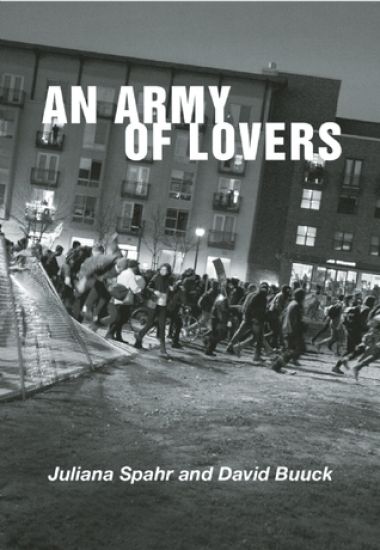
"This experimental work is not for the faint of heart, but it is laced with meditations that will appeal to readers concerned with poetry's role in the world."--Publishers Weekly "I am fascinated by their attention to inequality, to questions of violence and community: something borne out by the collaboration itself."--Bhana Kapil's Best Books of 2013 on The Volta "An Army of Lovers explores the liminal spaces where cities and individuals come together and stand apart with strange, brainy grace."--Michelle Tea, author of Mermaid in Chelsea Creek "By means of a series of stylistically and tonally various prose segments (by turns reflexive and dialogic, ironic and depressive, unhinged and hallucinatory, wetly emotional and dryly wry, including a detournement of a Raymond Carver story), the book centers, emotionally, on the ebb and flow of what it calls 'struggle-force.' Signature drone strikes, torture, ecological collapse, environmental illness and chronic fatigue syndrome: it's all connected." --Miranda Mellis, Rain Taxi "The book offers many ways of approaching the age-old questions What makes something art and What makes someone a decent citizen, as well as (if not primarily) exploring the ways in which the answers to these questions might intersect. More impressively, it does so without being didactic and yet without being obscure, as so many efforts at high-concept art tend to be."--Evan Karp, SF Weekly "Fantastical, lyrical, whimsical and wildly experimental, An Army of Lovers is as serious as it is absurd."--Christopher Higgs, HTMLGIANT "Authors who co-write often produce two halves that refuse to coalesce, but East Bay poets Juliana Spahr and David Buuck fuse with fantastic results in this short experimental novel. It's the story of Demented Panda and Koki, two poets united by a desire to write politically engaged works. Wounded, bored, inspired and skeptical, they soldier on through a landscape of toxic spills, consumer excess, odd juxtapositions and trance states." --Georgia Rowe, San Jose Mercury News "Authors Spahr and Buuck, who appear in this novel as Bay Area poets 'Koki' and 'Demented Panda,' style it up all the way from magical realism to 'new journalism' and Raymond Carver Cathedralspeak, but it's the weary 'I can't go on. I'll go on' optimism at which wounded veterans of the army of lovers excel. Theirs is a rigorous book, and a book of marvels, with something funny, something painful, stirring on every page."--Kevin Killian, author of Spreadeagle "This picaresque story about the 'particular lostness' of poetry, the ways poems always win and the lives of self-described 'mediocre' poets is actually pretty hilarious! It's also smart, incisive and politically astute. Now, to the barricades!"--Rebecca Brown, author of American Romances: Essays An Army of Lovers begins with the story of two poets, Demented Panda and Koki, united in their desire to write politically engaged poetry at a time when poetry seems to have lost its ability to effect social change. Their first project is more than a failure, resulting in a spell that unleashes a torrent of raw sewage and surrealistic embodiments of consumerist excess and black site torture techniques. Subsequent chapters feature an experimental composer (Koki?) and a performance artist (Panda?) whose bodies are literally invaded with the ills of capitalism, manifested through leaking blisters and other maladies, as well as a radical remix of a Raymond Carver story, questioning "What We Talk About When We Talk About Poetry." The novel concludes with Panda and Koki returning to the site of their failed collaboration to conjure up a more utopian vision of "an army of lovers." Fantastical, lyrical, whimsical and wildly experimental, An Army of Lovers is as serious as it is absurd.
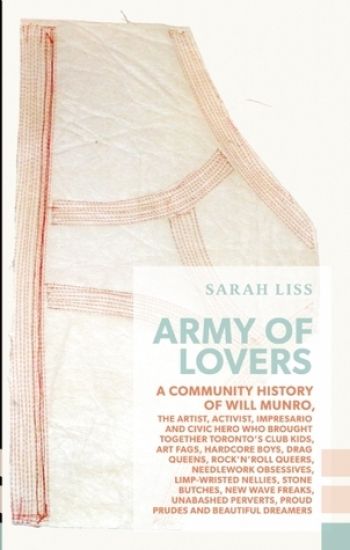
"Will was pretty much the perfect role model." -- Beth Ditto, The Gossip In the spring of 2010, Toronto lost one of its most important queer civic heroes when local artist, DJ, activist, impresario, promoter, party-thrower, cafe operator, community-builder and lover Will Munro died of brain cancer at the unfathomably young age of 35. Famed for his subversive, irreverent visual art, which co-opted rock 'n' roll imagery and raunchy gay iconography, and his legendary Vazaleen dance parties, which singlehandedly reinvented Toronto's queer nightlife culture, Will did more to revolutionize both his community and his city in a decade than most folks do in a lifetime. Weaving together a collage of stories from and about the people who knew and loved him, Army of Lovers is both a biography of Will Munro and a document of a galvanizing period in the history of Toronto, a moment when the city's various subcultures -- the queer community, the art scene, the independent music universe, the grassroots activist enclaves -- came of age and collided with one another. Selected by the Gay, Lesbian, Bisexual and Transgender Round Table (GLBTRT) of the American Library Association (ALA) for the 2014 Over the Rainbow Project book list
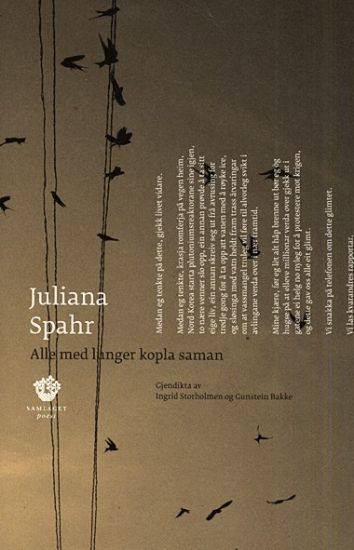
Dette er ei diktdagbok frå opptrappinga til Irak-krigen der forfattaren viser korleis privatsone og konfliktområde grip inn i kvarandre.
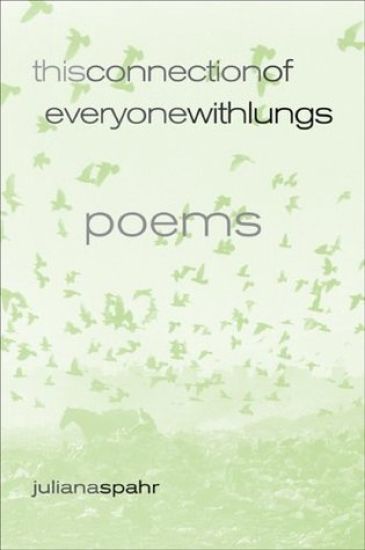
This Connection of Everyone with Lungs
Juliana Spahr
University of California Press
2005
pokkari
Halvin toimitettuna 32,80 €
Part planetary love poem, part 24/7 news flash, the hypnotic poems of This Connection of Everyone with Lungs wrap with equal, angular grace around lovers and battleships. These poems hear the tracer fire in a bird's song and capture cell division and troop deployments in the same expansive thought. They move through concentric levels of association and embrace - from the space between the hands to the mesosphere and back again - touching everything in between. The book's focus shifts between local and global, public and private, individual and social. Everything gets in: through all five senses, through windows, between your sheets, under your skin.

Juliana Spahr uses details to explore Hawai'i's politics of location and her own place in it as an outsider: a hard-core show where the singer shouts out "fuck you-aloha-I love you" over and over; the pidgin word 'da kine;' native Hawaiian rights to gathering; Palolo stream; the similarities and differences between hotel rooms and conference rooms; and acrobats at a Las Vegas-style floor show in Waikiki. Spahr is attentive to specifics and she draws from documentary poetics in these five interconnected poems that move between lyricism, rhythmic repetition, and explanatory prose. Conceptually provocative and yet moving at the same time, Fuck You-Aloha-I Love You demands reading and re-reading.

Experimental texts empower the reader by encouraging self-governing approaches to reading and by placing the reader on equal footing with the author. Everybody's Autonomy is about reading and identity. Contemporary avant garde writing has often been overlooked by those who study literature and identity. Such writing has been perceived as unrelated, as disrespectful of subjectivity. But Everybody's Autonomy instead locates within avant garde literature models of identity that are communal, connective, and racially concerned. Everybody's Autonomy, as it tackles literary criticism's central question of what sort of selves do works create, looks at works that encourage connection, works that present and engage with large, public worlds that are in turn shared with readers. With this intent, it aligns the iconoclastic work of Gertrude Stein with foreign, immigrant Englishes and their accompanying subjectivities. It examines the critique of white individualism and privilege in the work of language writers Lyn Hejinian and Bruce Andrews. It looks at how Harryette Mullen mixes language writing's open text with the distinctivesness of African-American culture to propose a communal, yet still racially conscious identity. And it examines Theresa Hak Kyung Cha's use of broken English and French to unsettle readers' fluencies and assimilating comprehensions, to decolonize reading. Such works, the book argues, well represent and expand changing notions of the public, of everybody.
Experimental texts empower the reader by encouraging self-governing approaches to reading and by placing the reader on equal footing with the author. Everybody's Autonomy is about reading and identity. Contemporary avant garde writing has often been overlooked by those who study literature and identity. Such writing has been perceived as unrelated, as disrespectful of subjectivity. But Everybody's Autonomy instead locates within avant garde literature models of identity that are communal, connective, and racially concerned. Everybody's Autonomy, as it tackles literary criticism's central question of what sort of selves do works create, looks at works that encourage connection, works that present and engage with large, public worlds that are in turn shared with readers. With this intent, it aligns the iconoclastic work of Gertrude Stein with foreign, immigrant Englishes and their accompanying subjectivities. It examines the critique of white individualism and privilege in the work of language writers Lyn Hejinian and Bruce Andrews. It looks at how Harryette Mullen mixes language writing's open text with the distinctivesness of African-American culture to propose a communal, yet still racially conscious identity. And it examines Theresa Hak Kyung Cha's use of broken English and French to unsettle readers' fluencies and assimilating comprehensions, to decolonize reading. Such works, the book argues, well represent and expand changing notions of the public, of everybody."