Kirjojen hintavertailu – 12 903 724 kirjaa ja 27 kauppaa

Kirjailija

Julius Stone

Kirjat ja teokset yhdessä paikassa: 11 kirjaa, julkaisuja vuosilta 1961–2020, suosituimpiin kuuluu Letters to Australia, Volume 3. Vertaile teosten hintoja ja tarkista saatavuus suomalaisista kirjakaupoista.

11 kirjaa

Kirjojen julkaisuvuodet: 1961–2020.

Letters to Australia, Volume 6

Letters to Australia, Volume 6

Julius Stone

Sydney University Press
2020
pokkari
The years 1956–72 were as eventful as any that had gone before, and Julius Stone touched on many international issues. The hydrogen bomb and the space race were popular topics. Decolonisation and independence in Asia and Africa were covered, especially Indonesia and South Africa. He spoke about the Cold War, Vietnam War and relations with China.
Letters to Australia, Volume 5

Letters to Australia, Volume 5

Julius Stone

Sydney University Press
2019
pokkari
Queen Elizabeth’s visit showed a strong remaining affection for the crown, despite the nation’s shift of its power alliances to the USA. In the USA, McCarthyism crashed with the discrediting of its leading figure; in Argentina, the autocratic populist movement of Peron came to an end; West Germany continued its spectacular economic growth; and Yugoslavia made a bid for neutrality, weakening the Soviet Union’s grip on the Balkan states.
Letters to Australia, Volume 4

Letters to Australia, Volume 4

Julius Stone

Sydney University Press
2019
pokkari
Letters to Australia is a collection of Julius Stone’s radio talks, originally broadcast by the Australian Broadcasting Commission between 1942 and 1972. Recently discovered in the nation’s archives, they take the reader back to the mid-20th century, bringing to life the people, events and the sweep of affairs during World War II and its turbulent aftermath, the hopes and fears of individuals and nations. They tell much of Australia’s role in that world and that era. More than anyone else at that time, Julius Stone gave Australians a sense that they were part of the world and could, and should, seek to influence these events. Volume 4 contains 131 essays from 1952 and 1953. These years, like the two preceding, saw incremental change. The Korean War ended, but only after long negotiations over the fate and rights of prisoners of war; the debates over the development of unified economic and political structures in Europe grew; and, with Stalin’s death and Beria’s fall, the Soviet Union began its slow evolution towards glasnost and perestroika and eventual dissolution, decades later. In the Pacific, Australia entered a multi-lateral, ANZUS, excluded the United Kingdom, consolidating the nation’s independence of Britain; Communist China pressed its claims to replace Taiwan on the Security Council; Queen Elizabeth II began her long reign; and adventurism by Egypt set the stage for the Suez crisis of 1956. In Asia, conflict in Vietnam grew, even as war ended in Korea. In Europe, West Germany grew in economic strength, its position between east and west still ambivalent; while the Soviet grip on eastern Europe grew in strength, intensifying their autocracies. The east-west balance of the great powers, and seemingly endless talks on nuclear disarmament, continued; but even in that atmosphere of stalemate, the emergence of NATO and of the Warsaw Pact as military alliances created some change – the growth of a sense that a balance of power between East and West could be sustained, could be lived with. Julius Stone had much to discuss.

Letters to Australia, Volume 3

Letters to Australia, Volume 3

Julius Stone

Sydney University Press
2019
pokkari
Originally broadcast by the ABC between 1942 and 1972 and re-discovered in 2006, these conversational opinion pieces by jurist Julius Stone take the reader back to the mid-20th century, bringing to life the people, events and the sweep of affairs during World War II and its turbulent aftermath. More than anyone else at that time, Stone gave Australians a sense that they were part of the world and that they could - and should - seek to influence world events. His broadcasts give a unique insight into Australia's changing sense of its place in the world during World War II and the postwar years, and of the hopes and fears of that era. Julius Stone returned from overseas in early 1950 (there were no broadcasts in 1949), and quickly resumed broadcasting. Through 1950 and 1951, the issues that attracted his analysis were disarmament, the growth of McCarthyism in the United States, the formal division of Germany and, increasingly, the war in Korea. The structure of that war, with the UN intervening against a rogue state, the success and controversy of the UN Commander – the American General Douglas MacArthur – the intervention of China and the issues of indoctrination, brain washing and human rights raised by the prisoners of the war are covered in many essays. MacArthur’s dismissal from command in Korea, and the fears raised by moves to re-arm Japan and Germany in order to bolster Western strength in the Cold War, unrest in Egypt and Iran all drew his attention. There was no decisive event to begin or end this volume. Still, change was there, if incremental, and these essays follow that change.
Letters to Australia, Volume 2

Letters to Australia, Volume 2

Julius Stone

Sydney University Press
2014
pokkari
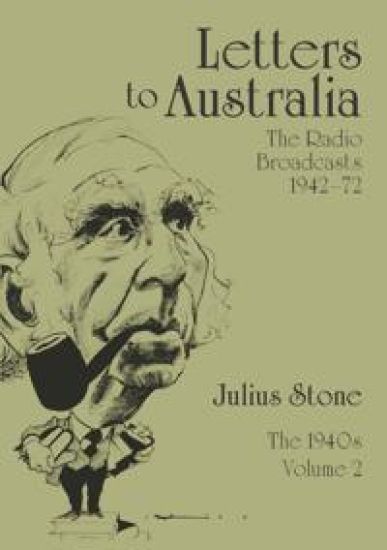
Letters to Australia is a collection of Julius Stone's radio talks, originally broadcast by the ABC between 1942 and 1972. Recently discovered in the nation's archives, they take the reader back to the mid-20th century, bringing to life the people, events and the sweep of affairs during World War II and its turbulent aftermath, the hopes and fears of individuals and nations. They tell much of Australia's role in that world and that era. More than anyone else at that time, Julius Stone gave Australians a sense that they were part of the world and could, and should, seek to influence these events. Volumes one and two contain essays from the 1940s. Volume two completes the 1940s broadcasts, with a series on decolonisation, and a remarkable set of commentaries on the events and people nations and regions, starting with Europe and concluding with the Americas. The volume closes with a series of talks on the jurisprudence of international relations, and four insightful end-of-the-decade talks on the key challenges he believed must be met to maintain intellectual freedom, to counter the narrowness of indoctrination, to respond constructively to the threat of racial conflict, and to assert the value and power of gradual reform.
Letters to Australia, Volume 1

Letters to Australia, Volume 1

Julius Stone

Sydney University Press
2014
pokkari
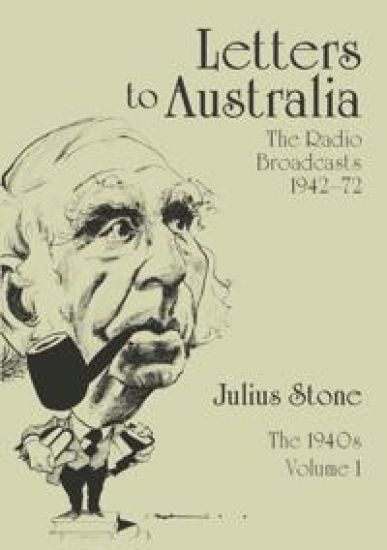
Letters to Australia is a collection of Julius Stone's radio talks, originally broadcast by the ABC between 1942 and 1972. Recently discovered in the nation's archives, they take the reader back to the mid-20th century, bringing to life the people, events and the sweep of affairs during World War II and its turbulent aftermath, the hopes and fears of individuals and nations. They tell much of Australia's role in that world and that era. More than anyone else at that time, Julius Stone gave Australians a sense that they were part of the world and could, and should, seek to influence these events. Volumes one and two contain essays from the 1940s. Volume one begins with 13 wartime broadcasts, given with war at its most threatening for Australia; they are a call to courage in dark times. The broadcasts became more nuanced when they resumed, in 1945 with the war almost won, and, over the remainder of the decade, they covered a wide range of issues – the complex aftermath of war, moves towards disarmament and the control of nuclear weapons, the shift of power from Britain and Europe to the US and USSR; the evolution of the Cold War; the birth of the United Nations; the first moves to European union, and the stirrings of the fundamentalist violence that is so large a part of today’s conflicts. Volume two completes the 1940s broadcasts, with a series on decolonisation, and a remarkable set of commentaries on the events and people nations and regions, starting with Europe and concluding with the Americas. The volume closes with a series of talks on the jurisprudence of international relations, and four insightful end-of-the-decade talks on the key challenges he believed must be met to maintain intellectual freedom, to counter the narrowness of indoctrination, to respond constructively to the threat of racial conflict, and to assert the value and power of gradual reform.
The International Court and World Crisis: International Conciliation, No. 536, January, 1962

The International Court and World Crisis: International Conciliation, No. 536, January, 1962

Julius Stone; Anne Winslow; Patricia Wohlgemuth

Literary Licensing, LLC
2013
sidottu
The International Court and World Crisis is a book that explores the role of international conciliation in resolving global conflicts. Written by Julius Stone, it was originally published in January 1962 as part of the International Conciliation series, which is a collection of publications by the Carnegie Endowment for International Peace. The book focuses on the International Court of Justice, which is the principal judicial organ of the United Nations. Stone examines the court's history, structure, and procedures, as well as its role in resolving international disputes. He also discusses the court's limitations and challenges, including its lack of enforcement powers and the political pressures that can influence its decisions. The book is particularly relevant to the early 1960s, a time of significant global turmoil, including the Cold War, decolonization, and the Cuban Missile Crisis. Stone argues that the International Court can play a crucial role in promoting peace and stability in the face of these crises, but only if it is given the resources and support it needs to function effectively. Overall, The International Court and World Crisis is a thoughtful and insightful analysis of the challenges facing international law and institutions in a rapidly changing world. It is an important read for anyone interested in international relations, conflict resolution, and the role of law in global affairs. Additional Editors Are Elizabeth G. Korbonski And Janet Cameron Duffy. This scarce antiquarian book is a facsimile reprint of the old original and may contain some imperfections such as library marks and notations. Because we believe this work is culturally important, we have made it available as part of our commitment for protecting, preserving, and promoting the world's literature in affordable, high quality, modern editions, that are true to their original work.
Law and the Social Sciences

Law and the Social Sciences

Julius Stone

University of Minnesota Press
1966
nidottu
Law and the Social Sciences was first published in 1966. Minnesota Archive Editions uses digital technology to make long-unavailable books once again accessible, and are published unaltered from the original University of Minnesota Press editions. The author, a distinguished authority on law, provides an illuminating and challenging discussion of the social aspects of law and legal problems. As a background to some penetrating observations, he takes stock of the contributions and interrelations of the bodies of knowledge, from both the juristic and the social science side, which bear upon the study of law at the present time. He is concerned to show the respects in which jurisprudential ideas in this area have been stimulated and clarified by work in the social sciences, and, conversely, to draw attention to the need for the increased interest of social scientists in this area to take account of juristic insights, many of them of long standing. He points out some of the dangers, not limited to waste of effort, arising from "parochialism" on the part of either the lawyer or the social scientist. The final section is devoted to a study of the contributions, potentialities, and limits of behavioralist and computer techniques in understanding and operating the appellate judicial process. The book is based on a series of three lectures given by the author as the William S. Pattee Memorial Lectures sponsored by the University of Minnesota Law School.