Kirjojen hintavertailu – 12 859 818 kirjaa ja 27 kauppaa

Kirjailija

Junjun Ni

Kirjat ja teokset yhdessä paikassa: 4 kirjaa, julkaisuja vuosilta 2019–2026, suosituimpiin kuuluu Advanced Unsaturated Soil Mechanics. Vertaile teosten hintoja ja tarkista saatavuus suomalaisista kirjakaupoista.

4 kirjaa

Kirjojen julkaisuvuodet: 2019–2026.

Advanced Unsaturated Soil Mechanics

Advanced Unsaturated Soil Mechanics

Charles W.W. Ng; Chao Zhou; Junjun Ni

TAYLOR FRANCIS LTD
2026
nidottu
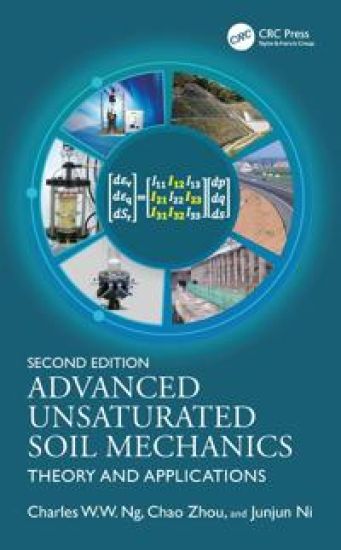
Unsaturated soil is a three-phase material that is ubiquitous on the Earth’s surface and exhibits complex behaviour, which becomes more complex in response to the Earth’s changing climate and increasing engineering activities. This is because the former affects its moisture and temperature conditions significantly and the latter governs its stress state and suction condition. This book is designed to meet the increasing challenges of climate change and engineering activities by covering the mechanics and engineering of unsaturated soil in a logical manner. It comprises four major parts: Water retention and flow characteristics Shear strength and stiffness at various temperatures State-dependent elasto-plastic constitutive modelling Field monitoring and engineering applications This second edition uniquely covers fundamental topics on unsaturated soil that are not covered in other similar books, including: the state- dependency of soil- water retention behaviour and water permeability functions, such as dependence on engineering activities small strain stiffness considering the influence of wetting- drying cycles and recent suction history, such as that due to climate change suction effects on dilatancy and peak shear strength cyclic thermal effects on soil behaviour state- dependent elastoplastic constitutive modelling of monotonic and cyclic behaviour engineering applications such as the South-to-North Water Transfer Project; an earthen landfill cover system devoid of geomembrane in the Xiaping landfill, Shenzhen; and a 15-m-deep multi- propped excavation in Tianjin, China
Advanced Unsaturated Soil Mechanics

Advanced Unsaturated Soil Mechanics

Charles W.W. Ng; Chao Zhou; Junjun Ni

TAYLOR FRANCIS LTD
2024
sidottu
Unsaturated soil is a three-phase material that is ubiquitous on the Earth’s surface and exhibits complex behaviour, which becomes more complex in response to the Earth’s changing climate and increasing engineering activities. This is because the former affects its moisture and temperature conditions significantly and the latter governs its stress state and suction condition. This book is designed to meet the increasing challenges of climate change and engineering activities by covering the mechanics and engineering of unsaturated soil in a logical manner. It comprises four major parts:Water retention and flow characteristicsShear strength and stiffness at various temperaturesState-dependent elasto-plastic constitutive modellingField monitoring and engineering applicationsThis second edition uniquely covers fundamental topics on unsaturated soil that are not covered in other similar books, including:the state- dependency of soil- water retention behaviour and water permeability functions, such as dependence on engineering activitiessmall strain stiffness considering the influence of wetting- drying cycles and recent suction history, such as that due to climate changesuction effects on dilatancy and peak shear strengthcyclic thermal effects on soil behaviourstate- dependent elastoplastic constitutive modelling of monotonic and cyclic behaviourengineering applications such as the South-to-North Water Transfer Project; an earthen landfill cover system devoid of geomembrane in the Xiaping landfill, Shenzhen; and a 15-m-deep multi- propped excavation in Tianjin, China
Plant-Soil Slope Interaction

Plant-Soil Slope Interaction

Charles Ng; Anthony Leung; Junjun Ni

Taylor Francis Ltd
2021
nidottu
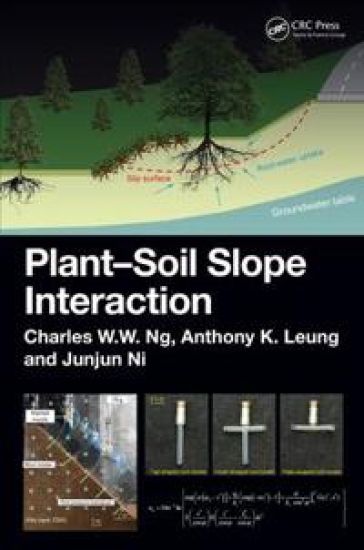
This inter-disciplinary book provides the latest advanced knowledge of plant effects on vegetated soil properties such as water retention capability, water permeability function, shear strength, slope hydrology, movements and failure mechanisms, and applies this knowledge to the solution of slope stability problems. It is the first book to cover in detail not only the mechanical effects of root reinforcement but more importantly the hydrological effects of plant transpiration on soil suction, soil shear strength, and water permeability. The book also offers a fundamental understanding of soil-plant-water interaction. Analytical equations are provided for predicting the combined hydrological and mechanical effects of plant roots on slope stability. A novel method is also given for simulating transpiration-induced suction in a geotechnical centrifuge. Application of this method to the study of the failure mechanisms of vegetated slopes reinforced by roots with different architectures is discussed. This book is essential reading for senior undergraduate and postgraduate students as well as researchers in civil engineering, geo-environmental engineering, plant ecology, agricultural science, hydrology and water resources. It also provides advanced knowledge for civil engineers seeking "green" engineering solutions to combat the negative impact of climate change on the long-term engineering sustainability of infrastructure slopes. Professionals other than civil engineers, such as ecologists, agriculturists, botanists, environmentalists, and hydrologists, would also find the book relevant and useful.
Plant-Soil Slope Interaction

Plant-Soil Slope Interaction

Junjun Ni; Charles Ng; Anthony Leung

CRC Press
2019
sidottu
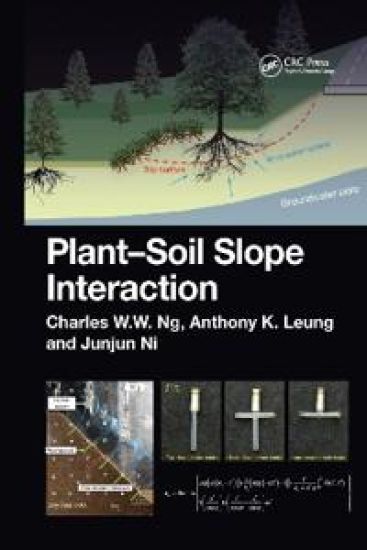
This inter-disciplinary book provides the latest advanced knowledge of plant effects on vegetated soil properties such as water retention capability, water permeability function, shear strength, slope hydrology, movements and failure mechanisms, and applies this knowledge to the solution of slope stability problems. It is the first book to cover in detail not only the mechanical effects of root reinforcement but more importantly the hydrological effects of plant transpiration on soil suction, soil shear strength, and water permeability. The book also offers a fundamental understanding of soil-plant-water interaction. Analytical equations are provided for predicting the combined hydrological and mechanical effects of plant roots on slope stability. A novel method is also given for simulating transpiration-induced suction in a geotechnical centrifuge. Application of this method to the study of the failure mechanisms of vegetated slopes reinforced by roots with different architectures is discussed. This book is essential reading for senior undergraduate and postgraduate students as well as researchers in civil engineering, geo-environmental engineering, plant ecology, agricultural science, hydrology and water resources. It also provides advanced knowledge for civil engineers seeking "green" engineering solutions to combat the negative impact of climate change on the long-term engineering sustainability of infrastructure slopes. Professionals other than civil engineers, such as ecologists, agriculturists, botanists, environmentalists, and hydrologists, would also find the book relevant and useful.