Kirjojen hintavertailu – 12 903 725 kirjaa ja 27 kauppaa

Kirjailija

Jurgen Basedow

Kirjat ja teokset yhdessä paikassa: 13 kirjaa, julkaisuja vuosilta 1999–2024, suosituimpiin kuuluu European Private Law. Vertaile teosten hintoja ja tarkista saatavuus suomalaisista kirjakaupoista.

Nimi esiintyy myös muodoissa: Jürgen Basedow

13 kirjaa

Kirjojen julkaisuvuodet: 1999–2024.

Uniform Law

Uniform Law

Jürgen Basedow

Mohr Siebeck
2024
sidottu
Decentralised law-making is an inescapable consequence of a global order built on sovereign States, and the steadily advancing process of globalisation demands an even greater harmonisation of rules and principles. Yet uniform law is usually approached on a sectoral basis, with specialists looking into the specific areas of their discipline only. In addition, in many cases the result of harmonisation and its implementation are the sole objects of interest. As a consequence, little attention is paid to the general structures of uniform law, the features inherent in the structure of uniform law or the underlying methods of unification. But the substance of unified rules and principles and their application in legal practice is in fact influenced by their underlying framework. It is therefore necessary to look at the specific instances of uniform law in the context of this general framework. In an overarching analysis, the author of this book explores this general framework of uniform law. He clarifies the concept of uniform law and identifies the drivers of and obstacles to unification. Against this background, the different actors who promote uniform law are examined, as are the various forms and extent of uniform law. After providing a description of the relationship between uniform and municipal law, the author considers the operation of treaty law and public international law in relation to uniform law conventions, before concluding with the topic of non-binding unification.

Eu Private Law

Eu Private Law

Jurgen Basedow

Intersentia Ltd
2021
sidottu
EU law covers numerous sectors of private law and is still expanding. Due to its fragmentary nature, most legal literature addresses specific areas such as EU labour law, EU company law, EU private international law, EU consumer law, etc. In contrast, this book presents an innovative approach in its analysis of EU private law, considering its continuous expansion as an ongoing process and interrogating some central questions: What is private law in the framework of the EU? How does EU private law relate to traditional concepts of private law? What is the impact on horizontal relations of the law of the Union which was established with a view to the integration of peoples in Europe? Is the frequent reference to the policy orientation of EU law sufficient to overcome the differences between public and private law? Like the growth rings of a tree the numerous acts and judgments of EU private law feed from the trunk and the roots, which developed in the vertical relations between the Union and the Member States. The foundations of EU law, which often have a background in legal history, comparative experience and public international law, impact upon horizontal relations in a manner previously unknown in national systems of private law. Across ten parts grouped in four books devoted to foundations, principles, enforcement and implementation, respectively, as well as the external dimension, the author elaborates on the peculiarities of EU private law as compared to the traditional analysis of private law in any given national legal system. The author traces throughout the book the origins of legal principles and rules in comparative law, legal history and public international law and their application and development in EU private law instruments and the judgments of the CJEU. This comparison helps to strengthen our understanding of those peculiarities and paves the way for a comprehensive critical assessment of the state of EU private law today.
The Law of Open Societies: Private Ordering and Public Regulation in the Conflict of Laws
This book endeavours to interpret the development of private international law in light of social change. Since the end of World War II the socio-economic reality of international relations has been characterised by a progressive move from closed to open societies. The dominant feature of our time is the opening of borders for individuals, goods, services, capital and data. It is reflected in the growing importance of ex ante planning - as compared with ex post adjudication - of cross-border relations between individuals and companies. What has ensued is a shift in the forces that shape international relations from states to private actors. The book focuses on various forms of private ordering for economic and societal relations, and its increasing significance, while also analysing the role of the remaining regulatory powers of the states involved. These changes stand out more distinctly by virtue of the comparative treatment of the law and the long-term perspective employed by the author. The text is a revised and updated version of the lectures given by the author during the 2012 summer courses of the Hague Academy of International Law.
Structure and Effects in EU Competition Law

Structure and Effects in EU Competition Law

Jurgen Basedow; Wolfgang Wurmnest

Kluwer Law International
2011
sidottu
During the last decade the European Commission has progressively adopted what is called a A more economic approach A| toward competition policy. This approach, which draws on U. S. antitrust policy, puts greater emphasis on possible welfare effects of business practices and is less concerned with competitive market structures. Under this school of thought concentration cannot be said to impede effective competition to the extent that efficiency gains outweigh market distortions. In order to stimulate the debate on this basic reorientation, in January 2009 the Max Planck Institute for Comparative and International Private Law at Hamburg convened economists, legal scholars, and practitioners for an exchange of views on these A new A| methodological foundations of EU competition policy and competition law. Two especially controversial elements were chosen for in-depth discussion: the prohibition of abuses of dominant positions and the review of State aid. This book reproduces fourteen papers from this conference, representing the considered views of prominent European lawyers, economists, academics, policymakers, and enforcement officials in the competition field on matters such as: A { the objectives of EU competition law; A { the current enforcement guidelines of the EU Commission regarding Article 102 TFEU A { measuring market power A { abusive low pricing strategies A { the economics of competition law enforcement A { recent developments in EU State aid law A { economic justifications for State aid A critical assessment of the Commission A|s State aid action plan by the German Monopolies Commission is appended in English. Applying law and economics theory to competition law, this book shows that the A more economic A| approach is exerting a considerable impact on various sectors of competition law. The authors clearly demonstrate the progress that can be made when lawyers and economists take notice of and respect the characteristics of each other A|s discipline. Moreover, the authors show how new insights of economic theory may be integrated into the relevant legal analysis. The book will therefore be appreciated by academics, practitioners, and officials representing both fields.
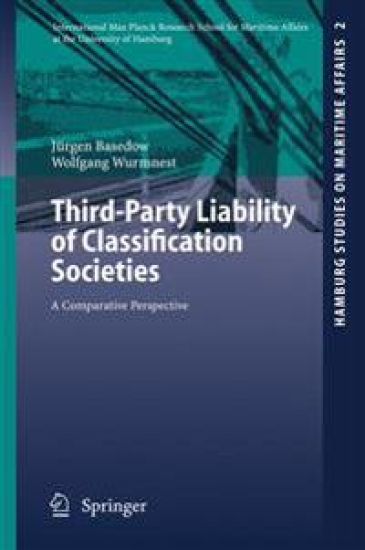
Third-Party Liability of Classification Societies

Third-Party Liability of Classification Societies

Jürgen Basedow; Wolfgang Wurmnest

Springer-Verlag Berlin and Heidelberg GmbH Co. K
2005
nidottu
Classification societies are charged with the technical supervision of maritime shipping to enhance the safety of life and property at sea by securing high te- nical standards of design, manufacture, construction and maintenance of seagoing vessels. Each and every shipping catastrophe caused by a technical defect reminds the maritime world of the central importance of the vessel’s proper technical supervision. Correspondingly, the liability of classification societies has become a particularly discussed issue over the past years. Their contractual liability is usually limited by general terms and conditions incorporated in the classification rules and cases brought by typical contracting partners of classification societies, such as ship owners and ship yards, are not an issue in the current debate. H- ever, one can note a substantial worldwide increase of actions brought by parties who are not in privity with classification societies. This study focuses on third-party liability of classification societies. It ori- nates in an expert opinion on selected issues relating to third-party liability which the authors compiled for the German classification society Germanischer Lloyd AG. Driven by the highly interesting legal issues and unexplored shores in this area of law, we continued our research and are able to present a relatively c- prehensive overview on the law on third-party liability of classification societies. Given the origins of our work, the discussion of limitations of liability clauses is based on the standard terms and conditions of the Germanischer Lloyd, version 2005.
Die Dritthaftung von Klassifikationsgesellschaften

Die Dritthaftung von Klassifikationsgesellschaften

Jürgen Basedow; Wolfgang Wurmnest

Mohr Siebeck
2004
nidottu
Klassifikationsgesellschaften sind die technischen Überwachungsorganisationen der Seeschiffahrt. In jüngerer Zeit sind sie verstärkt Ansprüchen Dritter ausgesetzt, mit denen sie keine Vertragsbeziehungen unterhalten. Diese Tendenz ist weltweit zu beobachten, wie aktuelle Fälle vor englischen, neuseeländischen und US-amerikanischen Gerichten belegen. Dritte versuchen sich vor allem im Anschluß an Schiffskatastrophen, aber auch im Zuge von Schiffsverkäufen, an einer Klassifikationsgesellschaft schadlos zu halten. Jürgen Basedow und Wolfgang Wurmnest untersuchen, welche Ansprüche solchen Dritten nach deutschem Recht gegen eine Klassifikationsgesellschaft zustehen und welche Bedeutung hierbei Haftungsbeschränkungen zukommt, die eine Klassifikationsgesellschaft mit ihren Vertragspartnern vereinbart. Somit steht die privatrechtliche Haftung von Klassifikationsgesellschaften im Mittelpunkt dieses Buches; ihre Haftung für hoheitliches Handeln wird nur am Rande gestreift. Die Autoren arbeiten die Problematik rechtsvergleichend auf und beziehen dabei das australische, englische, französische, neuseeländische und US-amerikanische Recht ein. Die von ihnen vertretene Lösung steht im Einklang mit dem fein austarierten System der Haftungsverteilung und -beschränkung des internationalen Seerechts, welches maßgeblich durch völkerrechtliche Übereinkommen geprägt wird.
Economic Regulation and Competition

Economic Regulation and Competition

Jurgen Basedow; Harald Baum; Hideki Kanda; Toshiyuki Kono

Kluwer Law International
2002
sidottu
At the beginning of the 21st century, in Japan and most of the continental European economies, we can observe a shift from what has been labelled a "corporatist" system to more market-oriented structures. Regulatory competition caused by the globalization of markets is increasingly placing the traditional legal institutions of these jurisdictions under severe strain. This is especially true for the services markets. Of these, the markets for financial services and telecommunications services have to adapt most urgently. These adaptations are already underway to varying extents and degrees, made possible by a mixture of de-regulation and re-regulation. In this volume, scholars from Germany, Austria, Switzerland, and Japan as well as practitioners from various institutions lay out the theoretical foundations and means for these developments. Through critical analysis, the various contributions show what has been reached so far in Europe and Japan and what remains to be achieved in the future.
Mehr Freiheit wagen

Mehr Freiheit wagen

Jürgen Basedow

Mohr Siebeck
2002
sidottu
Die Freiheit der wirtschaftlichen Betätigung ist in Deutschland nach wie vor durch eine Vielzahl staatlicher Eingriffe beschränkt. Die Deregulierungsphase zu Anfang der neunziger Jahre hat zwar einige Märkte dem Wettbewerb geöffnet, ist aber in vielen Sektoren ohne Wirkung geblieben. Jürgen Basedow, gegenwärtig Mitglied der Monopolkommission, hat diesen Prozeß von Anfang an begleitet und ihn mit zahlreichen kleineren Schriften gefördert, die vielfach an entlegenen Stellen oder noch gar nicht veröffentlicht sind. Diese Arbeiten werden hier im Kontext publiziert. In ihnen hebt der Autor immer wieder die deregulierende Wirkung des europäischen Gemeinschaftsrechts hervor und thematisiert die Zusammenhänge zwischen der Deregulierung der Märkte in der Europäischen Union und der Harmonisierung der Wettbewerbsbedingungen. Nicht zuletzt wird die Bedeutung des Wettbewerbsrechts als Garant der wirtschaftlichen Freiheit auf den deregulierten Märkten betont.
European Private Law, Sources, III

European Private Law, Sources, III

Jurgen Basedow

Kluwer Law International
2002
sidottu
This collection aims to satisfy the need of practitioners for access to the private law of the European Community, since the obligation to interpret national law in conformity with EC directives often requires a comparison with Community legislation. At the same time the collection facilitates analysis and may contribute to an improvement of the texts and their understanding. The collection does not reproduce the entire private law of the Community; it includes enactments that exclusively or mainly concern private law. The collection reproduces acts which can essentially be classified under six headings: (1) the law of companies and undertakings; (2) labour law; (3) the law of obligations, which mainly comprises measures of consumer protection; (4) the law of advertising; (5) copyright law; and (6) the law of industrial property. Parts (5) and (6) can be found in Volume 3. The European acts are binding in many languages. This book is conceived so as to provide a synoptical reproduction of different language versions of one and the same act, and to allow for a permanent comparison. It follows that it is limited to four languages which are selected in accordance with their frequency within the Community. They include the working languages used by the Community agencies in the legislative process. The acts are reproduced as amended by later secondary legislation, but without taking into account the renumbering of the provisions of the EC Treaty by the Treaty of Amsterdam.
European Private Law, Sources, II

European Private Law, Sources, II

Jurgen Basedow

Kluwer Law International
2000
sidottu
This collection should satisfy the need of practitioners for access to the private law of the Community, for the obligation to interpret national law in conformity with EC directives often requires a comparison with Community legislation. At the same time the collection should facilitate analysis and may thereby contribute to an improvement of the texts and their understanding. The collection does not reproduce the entire private law of the Community; it includes enactments that exclusively or mainly concern private law. The collection reproduces acts which can essentially be classified under six headings: (1) the law of companies and undertakings; (2) labour law; (3) the law of obligations, which mainly comprises measures of consumer protection; (4) the law of advertising; (5) copyright law and (6) the law of industrial property. Parts (3) and (4) can be found in Volume 2. The European acts are binding in many languages. A book which reproduces all of them would be desirable, but, for its price, impossible to sell. This book is conceived so as to provide a synoptical reproduction of different language versions of one and the same act, and to allow for a permanent comparison. It follows that it is limited to four languages which are selected in accordance with their frequency within the Community. They include the working languages used by the Community agencies in the legislative process. The acts are reproduced as amended by later secondary legislation, but without taking into account the renumbering of the provisions of the EC Treaty by the Treaty of Amsterdam.
Private Law in the International Arena:From National Conflict Rules Towards Harmonization and Unification - Liber Amicorum Kurt Siehr
Private Law in the International Arena contains fifty-seven original contributions authored by renowned lawyers from all over the World. It analyzes a wide variety of effects that cross-border activities have on the operation of private law, ranging from corporate and insolvency law to labor law, property law, the law of obligations, family law, European law and lex mercatoria. Civil procedure aspects, in national courts and arbitration proceedings, are also explored. This book provides a unique source of insights into the problems encountered and their possible solutions. It will be of interest to scholars and practitioners alike. All contributions have been written in honor of an eminent Private International Law scholar, Prof. Dr. Kurt Siehr of the University of Zurich.
Legal Aspects of Globalisation

Legal Aspects of Globalisation

Jurgen Basedow; Toshiyuki Kono

Kluwer Law International
2000
sidottu
The phenomenon of increased interconnectedness of the world's societies, generally referred to as globalization, is not only changing our everyday life, it also influences the legal framework we are living in. The challenges brought about by this process are especially great in fields of law which are by their very nature international such as private international law, the law of capital markets, international insolvency law or the law of the Internet: can, for example, established conflict-of-law rules survive in a globalized world? What options exist for regulating capital markets in the era of globalization? Are national laws on international insolvencies prepared for the increasing number of cross-border insolvency proceedings or does the UNCITRAL model law on cross-border insolvency show the way? How can national or international legislators react to the new forms of torts and copyright infringements via the World Wide Web? These are some of the questions which scholars from Japan and Germany try to answer in this volume. All essays are based on contributions to a symposium which took place in Fukuoka, Japan, on 28-29 March, 1999.
European Private Law

European Private Law

Jurgen Basedow

Kluwer Law International
1999
sidottu
This collection should satisfy the need of practitioners for access to the private law of the European Community, as the obligation to interpret national law in conformity with EC directives often requires a comparison with Community legislation. At the same time the collection will facilitate analysis and may thereby contribute to an improvement of the texts and their understanding. The collection does not reproduce the entire private law of the Community; it includes enactments that exclusively or mainly concern private law. The collection reproduces acts which can essentially be classified under six headings: (1) the law of companies and undertakings; (2) labour law; (3) the law of obligations, which mainly comprises measures of consumer protection; (4) the law of advertising; (5) copyright law and (6) the law of industrial property. Parts (1) and (2) can be found in Volume I. The European acts are binding in many languages. This text is conceived so as to provide a synoptical reproduction of different language versions of one and the same act, and to allow for a permanent comparison. It follows that it is limited to four languages which are selected in accordance with their frequency within the Community. They include the working languages used by the Community agencies in the legislative process. The acts are reproduced as amended by later secondary legislation, but without taking into account the renumbering of the provisions of the EC Treaty by the Treaty of Amsterdam.