Kirjojen hintavertailu – 12 859 818 kirjaa ja 27 kauppaa

Kirjailija

Jürgen Gerhards

Kirjat ja teokset yhdessä paikassa: 20 kirjaa, julkaisuja vuosilta 1993–2024, suosituimpiin kuuluu Framing Refugees. Vertaile teosten hintoja ja tarkista saatavuus suomalaisista kirjakaupoista.

Nimi esiintyy myös muodoissa: Jurgen Gerhards

20 kirjaa

Kirjojen julkaisuvuodet: 1993–2024.

Framing Refugees

Framing Refugees

Daniel Drewski; Jürgen Gerhards

Oxford University Press
2024
sidottu
This is an open access title available under the terms of a CC BY-NC-ND 4.0 International licence. It is free to read at Oxford Academic and offered as a free PDF download from OUP and selected open access locations. Across the world, the number of people forcibly displaced from their homes has more than doubled during the last decade. Although international law does not allow states to turn back refugees, some countries close their borders to refugees, some open their borders and grant extensive protection, while others admit some groups of refugees while excluding others. How can we make sense of these different responses to admitting refugees? In this book, Daniel Drewski and Jürgen Gerhards show that governments' refugee policy, as well as the stance adopted by opposition parties on the issue, is heavily dependent on how they frame their country's collective identity on the one hand and the identity and characteristics of the refugees on the other. By defining the "we" and the "others", politicians draw on collectively shared cultural repertoires, which vary by country and by political constituency within a country. The book is based on a discourse analysis of parliamentary debates. It explores the specific framing of nations' identities and the corresponding perceptions of otherness by focusing on six countries that have been confronted with large numbers of refugees: Germany, Poland, and Turkey, all responding to the exodus of Syrian and Middle Eastern refugees; Chile's reaction to the Venezuelan displacement; Singapore and its stance towards Rohingya refugees; and Uganda's response to the displacement from South Sudan. The study explores not only differences between governments of different countries but also the conflicting views of different political parties within the same country. This volume has emerged from research carried out as part of the Cluster of Excellence "Contestations of the Liberal Script - SCRIPTS", which analyzes the contemporary controversies about liberal ideas, institutions, and practices on the national and international level from a historical, global, and comparative perspective. It connects academic expertise in the social sciences and area studies and collaborates with research institutions in all world regions. Operating since 2019 and funded by the German Research Foundation (DFG), SCRIPTS unites eight major Berlin-based research institutions: Freie Universität Berlin, the Humboldt-Universität zu Berlin, the Berlin Social Science Center (WZB), the Hertie School, the German Institute for Economic Research (DIW), the Berlin branch of the German Institute of Global and Area Studies (GIGA), the Centre for East European and International Studies (ZOiS), and the Leibniz-Zentrum Moderner Orient (ZMO).
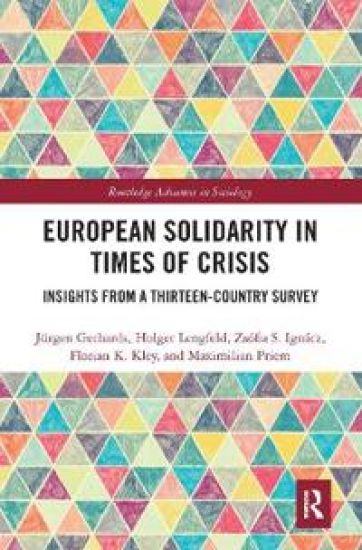
European Solidarity in Times of Crisis

European Solidarity in Times of Crisis

Jürgen Gerhards; Holger Lengfeld; Zsófia Ignácz; Florian Kley; Maximilian Priem

Routledge
2021
nidottu
The euro crisis, several sovereign debt crises, the Great Recession, the refugee crisis, and Brexit have all challenged Europeans’ willingness to show solidarity with other European citizens and member states of the European Union. European Solidarity in Times of Crisis provides a clear theoretical framework to understand European solidarity for the first time. It offers a systematic empirical approach to determine the strength and causes of European solidarity. The authors distinguish between four domains of solidarity and test a set of theoretically derived criteria with a unique dataset to investigate European solidarity. Based on a survey conducted in thirteen EU member states in 2016, the empirical analysis leads to some unanticipated results. Europeans display a notably higher degree of solidarity than many politicians and social scientists have presumed so far. This especially applies to the support of people in need (welfare solidarity) and the reduction of territorial disparities between rich and poor EU countries (territorial solidarity), but also to the domain of fiscal solidarity (financial support of indebted EU countries). This optimistic view is less true for the domain of refugee solidarity. While citizens of western and southern EU countries accept the accommodation of refugees and their allocation between European countries, the majority of people in eastern European countries do not share this point of view. The book will appeal to students and scholars in fields such as comparative sociology, political science, social policy and migration research, and European studies. It is also relevant to a non-academic audience interested in the development of the European project.
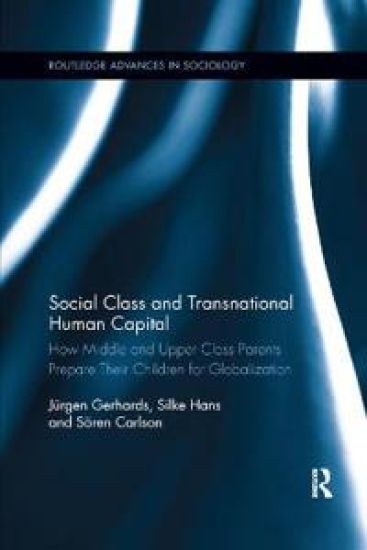
Social Class and Transnational Human Capital

Social Class and Transnational Human Capital

Jürgen Gerhards; Hans Silke; Sören Carlson

Routledge
2019
nidottu
Due to globalization processes, foreign language skills, knowledge about other countries and intercultural competences have increasingly become important for societies and people’s social positions. Previous research on social inequality, however, has dominantly focused on the reproduction of class structures within the boundaries of a particular nation-state without considering the importance of these specific skills and competences. Within Social Class and Transnational Human Capital authors Gerhards, Hans and Carlson refer to these skills as ‘transnational human capital’ and ask to what extent access to this increasingly sought-after resource depends on social class. Based on Pierre Bourdieu’s theory of class, they investigate this question via both quantitative and qualitative empirical analyses. In doing so the authors focus, among other examples, on the so-called school year abroad, i.e. students spending up to a year abroad while attending school – a practice which is rather popular in Germany, but also quite common in many other countries. Thus, this insightful volume explores how inequalities in the acquisition of transnational human capital and new forms of social distinction are produced within families, depending on their class position and the educational strategies parents pursue when trying to prepare their children for a globalizing world. An enlightening title, this book will appeal to undergraduate and postgraduate students, as well as postdoctoral researchers interested in fields such as sociology, social inequality research, globalization studies and educational studies.
European Solidarity in Times of Crisis

European Solidarity in Times of Crisis

Jürgen Gerhards; Holger Lengfeld; Zsófia Ignácz; Florian Kley; Maximilian Priem

Routledge
2019
sidottu
The euro crisis, several sovereign debt crises, the Great Recession, the refugee crisis, and Brexit have all challenged Europeans’ willingness to show solidarity with other European citizens and member states of the European Union. European Solidarity in Times of Crisis provides a clear theoretical framework to understand European solidarity for the first time. It offers a systematic empirical approach to determine the strength and causes of European solidarity. The authors distinguish between four domains of solidarity and test a set of theoretically derived criteria with a unique dataset to investigate European solidarity. Based on a survey conducted in thirteen EU member states in 2016, the empirical analysis leads to some unanticipated results. Europeans display a notably higher degree of solidarity than many politicians and social scientists have presumed so far. This especially applies to the support of people in need (welfare solidarity) and the reduction of territorial disparities between rich and poor EU countries (territorial solidarity), but also to the domain of fiscal solidarity (financial support of indebted EU countries). This optimistic view is less true for the domain of refugee solidarity. While citizens of western and southern EU countries accept the accommodation of refugees and their allocation between European countries, the majority of people in eastern European countries do not share this point of view. The book will appeal to students and scholars in fields such as comparative sociology, political science, social policy and migration research, and European studies. It is also relevant to a non-academic audience interested in the development of the European project.
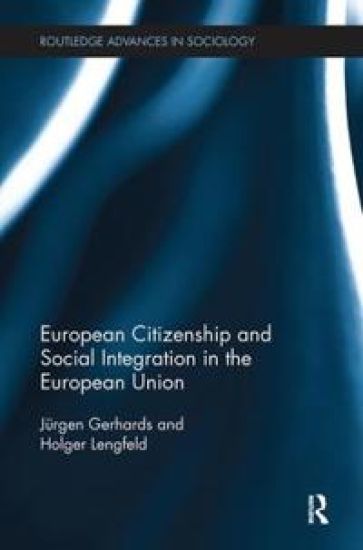
European Citizenship and Social Integration in the European Union

European Citizenship and Social Integration in the European Union

Jürgen Gerhards; Holger Lengfeld

CRC Press Inc
2018
nidottu
Since 2008, the European Union has been affected by one of the most severe crises in the history of Europe. This book builds on the work of Jürgen Habermas to answer the key question: is Europe strong enough to overcome the recent crisis? Arguing that recovery can only take place if the citizens of Europe regard themselves as members of a socially integrated European society, this volume sets out three conditions for successful European social integration: European citizens mutually respect each other as equals, accepting that all EU citizens should have equal economic, political and social rights. Those citizens objecting to the idea of European equality should not constitute a minority with potential for mobilisation that could impede the ongoing process of European social integration. Europeans act upon their equality beliefs in everyday practice – without differentiating between nationals and EU migrants. Based on a survey carried out in Germany, Spain, Poland and Turkey, the authors argue that the requirements for a socially integrated Europe are largely in place already. Their findings allow for optimism regarding the future of the EU, as the cultural foundations for a democratisation of Europe are laid. This volume develops a theoretical framework of a socially integrated European community, and will be useful for students and scholars of sociology, citizenship studies, social policy, political science and European studies.
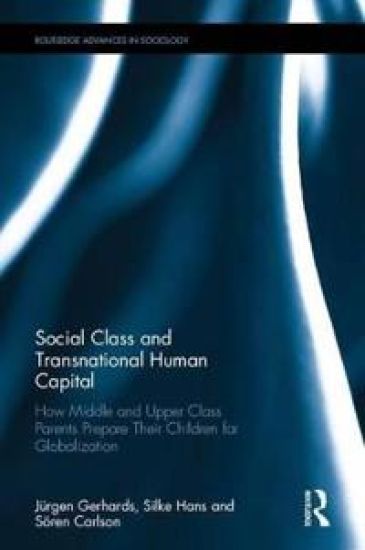
Social Class and Transnational Human Capital

Social Class and Transnational Human Capital

Jürgen Gerhards; Hans Silke; Sören Carlson

Routledge
2017
sidottu
Due to globalization processes, foreign language skills, knowledge about other countries and intercultural competences have increasingly become important for societies and people’s social positions. Previous research on social inequality, however, has dominantly focused on the reproduction of class structures within the boundaries of a particular nation-state without considering the importance of these specific skills and competences. Within Social Class and Transnational Human Capital authors Gerhards, Hans and Carlson refer to these skills as ‘transnational human capital’ and ask to what extent access to this increasingly sought-after resource depends on social class. Based on Pierre Bourdieu’s theory of class, they investigate this question via both quantitative and qualitative empirical analyses. In doing so the authors focus, among other examples, on the so-called school year abroad, i.e. students spending up to a year abroad while attending school – a practice which is rather popular in Germany, but also quite common in many other countries. Thus, this insightful volume explores how inequalities in the acquisition of transnational human capital and new forms of social distinction are produced within families, depending on their class position and the educational strategies parents pursue when trying to prepare their children for a globalizing world. An enlightening title, this book will appeal to undergraduate and postgraduate students, as well as postdoctoral researchers interested in fields such as sociology, social inequality research, globalization studies and educational studies.
Kollektive Erinnerungen der europäischen Bürger im Kontext von Transnationalisierungsprozessen
Im Zentrum des Buches steht eine Rekonstruktion der Erinnerungen der Bürger in vier ausgewählten Ländern der Europäischen Union (Deutschland, Großbritannien, Polen und Spanien). Konkret geht es der Frage nach, ob sich im Zuge der zunehmenden europäischen und globalen Vernetzung der Nationalstaaten die nationalen Vergangenheitsdeutungen der Menschen verändert und sich für transnationale und europäische Erinnerungen geöffnet haben. Wie konstruieren die Bürger kollektive Erinnerungen in Zeiten von Transnationalisierung und Europäisierung? Und welche nationalen und transnationalen Bezüge nehmen sie dabei vor?
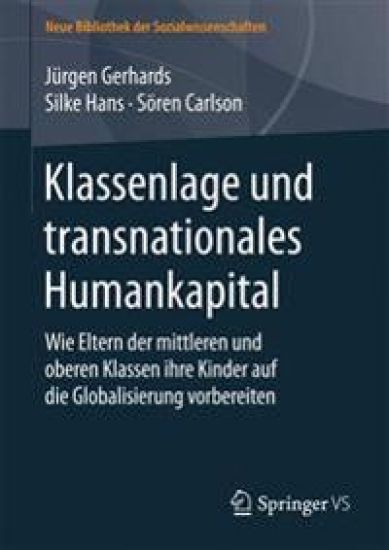
Klassenlage und transnationales Humankapital

Klassenlage und transnationales Humankapital

Jürgen Gerhards; Silke Hans; Sören Carlson

Springer vs
2016
sidottu
Fremdsprachenkenntnisse, interkulturelle Kompetenzen und ein kosmopolitischer Habituswerden im Kontext von Globalisierungsprozessen immer bedeutsamer. Die Autoren der Studiezeigen, dass der frühe Erwerb von transnationalem Humankapital durch den Besuch einesbilingualen Kindergartens oder ein Auslandsjahr als Schüler von der sozialen Klassenlage der Eltern abhängig ist. Mit Bezugnahme auf die Arbeiten Pierre Bourdieus und auf der Grundlage von quantitativen Daten einerseits und einer dichten qualitativen Beschreibung andererseits beschreiben sie, wie die Eltern der oberen und mittleren Klassen ihre Kinder systematisch auf eine globalisierte Welt vorbereiten, neue Distinktionsgewinne erzielen und damit neue soziale Ungleichheiten produzieren.
European Citizenship and Social Integration in the European Union
Since 2008, the European Union has been affected by one of the most severe crises in the history of Europe. This book builds on the work of Jürgen Habermas to answer the key question: is Europe strong enough to overcome the recent crisis? Arguing that recovery can only take place if the citizens of Europe regard themselves as members of a socially integrated European society, this volume sets out three conditions for successful European social integration: European citizens mutually respect each other as equals, accepting that all EU citizens should have equal economic, political and social rights. Those citizens objecting to the idea of European equality should not constitute a minority with potential for mobilisation that could impede the ongoing process of European social integration. Europeans act upon their equality beliefs in everyday practice – without differentiating between nationals and EU migrants. Based on a survey carried out in Germany, Spain, Poland and Turkey, the authors argue that the requirements for a socially integrated Europe are largely in place already. Their findings allow for optimism regarding the future of the EU, as the cultural foundations for a democratisation of Europe are laid. This volume develops a theoretical framework of a socially integrated European community, and will be useful for students and scholars of sociology, citizenship studies, social policy, political science and European studies.
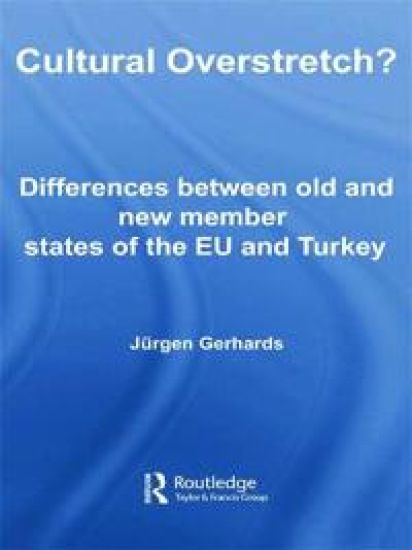
Cultural Overstretch?

Cultural Overstretch?

Jurgen Gerhards

Routledge
2014
nidottu
Within a few years the European Union will be enlarged from fifteen to twenty-eight member states, including Turkey. Cultural Overstretch investigates whether the new countries culturally fit into the European Union. Interpreting the European treaties and the European Law, Gerhards describes in a first step what he calls 'The value script of the European Union'. Using survey data from twenty-eight countries the author examines in a second step whether citizens support the value script of the European Union and whether there are significant differences between old and new member states and candidate countries. The book also highlights cultural differences by referring to modernization theory and forecasts in the concluding chapter the political consequences of a possible cultural overstretch of the European Union.
Wir, ein europäisches Volk?

Wir, ein europäisches Volk?

Jürgen Gerhards; Holger Lengfeld

Springer vs
2013
sidottu
? Die Eurokrise ist eine der schwersten Krisen der EU seit ihrer Gründung. Bei ihrer Lösung geht es nicht allein um den Erfolg von konkreten wirtschaftspolitischen Maßnahmen, sondern um den Zusammenhalt zwischen den Bürgern der verschiedenen Mitgliedsländer. Jürgen Gerhards und Holger Lengfeld entwickeln ein Konzept einer sozial integrierten europäischen Gesellschaft, das auf der Annahme beruht, dass sich die EU-Bürger unabhängig von ihrer jeweils konkreten nationalen Herkunft als Gleiche anerkennen. Anhand von Daten einer Umfrage aus vier Ländern prüfen sie, in welchem Maße die Europäer diese Idee einer europäisierten Chancengleichheit unterstützen oder ob sie weiterhin einem nationalstaatlich geschlossenen Gleichheitskonzept anhängen. Die empirischen Befunde der Studie stimmen optimistisch: Die kulturellen Grundlagen für ein sozial integriertes Europa scheinen gegeben zu sein, da sich die Bürger der Europäischen Union in hohem Maße als Gleiche anerkennen, sich kaum gesellschaftliche Konfliktlinien um die Zubilligung gleicher Rechte für Bürger aus anderen EU-Ländern zeigen und die Menschen sich auch in der Alltagspraxis weitgehend an diesen Werten orientieren.
Terrorismus im Fernsehen

Terrorismus im Fernsehen

Jürgen Gerhards; Mike S. Schäfer; Ishtar Al Jabiri; Juliane Seifert

Vs Verlag Fur Sozialwissenschaften
2011
nidottu
Ohne die Berichterstattung der Massenmedien würden die meisten Menschen kaum etwas über terroristische Anschläge erfahren. Allerdings können Medien derartige Anschläge sehr unterschiedlich darstellen. Die Studie vergleicht die Terrorismusberichterstattung von fünf Fernsehsendern aus unterschiedlichen Ländern und Weltregionen: CNN, Al Jazeera, BBC, ARD und RTL. Untersucht werden die Formate der Berichterstattung, die inhaltlichen Deutungen der Anschläge und die damit verbundenen Emotionsdarstellungen. Vorgefundene Unterschiede und Gemeinsamkeiten werden u.a. mit Hilfe von Globalisierungstheorien und Theorien kultureller Unterschiede interpretiert.
Die Moderne und ihre Vornamen

Die Moderne und ihre Vornamen

Jürgen Gerhards

Springer Fachmedien Wiesbaden
2010
nidottu
Die Studie versteht sich sowohl als eine empirische Analyse kultureller Modernisierungsprozesse am Beispiel der Entwicklung von Vornamen, als auch als eine Einführung in die Kultursoziologie, die sich kritisch mit den Prämissen des "cultural turn" auseinandersetzt und stattdessen auf klassische Theorien und Methoden der Soziologie zurückgreift. Am Beispiel der Vergabe von Vornamen lassen sich kulturelle Modernisierungsprozesse empirisch beschreiben und strukturell erklären: Die traditionellen Ligaturen Familie, Religion und Bindung an die Nation verlieren im Zeitverlauf in der Strukturierung der Vergabe von Vornamen an Bedeutung; Prozesse der Individualisierung und der Globalisierung gewinnen stattdessen an Relevanz.
Cultural Overstretch?

Cultural Overstretch?

Jurgen Gerhards

Routledge
2007
sidottu
Within a few years the European Union will be enlarged from fifteen to twenty-eight member states, including Turkey. Cultural Overstretch investigates whether the new countries culturally fit into the European Union. Interpreting the European treaties and the European Law, Gerhards describes in a first step what he calls 'The value script of the European Union'. Using survey data from twenty-eight countries the author examines in a second step whether citizens support the value script of the European Union and whether there are significant differences between old and new member states and candidate countries. The book also highlights cultural differences by referring to modernization theory and forecasts in the concluding chapter the political consequences of a possible cultural overstretch of the European Union.
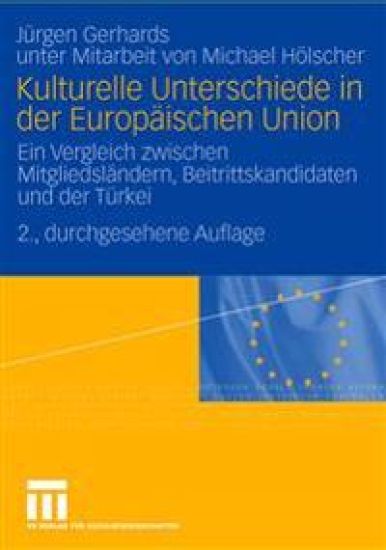
Kulturelle Unterschiede in der Europäischen Union

Kulturelle Unterschiede in der Europäischen Union

Jürgen Gerhards

VS Verlag fur Sozialwissenschaften
2006
nidottu
Die Europäische Union hat sich inneralb von wenigen Jahren von 15 auf 25 Mitgliedsländer erweitert und wird die Anzahl der Länder in den nächsten Jahren weiter ausdehnen. Passen die neuen Länder kulturell zum Selbstverständnis der EU oder führt die Erweiterung zu einer kulturellen Überdehnung? Die Untersuchung beschreibt auf der Basis der Auswertung von Umfragedaten die kulturellen Unterschiede zwischen den Ländern und versucht, die Unterschiede in den Werteorientierungen der Bürger zu erklären.
Die Herstellung einer öffentlichen Hegemonie

Die Herstellung einer öffentlichen Hegemonie

Jürgen Gerhards; Mike S. Schäfer

Vs Verlag Fur Sozialwissenschaften
2006
nidottu
Biowissenschaftliche Forschungen und deren Anwendung waren in den vergangenen Jahren häufig Gegenstand öffentlicher Auseinandersetzungen. Der Ausgang dieser Debatten hat die Entwicklung der Wissenschaft entscheidend beeinflusst. Die Untersuchung zeigt am Beispiel der öffentlichen Diskurse über die Sequenzierung des menschlichen Erbguts in Deutschland und den USA, wie es den Befürwortern dieser Forschung gelungen ist, eine öffentliche Hegemonie herzustellen: Die öffentliche Debatte wird in beiden Ländern dominiert von wissenschaftlichen Akteuren, die das Projekt der "Entschlüsselung" des menschlichen Erbguts in erster Linie positiv bewerten. Wissenschaftliche und medizinische Deutungen und die damit verbundenen Heilsversprechen dominieren den Diskurs und erzeugen die nötige Legitimation. Dieser Befund gilt gleichermaßen für Deutschland und die USA, aber auch für drei weitere Länder (Österreich, Großbritannien und Frankreich) und die Debatte im Internet, so dass man von der Herstellung einer transnationalen öffentlichen Hegemonie sprechen kann.
Shaping Abortion Discourse

Shaping Abortion Discourse

Myra Marx Ferree; William Anthony Gamson; Jürgen Gerhards; Dieter Rucht

Cambridge University Press
2002
sidottu
Using controversy over abortion as a lens through which to compare the political process and role of the media in these two very different democracies, this book examines the contest over meaning that is being waged by social movements, political parties, churches and other social actors. Abortion is a critical battleground for debates over social values in both countries, but the constitutional premises on which arguments rest differ, as do the strategies that movements and parties adopt and the opportunities for influence that are open to them. By examining how these debates are conducted and by whom in light of the normative claims made by democratic theorists, the book also offers a means of judging how well either country lives up to the ideals of democratic debate in practice.
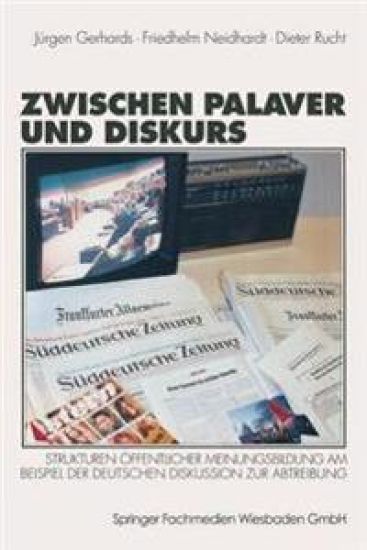
Zwischen Palaver und Diskurs

Zwischen Palaver und Diskurs

Jürgen Gerhards; Friedhelm Neidhardt; Dieter Rucht

VS Verlag fur Sozialwissenschaften
1998
nidottu
Liberale und deliberative Modelle politischer Öffentlichkeit formulieren unterschiedliche Gütekriterien im Hinblick auf die Zwecke und die Bedingungen öffentlicher Kommunikation. Auf der Basis einer systematischen Inhaltsanalyse von zwei Tageszeitungen und einer Befragung von kollektiven Akteuren prüfen die Autoren am Beispiel der Abtreibungsdebatte und in welchem Maße die Öffentlichkeit der Bundesrepublik den Normvorstellungen liberaler oder deliberativer Modelle nahekommt. Darüber hinaus formulieren und prüfen sie Erklärungen für ihre deskriptiven Befunde: Aufgrund welcher Bedingungen werden Erwartungen an Öffentlichkeit und öffentliche Meinungsbildung tatsächlich erfüllt oder nicht erfüllt? Welche Besonderheiten öffentlicher Kommunikation bestimmen die Auswahl der Akteure, die zu Wort kommen, das Diskursniveau ihrer Argumente und die Qualitäten dessen, was "öffentliche Meinung" darstellt?
Neue Konfliktlinien in der Mobilisierung öffentlicher Meinung

Neue Konfliktlinien in der Mobilisierung öffentlicher Meinung

Jürgen Gerhards

VS Verlag fur Sozialwissenschaften
1993
nidottu
Wie werden Themen zu öffentlich diskutierten Themen? Welche Strukturbedingungen und welche Deutungsmuster sind für eine Mobilisierung von Öffentlichkeit bedeutsam? Im ersten Teil dieses Buches wird ein theoretisches Modell öffentlicher Meinungsbildung entwickelt, das eine systemtheoretische Bestimmung von Öffentlichkeit als ein intermediäres System mit der Theorie sozialer Konfliktlinien verbindet. Dieses theoretische Modell wird dann am Beispiel des öffentlichen Diskurses über die IWF-Tagung in Berlin 1988 in Form einer Mehrebenenanalyse plausibilisiert. Dazu werden verschiedene empirische Analysen (quantivative Inhaltsanalyse der Medienberichterstattung, Auswertung von Bevölkerungsumfragen, Diskursanalyse von Flugblättern und parlamentarischen Protokollen u. a.) miteinander in Beziehung gesetzt.