Kirjojen hintavertailu – 12 903 725 kirjaa ja 27 kauppaa
Kirjailija
Justin E.H. Smith
Kirjat ja teokset yhdessä paikassa: 3 kirjaa, julkaisuja vuosilta 2017–2023, suosituimpiin kuuluu Liberties Journal of Culture and Politics. Vertaile teosten hintoja ja tarkista saatavuus suomalaisista kirjakaupoista.
Michael Ignatieff; Mary Gaitskill; Sergei Lebedev; Antonia Bouis; Karen Solie; Michael Walzer; David A. Bell; Justin E.H. Smith; Michael C. Kimmage; Andrew Scull; Robert Alter; Steven B. Smith; Benjamin Moser; Helen Vendler; John Hodgen; Adam Zagajewski
Liberties, a Journal of Culture and Politics, is essential reading for those engaged in the cultural and political issues of our time. In this issue of Liberties: Michael Ignatieff - The Mind’s Emancipation; Mary Gaitskill - The Trials of the Young; Sergei Lebedev - Putin’s Philosopher: A Memoir; Michael Walzer - Moral Concern; Justin E. H. Smith – The Happiness Industrial Complex; Andrew Scull – The Fashions in Trauma; David A. Bell – The Triumph of Anti-Politics in America; Michael Kimmage – A Defense of Delight in a Dark Time; Robert Alter – Proust and the Mystification of the Jews; Steven B. Smith – What is a Statesman?; Benjamin Moser – Rembrandt’s shadows; Helen Vendler – The Poetry of Charm; Celeste Marcus – Priorism, or the Joshua Katz Affair; Leon Wieseltier – Problems and Struggles; and, new poems by Karen Solie, Adam Zagajewski, and John Hodgen. Published quarterly, Liberties, is a collection of the most significant writers today as well as launching the voices of tomorrow. Liberties features serious, independent, stylish, and controversial essays by significant writers and introduces the next generation of writers and poets to inspire and impact the intellectual and creative lifeblood of today’s culture and politics. Nobel Prize winners, leading op-ed writers, well-known non-fiction writers, rising talents, and poets from around the world are part of the Liberties series. There’s a reason why engaged citizens, cultural warriors, political leaders, opinion makers, and activists from across the cultural and political spectrum read and cherish Liberties.
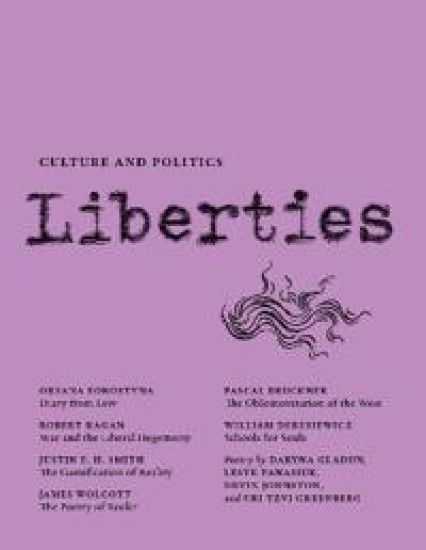
“A Meteor of Intelligent Substance” “Something was Missing in our Culture, and Here It Is” "Liberties is THE place to be.” Liberties, a journal of Culture and Politics, is essential reading for those engaged in the cultural and political issues and causes of our time. Liberties features serious, independent, stylish, and controversial essays by significant writers throughout the world; new poetry; and, introduces the next generation of writers and voices to inspire and impact the intellectual and creative lifeblood of today’s culture and politics. In this edition of Liberties: Oksana Forostyna’s A Diary from Lviv Robert Kagan argues All Wars are Wars of Choice Justin E. H. Smith grapples with The Gamification of Reality James Wolcott questions The Poetry of Rock Pascal Bruckner sees The Oblomovization of the West William Deresiewicz on higher education’s Schools for Souls Jaroslaw Anders writes An Open Letter to an Enemy in My Native Land Elliot Ackerman reveals The Politicization of the American Military Jonathan Baskin on Sheila Heti and the Fight for Art A Conversation About Modern History betweenIsaiah Berlin and Adam Michnik David Thomson goes back to Chinatown with Roman Polanski and John Huston Helen Vendler reads John Donne for How to Talk to God Celeste Marcus on Why Women Mortify Themselves Leon Wieseltier on Ukraine and Us And poetry from Valzhyna Mort, Daryna Gladun, Lesyk Panasiuk, Uri Tzvi Greenberg, Henri Cole, Claire Malroux, La Fontaine, and Devin Johnston
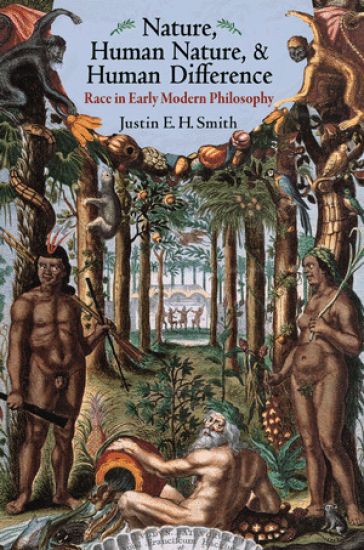
People have always been xenophobic, but an explicit philosophical and scientific view of human racial difference only began to emerge during the modern period. Why and how did this happen? Surveying a range of philosophical and natural-scientific texts, dating from the Spanish Renaissance to the German Enlightenment, Nature, Human Nature, and Human Difference charts the evolution of the modern concept of race and shows that natural philosophy, particularly efforts to taxonomize and to order nature, played a crucial role. Smith demonstrates how the denial of moral equality between Europeans and non-Europeans resulted from converging philosophical and scientific developments, including a declining belief in human nature's universality and the rise of biological classification. The racial typing of human beings grew from the need to understand humanity within an all-encompassing system of nature, alongside plants, minerals, primates, and other animals. While racial difference as seen through science did not arise in order to justify the enslavement of people, it became a rationalization and buttress for the practices of trans-Atlantic slavery. From the work of Francois Bernier to G. W. Leibniz, Immanuel Kant, and others, Smith delves into philosophy's part in the legacy and damages of modern racism. With a broad narrative stretching over two centuries, Nature, Human Nature, and Human Difference takes a critical historical look at how the racial categories that we divide ourselves into came into being.