Kirjojen hintavertailu – 12 903 725 kirjaa ja 27 kauppaa

Kirjailija

Justin Martyr

Kirjat ja teokset yhdessä paikassa: 19 kirjaa, julkaisuja vuosilta 2003–2024, suosituimpiin kuuluu Dialogue with Trypho. Vertaile teosten hintoja ja tarkista saatavuus suomalaisista kirjakaupoista.

19 kirjaa

Kirjojen julkaisuvuodet: 2003–2024.

Justin Martyr

Justin Martyr

Justin Martyr

Lighthouse Publishing
2022
pokkari
Do not suppose, ye Greeks, that my separation from your customs is unreasonable and unthinking; for I found in them nothing that is holy or acceptable to God. For the very compositions of your poets are monuments of madness and intemperance. For anyone who becomes the scholar of your most eminent instructor, is more beset by difficulties than all men besides. For first they say that Agamemnon, abetting the extravagant lust of his brother, and his madness and unrestrained desire, readily gave even his daughter to be sacrificed and troubled all Greece that he might rescue Helen, who had been ravished by the leprous shepherd. But when in the course of the war they took captives, Agamemnon was himself taken captive by Chryseis, and for Briseis' sake kindled a feud with the son of Thetis. And Pelides himself, who crossed the river, overthrew Troy and subdued Hector, this your hero became the slave of Polyxena, and was conquered by a dead Amazon, and putting off the god-fabricated armor, and donning the hymeneal robe, he became a sacrifice of love in the temple of Apollo. And the Ithacan Ulysses made a virtue of a vice. And indeed his sailing past the Sirens gave evidence that he was destitute of worthy prudence because he could not depend on his prudence for stopping his ears. Ajax, son of Telamon, who bore the shield of sevenfold ox-hide, went mad when he was defeated in the contest with Ulysses for the armor. Such things I have no desire to be instructed in. Of such virtue, I am not covetous, that I should believe the myths of Homer.

Justin Martyr's Dialogue With Trypho the Jew. Translated From the Greek Into English, With Notes, Chiefly for the Advantage of English Readers, a Preliminary Dissertation, and a Short Analysis. By Henry Brown, ... of 2; Volume 2
The 18th century was a wealth of knowledge, exploration and rapidly growing technology and expanding record-keeping made possible by advances in the printing press. In its determination to preserve the century of revolution, Gale initiated a revolution of its own: digitization of epic proportions to preserve these invaluable works in the largest archive of its kind. Now for the first time these high-quality digital copies of original 18th century manuscripts are available in print, making them highly accessible to libraries, undergraduate students, and independent scholars. The Age of Enlightenment profoundly enriched religious and philosophical understanding and continues to influence present-day thinking. Works collected here include masterpieces by David Hume, Immanuel Kant, and Jean-Jacques Rousseau, as well as religious sermons and moral debates on the issues of the day, such as the slave trade. The Age of Reason saw conflict between Protestantism and Catholicism transformed into one between faith and logic -- a debate that continues in the twenty-first century.++++The below data was compiled from various identification fields in the bibliographic record of this title. This data is provided as an additional tool in helping to insure edition identification: ++++William Andrews Clark Memorial Library (UCLA)N007929A translation of 'Dialogus cum Tryphone'. Oxford: printed for the editor, by W. Jackson. And sold by Mess. Rivington, London; J. Fletcher, Oxford; J. Merril in Cambridge; and Mess. Martin and Gregory, in Leicester, 1755. 2v.; 8
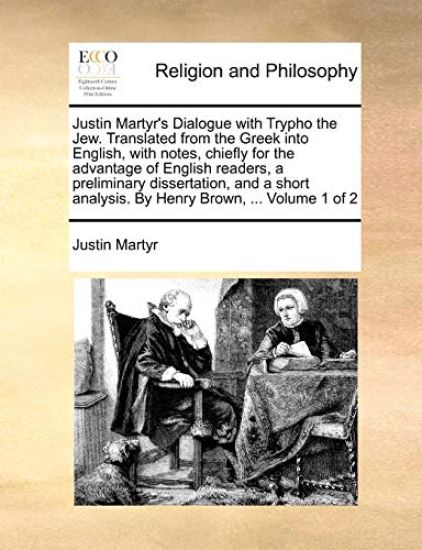
Justin Martyr's Dialogue With Trypho the Jew. Translated From the Greek Into English, With Notes, Chiefly for the Advantage of English Readers, a Preliminary Dissertation, and a Short Analysis. By Henry Brown, ... of 2; Volume 1
The 18th century was a wealth of knowledge, exploration and rapidly growing technology and expanding record-keeping made possible by advances in the printing press. In its determination to preserve the century of revolution, Gale initiated a revolution of its own: digitization of epic proportions to preserve these invaluable works in the largest archive of its kind. Now for the first time these high-quality digital copies of original 18th century manuscripts are available in print, making them highly accessible to libraries, undergraduate students, and independent scholars. The Age of Enlightenment profoundly enriched religious and philosophical understanding and continues to influence present-day thinking. Works collected here include masterpieces by David Hume, Immanuel Kant, and Jean-Jacques Rousseau, as well as religious sermons and moral debates on the issues of the day, such as the slave trade. The Age of Reason saw conflict between Protestantism and Catholicism transformed into one between faith and logic -- a debate that continues in the twenty-first century.++++The below data was compiled from various identification fields in the bibliographic record of this title. This data is provided as an additional tool in helping to insure edition identification: ++++William Andrews Clark Memorial Library (UCLA)N007929A translation of 'Dialogus cum Tryphone'. Oxford: printed for the editor, by W. Jackson. And sold by Mess. Rivington, London; J. Fletcher, Oxford; J. Merril in Cambridge; and Mess. Martin and Gregory, in Leicester, 1755. 2v.; 8
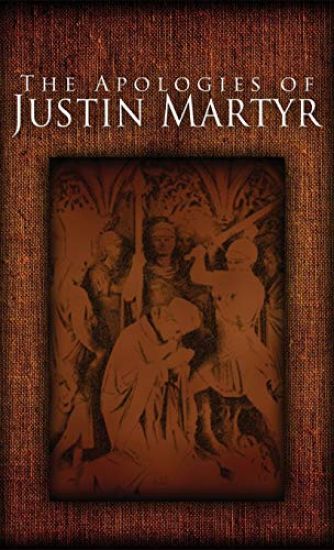
The First Apology, The Second Apology, Dialogue with Trypho, Exhortation to the Greeks, Discourse to the Greeks, The Monarchy of the Rule of God
St. Justin Martyr is known as the outstanding apologist of the second century. While the Apostolic Fathers like St. Clement of Rome, St. Ignatius of Antioch, and St. Polycarp had addressed members within the Christian fold, St. Justin is considered to be the first prominent defender of the Christian faith against non-Christians and the enemies of the Church. The chief sources for the uncertain and meager chronological data of Justin's life are his own writings, the two Apologies and the Dialogue with Trypho. The circumstances leading up to his conversion are recorded in the first eight chapters of the Dialogue, and the events surrounding his death are reported in the Acta SS. Justini et Sociorum, an authentic source of the latter part of the second century. Historians place his birth in the beginning of the second century (ca. 100-110 A. D.) at Flavia Neapolis (today Nablus) in Samaria. Although St. Epiphanius calls him a Samaritan, and he himself refers to his people as Samarians, Justin was not Jewish in either race or religion. His family was rather of pagan and Greco-Roman anscestry. They had come as colonists to Flavia Neapolis during the reign of Titus (79-81 A. D.), the son of Flavius Vespasian (69-79), who had built this city and had granted its inhabitants the privileges of Roman citizens. Obviously, the parents of Justin had considerable means and could afford to give their son an excellent education in the pagan culture of the day. Young Justin had a keen mind, was inquisitive by nature and endowed with a burning thirst for learning. He tried to broaden his knowledge further by extensive travels. Driven by an inner urge and a profound inclination for philosophy, he subsequently frequented the schools of the Stoics, the Peripatetics, the Pythagoreans, and the Platonists. He set out to reach the truth; to gain a perfect knowledge of God was his greatest and only ambition. Dissatisfied with the Stoics and Peripatetics, he tells us of finding temporary peace in the philosophy of the Platonists: 'the perception of incorporeal things quite overwhelmed me and the Platonic theory of ideas added wings to my mind, so that in a short time I imagined myself a wise man. So great was my folly that I fully expected immediately to gaze upon God.'
Dialogue with Trypho

Dialogue with Trypho

Justin Martyr

The Catholic University of America Press
2003
nidottu

Halvin toimitettuna 32,70 €

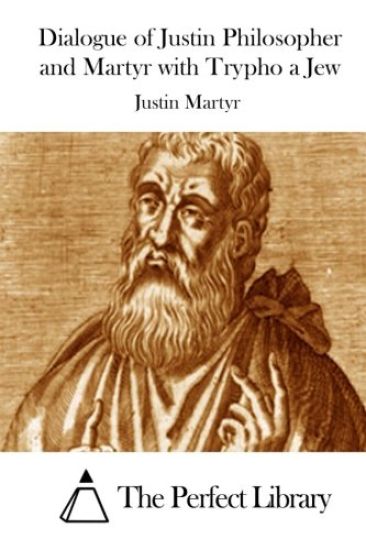
Outside the New Testament, our earliest complete witness to Christian apologetic against the Jews remains the ""Dialogue with Trypho"", written by Justin Martyr (circa 165), a convert to Christianity from traditional Greek religion. The ""Dialogue"" purports to be a two-day dialogue that took place in Asia Minor between Justin and Trypho, a Hellenized Jew. Justin argues extensively on the basis of lengthy Old Testament quotations that Christ is the Messiah and God incarnate, and that the Christian community is the new Israel. In the beginning of the work Justin recounts how he converted to Christianity. The ""Dialogue"" remains of great, and varying, interest. It has important information on the development of Jewish-Christian relations, on the development of the text of the New Testament, and on the existence and character of the early Jewish Christian community. Justin's story of how he became a Christian is one of our early conversion accounts. The ""Dialogue"" is a useful textbook for classes investigating the development of religion in Late Antiquity since it touches on many aspects of religion in the Roman Empire. This edition of the ""Dialogue with Trypho"" is a revision of Thomas B. Fall's translation, which appeared in ""Fathers of the Church"", volume 6. Thomas P. Halton has amended the translation in light of the 1997 critical edition by Miroslav Marcovich, and has provided extensive annotation to recent scholarship on the ""Dialogue"". Michael Slusser has edited the volume to bring it into conformity with the new selection from the ""Fathers of the Church"" series.