Kirjojen hintavertailu – 12 903 725 kirjaa ja 27 kauppaa

Kirjailija

Juval Portugali

Kirjat ja teokset yhdessä paikassa: 10 kirjaa, julkaisuja vuosilta 1992–2025, suosituimpiin kuuluu Synergetic Cities: Information, Steady State and Phase Transition. Vertaile teosten hintoja ja tarkista saatavuus suomalaisista kirjakaupoista.

10 kirjaa

Kirjojen julkaisuvuodet: 1992–2025.

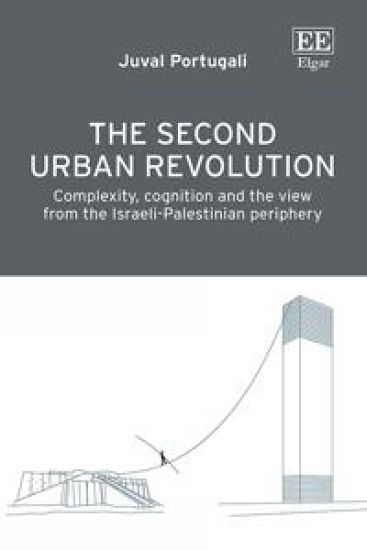
The Second Urban Revolution

The Second Urban Revolution

Juval Portugali

EDWARD ELGAR PUBLISHING LTD
2025
sidottu
In this timely book, Juval Portugali ties together ancient archaeology with the present to explore the city as a phenomenon that has been rapidly increasing in power and importance since its earliest emergence. He links the walled cities of ancient civilization with modern-day borderless cities, while providing connections between modern nationalism and postmodern urbanism. With a specific focus on two urban revolutions, the first emergence of the city 5,500 years ago and the urban revolution we are currently undergoing, Portugali analyzes the shift to a global population residing predominantly in urban environments. He examines these two urban revolutions from the perspective of the Israeli-Palestinian periphery, in terms of complex-cognitive, self-organized systems. Ultimately, the book addresses how urbanism is becoming the driving force behind human life and consciousness for the first time in history and expresses a new theory of ancient and modern urbanism oriented around socio-spatial evolution. Investigating the interrelation between complexity theory and cognitive theory – and their connection to the city – this book is an enlightening read for scholars and students of urban studies, human geography, political geography and geopolitics, and urban economics. It is also a crucial resource for those researching cities and complexity.
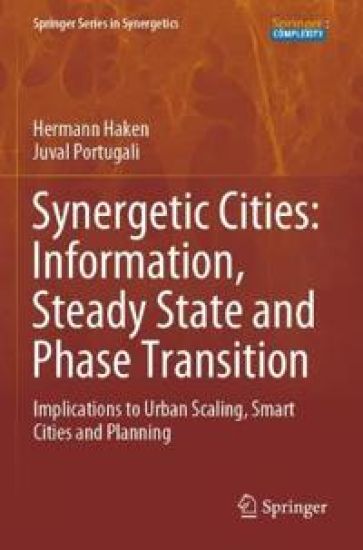
Synergetic Cities: Information, Steady State and Phase Transition

Synergetic Cities: Information, Steady State and Phase Transition

Hermann Haken; Juval Portugali

Springer Nature Switzerland AG
2022
nidottu
The book offers a novel approach to the study of the complex dynamics of cities. It is based on (1) Synergetics as a science of cooperation and selforganization, (2) information theory including semantic and pragmatic aspects, and optimization principles, (3) a theory of steady state maintenance, and of (4) phase transition, i.e. qualitative changes of structure or behavior. From this novel theoretical vantage point, the book addresses particularly three issues that stand at the core of current discourse on cities: Urban Scaling, Smart Cities and City Planning. An important consequence of “the 21st century as the age of cities”, is that the study of cities currently attracts scientists from a variety of disciplines, ranging from physics, mathematics and computer science, through urban studies, architecture, planning and human geography, to economics, psychology, sociology, public administration and more. The book is thus likely to attract scholars, researchers andstudents of these research domains, of complexity theories of cities, as well as of general complexity theory. In addition, it is directed also to practitioners of urbanism, city planning and urban design.
Synergetic Cities: Information, Steady State and Phase Transition

Synergetic Cities: Information, Steady State and Phase Transition

Hermann Haken; Juval Portugali

Springer Nature Switzerland AG
2021
sidottu
The book offers a novel approach to the study of the complex dynamics of cities. It is based on (1) Synergetics as a science of cooperation and selforganization, (2) information theory including semantic and pragmatic aspects, and optimization principles, (3) a theory of steady state maintenance, and of (4) phase transition, i.e. qualitative changes of structure or behavior. From this novel theoretical vantage point, the book addresses particularly three issues that stand at the core of current discourse on cities: Urban Scaling, Smart Cities and City Planning. An important consequence of “the 21st century as the age of cities”, is that the study of cities currently attracts scientists from a variety of disciplines, ranging from physics, mathematics and computer science, through urban studies, architecture, planning and human geography, to economics, psychology, sociology, public administration and more. The book is thus likely to attract scholars, researchers andstudents of these research domains, of complexity theories of cities, as well as of general complexity theory. In addition, it is directed also to practitioners of urbanism, city planning and urban design.
Information Adaptation: The Interplay Between Shannon Information and Semantic Information in Cognition
This monograph demonstrates the interplay between Shannon information and semantic information in cognition. It shows that Shannon’s information acts as driving force for the formation of semantic information; and vice versa, namely, that semantic information participates in the formation of Shannonian information. The authors show that in cognition, Shannonian and semantic information are interrelated as two aspects of a cognitive process termed as information adaptation. In the latter the mind/brain adapts to the environment by the deflating and/or inflating of the information conveyed by the environment. In the process of information adaptation, quantitative variations in Shannon’s information entail different meanings while different meanings affect the quantity of information. The book illustrates the above conceptually and mathematically by reference to three cognitive processes: pattern recognition, face learning and the recognition of a moving object.
Complexity, Cognition and the City

Complexity, Cognition and the City

Juval Portugali

Springer-Verlag Berlin and Heidelberg GmbH Co. K
2013
nidottu
Complexity, Cognition and the City aims at a deeper understanding of urbanism, while invoking, on an equal footing, the contributions both the hard and soft sciences have made, and are still making, when grappling with the many issues and facets of regional planning and dynamics. In this work, the author goes beyond merely seeing the city as a self-organized, emerging pattern of some collective interaction between many stylized urban "agents" – he makes the crucial step of attributing cognition to his agents and thus raises, for the first time, the question on how to deal with a complex system composed of many interacting complex agents in clearly defined settings. Accordingly, the author eventually addresses issues of practical relevance for urban planners and decision makers. The book unfolds its message in a largely nontechnical manner, so as to provide a broad interdisciplinary readership with insights, ideas, and other stimuli to encourage further research – with the twofold aim of further pushing back the boundaries of complexity science and emphasizing the all-important interrelation of hard and soft sciences in recognizing the cognitive sciences as another necessary ingredient for meaningful urban studies.
Complexity, Cognition and the City

Complexity, Cognition and the City

Juval Portugali

Springer-Verlag Berlin and Heidelberg GmbH Co. K
2011
sidottu
Complexity, Cognition and the City aims at a deeper understanding of urbanism, while invoking, on an equal footing, the contributions both the hard and soft sciences have made, and are still making, when grappling with the many issues and facets of regional planning and dynamics. In this work, the author goes beyond merely seeing the city as a self-organized, emerging pattern of some collective interaction between many stylized urban "agents" – he makes the crucial step of attributing cognition to his agents and thus raises, for the first time, the question on how to deal with a complex system composed of many interacting complex agents in clearly defined settings. Accordingly, the author eventually addresses issues of practical relevance for urban planners and decision makers. The book unfolds its message in a largely nontechnical manner, so as to provide a broad interdisciplinary readership with insights, ideas, and other stimuli to encourage further research – with the twofold aim of further pushing back the boundaries of complexity science and emphasizing the all-important interrelation of hard and soft sciences in recognizing the cognitive sciences as another necessary ingredient for meaningful urban studies.
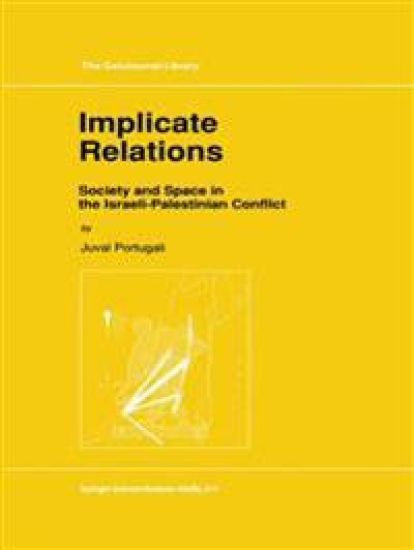
Implicate Relations

Implicate Relations

Juval Portugali

Springer
2010
nidottu
In his beautiful booklnvisible eities Italo Calvino writes about the two cities ofValdrada, the one which lies on the shores of a lake, and the other which is reflected in the lake and contains not only the exterior of Valdrada on the shores, but also its interior, and probably its inhabitants. "Valdrada's inhabitants know", writes Calvino, "that each of their actions is, at once, that action and its mirror image . . . and this awareness prevents them from succumbing for a single moment to chance and forgetfulness". Such mirror­ image relations are characteristic of the Israeli-Palestinian relations, and the awareness of this property is, to my mind, one of the most dominant experiences in being 'an Israeli. As an Israeli I can testify that Palestinianism is a permanent resident in the personal and collective consciousness of Israelis, and I have good grounds to suppose that Zionism plays a similar role in the personal and collective consciousness of Palestinians. The Israeli-Palestinian conflict is thus not only political, but also very personal, and the account I present below is no exception. It is my personal, and in this respect Israeli, perspective of the conflict between Israelis and Palestinians, with no pretension to a value-free and objective science.
Self-Organization and the City

Self-Organization and the City

Juval Portugali; H. Haken

Springer-Verlag Berlin and Heidelberg GmbH Co. K
2010
nidottu
Cities first came into existence more than five thousand years ago. How to deal with these partly fascinating, partly frightening creatures of mankind, both practically and intellectually, concerns all of us and, in particular, presents areal challenge to city planners. Each historical epoch has had its own par­ ticular attitudes associated with the "Zeitgeist". Accordingly, the planning and steering of cities were based on quite different criteria. But in spite of these differences, the concept of planning and steering was, and still is, the cornerstone of our dealing with cities. Nevertheless, the planner's dilemma is becoming more and more visible: cities and megacities seem to be un­ plannable. In this book, Juval Portugali intro duces a new idea: Cities are self­ organizing systems. To substantiate his revolutionary concept, he uses several interlinked methods. On the one hand, and to my own delight, he employs in his arguments theoretical tools developed in the interdisciplinary field of synergetics. On the other hand, jointly with his co-workers, he has performed detailed model calculations on cellular nets. It has been a great pleasure and a wonderful experience for me to discuss these concepts with Juval Portugali over a number of years. I was repeatedly and deeply impressed by the way he established profound and often surprising links to other fields of science.
Self-Organization and the City

Self-Organization and the City

Juval Portugali; H. Haken

Springer-Verlag Berlin and Heidelberg GmbH Co. K
1999
sidottu
Cities first came into existence more than five thousand years ago. How to deal with these partly fascinating, partly frightening creatures of mankind, both practically and intellectually, concerns all of us and, in particular, presents areal challenge to city planners. Each historical epoch has had its own par­ ticular attitudes associated with the "Zeitgeist". Accordingly, the planning and steering of cities were based on quite different criteria. But in spite of these differences, the concept of planning and steering was, and still is, the cornerstone of our dealing with cities. Nevertheless, the planner's dilemma is becoming more and more visible: cities and megacities seem to be un­ plannable. In this book, Juval Portugali intro duces a new idea: Cities are self­ organizing systems. To substantiate his revolutionary concept, he uses several interlinked methods. On the one hand, and to my own delight, he employs in his arguments theoretical tools developed in the interdisciplinary field of synergetics. On the other hand, jointly with his co-workers, he has performed detailed model calculations on cellular nets. It has been a great pleasure and a wonderful experience for me to discuss these concepts with Juval Portugali over a number of years. I was repeatedly and deeply impressed by the way he established profound and often surprising links to other fields of science.
Implicate Relations

Implicate Relations

Juval Portugali

Springer
1992
sidottu
In his beautiful booklnvisible eities Italo Calvino writes about the two cities ofValdrada, the one which lies on the shores of a lake, and the other which is reflected in the lake and contains not only the exterior of Valdrada on the shores, but also its interior, and probably its inhabitants. "Valdrada's inhabitants know", writes Calvino, "that each of their actions is, at once, that action and its mirror image . . . and this awareness prevents them from succumbing for a single moment to chance and forgetfulness". Such mirror­ image relations are characteristic of the Israeli-Palestinian relations, and the awareness of this property is, to my mind, one of the most dominant experiences in being 'an Israeli. As an Israeli I can testify that Palestinianism is a permanent resident in the personal and collective consciousness of Israelis, and I have good grounds to suppose that Zionism plays a similar role in the personal and collective consciousness of Palestinians. The Israeli-Palestinian conflict is thus not only political, but also very personal, and the account I present below is no exception. It is my personal, and in this respect Israeli, perspective of the conflict between Israelis and Palestinians, with no pretension to a value-free and objective science.