Kirjojen hintavertailu – 12 903 725 kirjaa ja 27 kauppaa

Kirjailija

Juvenal

Kirjat ja teokset yhdessä paikassa: 87 kirjaa, julkaisuja vuosilta 1960–2025, suosituimpiin kuuluu Traduction des satyres de Perse, et de Juvenal. Vertaile teosten hintoja ja tarkista saatavuus suomalaisista kirjakaupoista.

Nimi esiintyy myös muodoissa: Juvénal

87 kirjaa

Kirjojen julkaisuvuodet: 1960–2025.

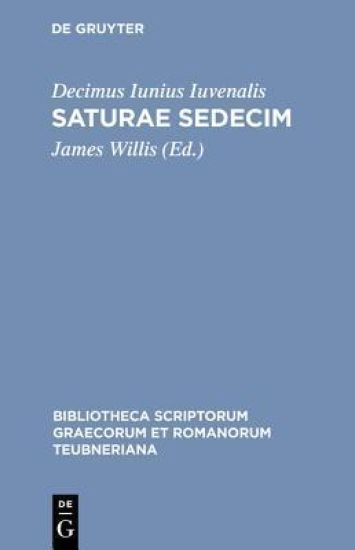
Saturae

Saturae

Juvenal

The University of Michigan Press
1998
sidottu
The Bibliotheca Teubneriana, established in 1849, has evolved into the world's most venerable and extensive series of editions of Greek and Latin literature, ranging from classical to Neo-Latin texts. Some 4-5 new editions are published every year. A team of renowned scholars in the field of Classical Philology acts as advisory board: Gian Biagio Conte (Scuola Normale Superiore di Pisa)Marcus Deufert (Universitat Leipzig)James Diggle (University of Cambridge)Donald J. Mastronarde (University of California, Berkeley)Franco Montanari (Universita di Genova)Heinz-Gunther Nesselrath (Georg-August-Universitat Goettingen)Dirk Obbink (University of Oxford)Oliver Primavesi (Ludwig-Maximilians Universitat Munchen)Michael D. Reeve (University of Cambridge)Richard J. Tarrant (Harvard University) Formerly out-of-print editions are offered as print-on-demand reprints. Furthermore, all new books in the Bibliotheca Teubneriana series are published as eBooks. The older volumes of the series are being successively digitized and made available as eBooks. If you are interested in ordering an out-of-print edition, which hasn't been yet made available as print-on-demand reprint, please contact us: Tessa. [email protected] editions of Latin texts published in the Bibliotheca Teubneriana are collected in the online database BTL Online.
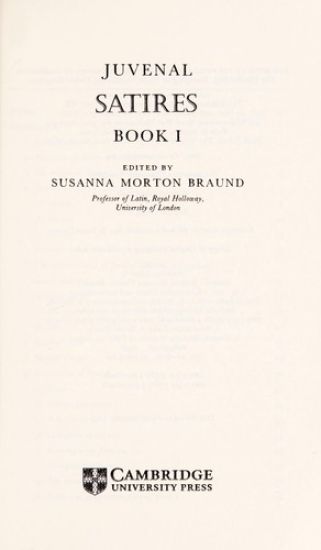
Juvenal: Satires Book I

Juvenal: Satires Book I

Juvenal

Cambridge University Press
1996
pokkari
Satire was a genre of poetry invented and developed by the Romans. When it came into Juvenal’s hands, he stamped his mark upon it: indignation. His angry voice had an overwhelming influence upon later European satirists and persists in modern forms of satire. In this new commentary, Susanna Morton Braund situates Juvenal within the genre of satire and illuminates his appropriation of the ‘grand style’ of declamatory rhetoric and epic poetry for his indignant persona in Satires 1–5, including the notorious second Satire. The commentary on each of the Satires is followed by an essay which offers an interpretation of the poem, including a synthesis of recent critical thought. These essays, together with the overview in the Introduction, present the first integrated reading of Book I as an organic structure.
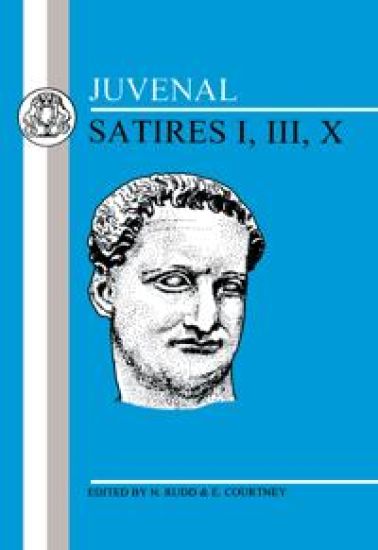
Juvenal: Satires I, III, X

Juvenal: Satires I, III, X

Juvenal

Bristol Classical Press
1991
nidottu
This introduction to three of Juvenal's satires aims to help intermediate high school or college readers understand the meaning of Juvenal's Latin. Satire I is Juvenal's explanation of why he writes poetry and satire. Satire III discusses why life in Rome has become intolerable. Satire X concerns itself with explaining why most prayers are misguided and - if answered - harmful. This edition made accessible, in a concise format, with an introduction and commentary, the three Satires, which are most frequently prescribed at A-level and early university courses. It has been constantly reprinted since it was first published, a measure of its success.
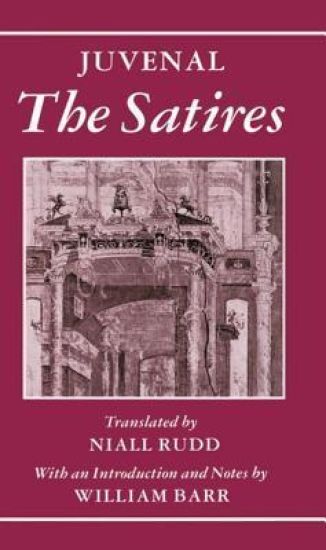
The Satires

The Satires

Juvenal

Clarendon Press
1991
sidottu
BLA new translation combining textual accuracy with colourful poetry Juvenal, whose work dates from the early second century AD, is commonly considered the greatest of Roman satirical poets. His sixteen satires are all concerned with contemporary Roman society. They are notable for their bitter, ironical humour, power of invective, grim epigrams, sympathy with the poor, and a narrow pessimism. Juvenal's influence was great among English satirists, notably Samuel Johnson. In this new translation of the Satires, Professor Rudd combines textual accuracy with colourful poetry. His verse vividly conveys Juvenal's gift for evoking a wealth of imagery with a few economical phrases. The introduction and notes provided by Dr Barr outline the background to the Satires and explain contemporary allusions. This translation should therefore be fully accessible to the modern reader.