Kirjojen hintavertailu – 12 859 829 kirjaa ja 27 kauppaa

Kirjailija

K.A. Padmanabhan

Kirjat ja teokset yhdessä paikassa: 3 kirjaa, julkaisuja vuosilta 2001–2018, suosituimpiin kuuluu Superplastic Flow. Vertaile teosten hintoja ja tarkista saatavuus suomalaisista kirjakaupoista.

Nimi esiintyy myös muodoissa: K. A. Padmanabhan

3 kirjaa

Kirjojen julkaisuvuodet: 2001–2018.

Superplasticity

Superplasticity

K. A. Padmanabhan; S. Balasivanandha Prabu; R. R. Mulyukov; Ayrat Nazarov; R. M. Imayev; S. Ghosh Chowdhury

Springer-Verlag Berlin and Heidelberg GmbH Co. K
2018
sidottu
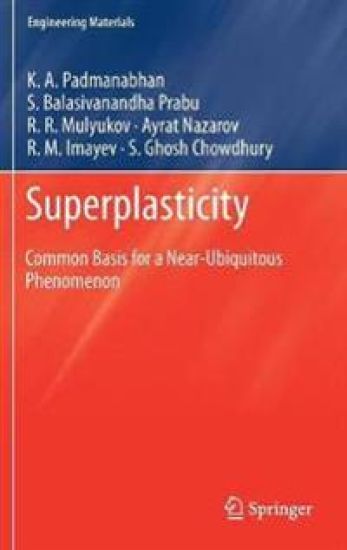
This book combines the perspectives of materials science of Superplasticity, on the one hand, and those of design and mechanics, on the other, in order to provide a holistic view of materials, design, mechanics and performance which will lead to useful solutions of societal benefits, in addition to providing great intellectual challenges. After considering the experimental evidence for superplasticity in different classes of materials, the book discusses the physics-based models, along with their advantages and limitations. Then, the analyses for superplastic forming available in the framework of continuum mechanics, finite element analysis and numerical simulations are presented. Finally, the authors highlight some successful industrial applications. This book is recommended as a text book for courses on Superplasticity and as supplementary use for courses on Materials Processing, Manufacturing, High Temperature Deformation, Nanotechnology and Mechanical Behavior of Materials. Persons working in Department of Materials Science and Engineering, Physics, Mechanics, Mechanical Engineering, Aerospace Engineering, Metallurgy, Ceramics and Geo-sciences are likely to find the book to be useful. It is also recommended as a reference source for practicing engineers involved in the design, processing and manufacture of industrial components, which exploit the unique properties associated with superplastic materials.
Superplastic Flow

Superplastic Flow

K.A. Padmanabhan; R.A. Vasin; F.U. Enikeev

Springer-Verlag Berlin and Heidelberg GmbH Co. K
2010
nidottu
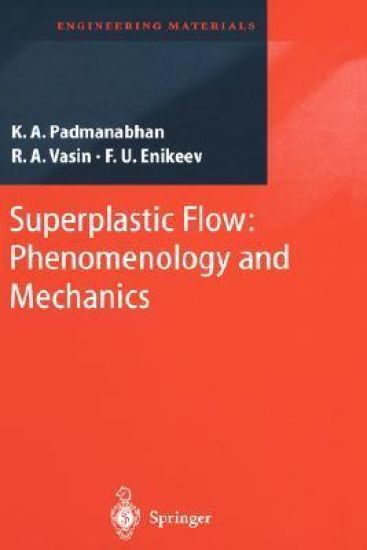
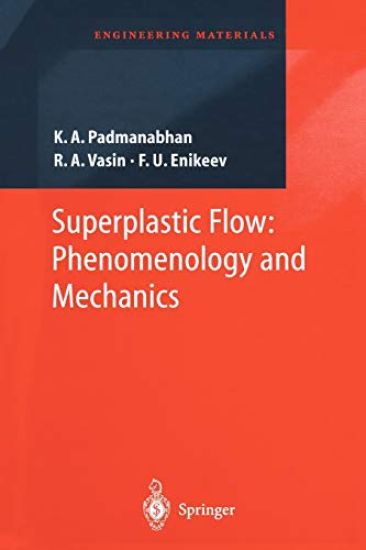
Superplasticity is the ability of polycrystalline materials under certain conditions to exhibit extreme tensile elongation in a nearly homogeneous/isotropic manner. Historically, this phenomenon was discovered and systematically studied by metallurgists and physicists. They, along with practising engineers, used materials in the superplastic state for materials forming applications. Metallurgists concluded that they had the necessary information on superplasticity and so theoretical studies focussed mostly on understanding the physical and metallurgi­ cal properties of superplastic materials. Practical applications, in contrast, were led by empirical approaches, rules of thumb and creative design. It has become clear that mathematical models of superplastic deformation as well as analyses for metal working processes that exploit the superplastic state are not adequate. A systematic approach based on the methods of mechanics of solids is likely to prove useful in improving the situation. The present book aims at the following. 1. Outline briefly the techniques of mechanics of solids, particularly as it applies to strain rate sensitive materials. 2. Assess the present level of investigations on the mechanical behaviour of superplastics. 3. Formulate the main issues and challenges in mechanics ofsuperplasticity. 4. Analyse the mathematical models/constitutive equations for superplastic flow from the viewpoint of mechanics. 5. Review the models of superplastic metal working processes. 6. Indicate with examples new results that may be obtained using the methods of mechanics of solids.
Superplastic Flow

Superplastic Flow

K.A. Padmanabhan; R.A. Vasin; F.U. Enikeev

Springer-Verlag Berlin and Heidelberg GmbH Co. K
2001
sidottu
Superplasticity is the ability of polycrystalline materials under certain conditions to exhibit extreme tensile elongation in a nearly homogeneous/isotropic manner. Historically, this phenomenon was discovered and systematically studied by metallurgists and physicists. They, along with practising engineers, used materials in the superplastic state for materials forming applications. Metallurgists concluded that they had the necessary information on superplasticity and so theoretical studies focussed mostly on understanding the physical and metallurgi­ cal properties of superplastic materials. Practical applications, in contrast, were led by empirical approaches, rules of thumb and creative design. It has become clear that mathematical models of superplastic deformation as well as analyses for metal working processes that exploit the superplastic state are not adequate. A systematic approach based on the methods of mechanics of solids is likely to prove useful in improving the situation. The present book aims at the following. 1. Outline briefly the techniques of mechanics of solids, particularly as it applies to strain rate sensitive materials. 2. Assess the present level of investigations on the mechanical behaviour of superplastics. 3. Formulate the main issues and challenges in mechanics ofsuperplasticity. 4. Analyse the mathematical models/constitutive equations for superplastic flow from the viewpoint of mechanics. 5. Review the models of superplastic metal working processes. 6. Indicate with examples new results that may be obtained using the methods of mechanics of solids.