Kirjojen hintavertailu – 12 859 827 kirjaa ja 27 kauppaa

Kirjailija

Kai Nielsen

Kirjat ja teokset yhdessä paikassa: 13 kirjaa, julkaisuja vuosilta 1973–2023, suosituimpiin kuuluu Equality and Liberty. Vertaile teosten hintoja ja tarkista saatavuus suomalaisista kirjakaupoista.

13 kirjaa

Kirjojen julkaisuvuodet: 1973–2023.

Marxism And The Moral Point Of View

Marxism And The Moral Point Of View

Kai Nielsen

TAYLOR FRANCIS LTD
2023
nidottu
Marxism and the Moral Point of View attempts to say what consistent Marxists working within the parameters of the canonical conceptions of Marxism should say about morality. This includes what they should say about the function of morality in society, about the extent of moral comment they can justifiably make, and about freedom, equality, and justice, including the justice of whole social formations. Karl Marx-and most Marxists follow him-was opposed.
Marxism And The Moral Point Of View

Marxism And The Moral Point Of View

Kai Nielsen

TAYLOR FRANCIS LTD
2021
sidottu
Marxism and the Moral Point of View attempts to say what consistent Marxists working within the parameters of the canonical conceptions of Marxism should say about morality. This includes what they should say about the function of morality in society, about the extent of moral comment they can justifiably make, and about freedom, equality, and justice, including the justice of whole social formations. Karl Marx-and most Marxists follow him-was opposed.
On Transforming Philosophy

On Transforming Philosophy

Kai Nielsen

Routledge
2021
nidottu
Since Rorty, the crisis of method and interests in philosophy has been at the forefront of metaphilosophy. In this book, Kai Nielsen, one of the most prominent critics of philosophy-as-usual, examines critically the most important claims made on behalf of philosophy. After rejecting as chimerical the ambitious claims of traditional, especially foun
After The Demise Of The Tradition
This ambitious book addresses the "end-of-philosophy" debate and the challenge it presents to contemporary philosophy, both continental and analytic. It is a chain of argument as well as a conversation conducted in the presence of the major contributors to that debate: the critics (especially Richard Rorty) of the dominantly Platonic-Cartesian-Kantian tradition on the one hand and its defenders on the other. Nielsen's account draws on Wittgenstein, Quine, Davidson, Habermas, and Foucault, among others. Nielsen takes Rorty's arguments seriously and insists that they demand a rethinking of the role of philosophy in a world in which the claims of relativism, nihilism, and historicism loom increasingly larger. But, unlike most who are impressed with the end-of-philosophy argument, he provides an original and constructive response: the development of a holistic, antifoundationalist account of philosophy that utilizes a form of critical theory and wide reflective equilibrium in carving out a positive role for a new kind of philosophy. This is an important book not just for philosophers but tor social theorists, for literary critics, and indeed for scholars in any field in which the status of knowledge has become problematic.
On Transforming Philosophy

On Transforming Philosophy

Kai Nielsen

Routledge
2019
sidottu
When I first conceived of this book, I intended to write a short book and one, the great philosophical figures of the past and a few very eminent contemporaries aside, which made no reference to other philosophers and contained no quotations, footnotes and the like. I ended up doing neither. Indeed I went nearly to the exact opposite. I wrote a rather long book with, among other things, extensive discussions of my contemporaries and near contemporaries.
Does God Exist?

Does God Exist?

J. P. Moreland; Kai Nielsen

Prometheus Books
1993
pokkari
Is there a God? What is the evidence for belief in such a being? What is God like? Or, is God a figment of human inspiration? How do we know that such a being might not exist? Should belief or disbelief in God's existence make a difference in our opinions and moral choices, in the way we see ourselves and relate to those around us? These are fundamental questions, and their answers have shaped individual lives, races, and nations throughout history. On March 24, 1988, at the University of Mississippi, J. P. Moreland, a leading Christian philosopher and ethicist, and Kai Nielsen, one of today's best-known atheist philosophers, went head-to-head over these questions. Does God Exist? records their entire lively debate and includes questions from the audience, the debaters' answers, and the responses of four recognized scholars - William Lane Craig, Antony Flew, Dallas Willard, and Keith Parsons. Noted author and philosopher Peter Kreeft has written an introduction, concluding chapter, and appendix - all designed to help readers decide for themselves whether God is fact or fantasy.

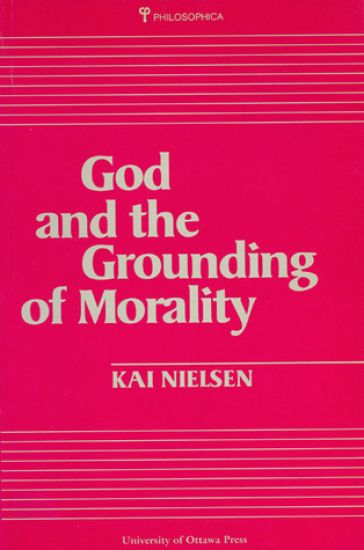
God and the Grounding of Morality

God and the Grounding of Morality

Kai Nielsen

University of Ottawa Press
1991
pokkari
These essays make a single central claim: that human beings can still make sense of their lives and still have a humane morality, even if their worldview is utterly secular and even if they have lost the last vestige of belief in God. 'Even in a self-consciously Godless world life can be fully meaningful', Nielsen contends.
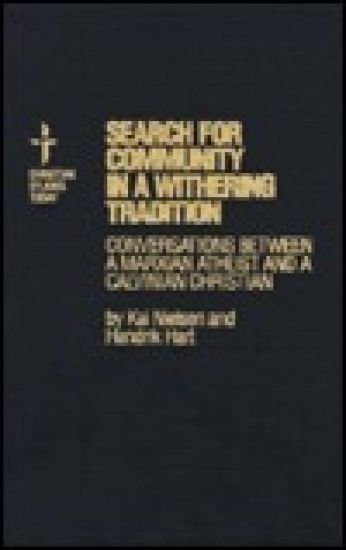
Search for Community in a Withering Tradition

Search for Community in a Withering Tradition

Kai Nielsen; Hendrik Hart

University Press of America
1990
sidottu
What happens in a conversation between a committed Atheist and a committed Christian? While agreeing to disagree on almost every detail, Kai Nielsen, Chair of the Department of Philosophy, University of Calgary, and Hendrik Hart, Senior Member in Philosophy at the graduate Institute for Christian Studies, Toronto, agree that it is not fruitless. They agree that the tradition of reason is withering and that deeply alienated communities do not sufficiently share significant beliefs. Their conversation is of great importance to the continued flourishing of humanity in community. Co-published with the Institute for Christian Studies.
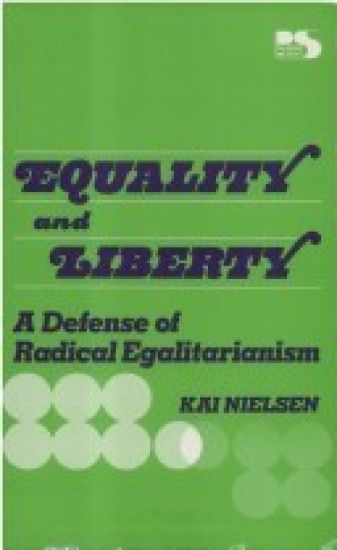
Equality and Liberty

Equality and Liberty

Kai Nielsen

Rowman Littlefield
1985
sidottu
Probably no issue is more confounding in the social policy arena or more closely argued among political philosophers than the question of the relationship between equality and liberty: are they compatible in a just society? In a systematic discussion that expands our understanding of what constitutes liberty, equality, and, especially, justice, Professor Nielsen puts forth a vigorous defense of an uncompromising egalitarianism based on a commitment to the belief that the interests of everyone matter, and matter equally.