Kirjojen hintavertailu – 12 903 724 kirjaa ja 27 kauppaa

Kirjailija

Kai-Tai Fang

Kirjat ja teokset yhdessä paikassa: 6 kirjaa, julkaisuja vuosilta 2002–2025, suosituimpiin kuuluu Theory and Application of Uniform Experimental Designs. Vertaile teosten hintoja ja tarkista saatavuus suomalaisista kirjakaupoista.

6 kirjaa

Kirjojen julkaisuvuodet: 2002–2025.

Representative Points of Statistical Distributions

Representative Points of Statistical Distributions

Kai-Tai Fang; Huajun Ye; Yongdao Zhou

TAYLOR FRANCIS LTD
2025
sidottu
Statistical simulation has become a cornerstone in statistical research and applications. The aim of Representative Points of Statistical Distributions: Applications in Statistical Inference is to present a comprehensive exploration of various methods for statistical simulation and resampling, focusing on consistency and efficiency. It covers a range of representative points (RPs) – Monte Carlo (MC) RPs, quasi-Monte Carlo (QMC) RPs, and mean square error (MSE) RPs – and their applications, and includes a collection of recent developments in the field. It also explores other types of representative points and the corresponding approximate distributions, and delves into the realm of statistical simulation by exploring the limitations of traditional MC methods and the innovations brought about by the bootstrap method. In addition, the text introduces other kinds of representative points and the corresponding approximate distributions such as QMC and MSE methods. FeaturesComprehensive exploration of statistical simulation methods: provides a deep dive into MC methods and bootstrap methods, and introduces other kinds of RPs and the corresponding approximate distributions, such as QMC and MSE methods. Emphasis on consistency and efficiency: highlights the advantages of these methods in terms of consistency and efficiency, addressing the slow convergence rate of classical statistical simulation. Collection of recent developments: brings together the latest advancements in the field of statistical simulation, keeping readers up to date with the most current research. Practical applications: includes numerous practical applications of various types of RPs (MC-RPs, QMC-RPs, and MSE-RPs) in statistical inference and simulation. Educational resource: can serve as a textbook for postgraduate students, a reference book for undergraduate students, and a valuable resource for professionals in various fields. The book serves as a valuable resource for postgraduate students, researchers, and practitioners in statistics, mathematics, and other quantitative fields.
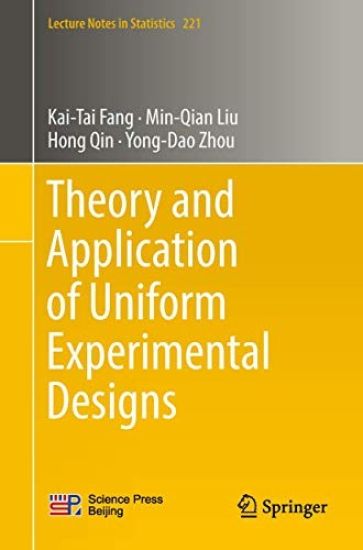
Theory and Application of Uniform Experimental Designs

Theory and Application of Uniform Experimental Designs

Kai-Tai Fang; Min-Qian Liu; Hong Qin; Yong-Dao Zhou

Springer Verlag, Singapore
2018
nidottu
The book provides necessary knowledge for readers interested in developing the theory of uniform experimental design. It discusses measures of uniformity, various construction methods of uniform designs, modeling techniques, design and modeling for experiments with mixtures, and the usefulness of the uniformity in block, factorial and supersaturated designs. Experimental design is an important branch of statistics with a long history, and is extremely useful in multi-factor experiments. Involving rich methodologies and various designs, it has played a key role in industry, technology, sciences and various other fields. A design that chooses experimental points uniformly scattered on the domain is known as uniform experimental design, and uniform experimental design can be regarded as a fractional factorial design with model uncertainty, a space-filling design for computer experiments, a robust design against the model specification, and a supersaturated design and can be applied to experiments with mixtures.
Design and Modeling for Computer Experiments

Design and Modeling for Computer Experiments

Kai-Tai Fang; Runze Li; Agus Sudjianto

CRC Press
2020
nidottu
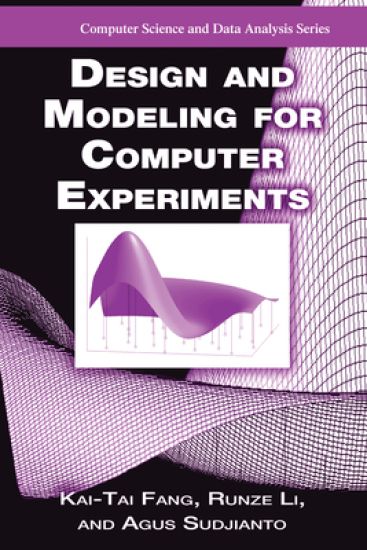
Computer simulations based on mathematical models have become ubiquitous across the engineering disciplines and throughout the physical sciences. Successful use of a simulation model, however, requires careful interrogation of the model through systematic computer experiments. While specific theoretical/mathematical examinations of computer experiment design are available, those interested in applying proposed methodologies need a practical presentation and straightforward guidance on analyzing and interpreting experiment results. Written by authors with strong academic reputations and real-world practical experience, Design and Modeling for Computer Experiments is exactly the kind of treatment you need. The authors blend a sound, modern statistical approach with extensive engineering applications and clearly delineate the steps required to successfully model a problem and provide an analysis that will help find the solution. Part I introduces the design and modeling of computer experiments and the basic concepts used throughout the book. Part II focuses on the design of computer experiments. The authors present the most popular space-filling designs - like Latin hypercube sampling and its modifications and uniform design - including their definitions, properties, construction and related generating algorithms. Part III discusses the modeling of data from computer experiments. Here the authors present various modeling techniques and discuss model interpretation, including sensitivity analysis. An appendix reviews the statistics and mathematics concepts needed, and numerous examples clarify the techniques and their implementation. The complexity of real physical systems means that there is usually no simple analytic formula that sufficiently describes the phenomena. Useful both as a textbook and professional reference, this book presents the techniques you need to design and model computer experiments for practical problem solving.
Growth Curve Models and Statistical Diagnostics

Growth Curve Models and Statistical Diagnostics

Jian-Xin Pan; Kai-Tai Fang

Springer-Verlag New York Inc.
2011
nidottu
Growth-curve models are generalized multivariate analysis-of-variance models. These models are especially useful for investigating growth problems on short times in economics, biology, medical research, and epidemiology. This book systematically introduces the theory of the GCM with particular emphasis on their multivariate statistical diagnostics, which are based mainly on recent developments made by the authors and their collaborators. The authors provide complete proofs of theorems as well as practical data sets and MATLAB code.
Design and Modeling for Computer Experiments

Design and Modeling for Computer Experiments

Kai-Tai Fang; Runze Li; Agus Sudjianto

Chapman Hall/CRC
2005
sidottu
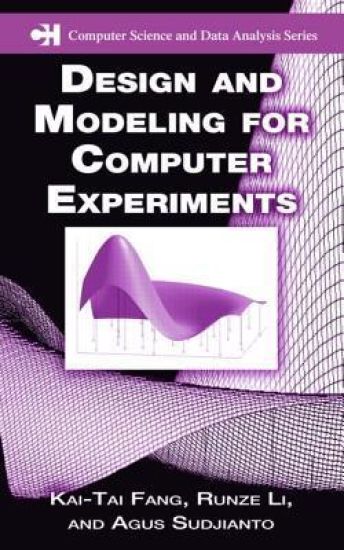
Computer simulations based on mathematical models have become ubiquitous across the engineering disciplines and throughout the physical sciences. Successful use of a simulation model, however, requires careful interrogation of the model through systematic computer experiments. While specific theoretical/mathematical examinations of computer experiment design are available, those interested in applying proposed methodologies need a practical presentation and straightforward guidance on analyzing and interpreting experiment results. Written by authors with strong academic reputations and real-world practical experience, Design and Modeling for Computer Experiments is exactly the kind of treatment you need. The authors blend a sound, modern statistical approach with extensive engineering applications and clearly delineate the steps required to successfully model a problem and provide an analysis that will help find the solution. Part I introduces the design and modeling of computer experiments and the basic concepts used throughout the book. Part II focuses on the design of computer experiments. The authors present the most popular space-filling designs - like Latin hypercube sampling and its modifications and uniform design - including their definitions, properties, construction and related generating algorithms. Part III discusses the modeling of data from computer experiments. Here the authors present various modeling techniques and discuss model interpretation, including sensitivity analysis. An appendix reviews the statistics and mathematics concepts needed, and numerous examples clarify the techniques and their implementation. The complexity of real physical systems means that there is usually no simple analytic formula that sufficiently describes the phenomena. Useful both as a textbook and professional reference, this book presents the techniques you need to design and model computer experiments for practical problem solving.
Growth Curve Models and Statistical Diagnostics

Growth Curve Models and Statistical Diagnostics

Jian-Xin Pan; Kai-Tai Fang

Springer-Verlag New York Inc.
2002
sidottu
Growth-curve models are generalized multivariate analysis-of-variance models. These models are especially useful for investigating growth problems on short times in economics, biology, medical research, and epidemiology. This book systematically introduces the theory of the GCM with particular emphasis on their multivariate statistical diagnostics, which are based mainly on recent developments made by the authors and their collaborators. The authors provide complete proofs of theorems as well as practical data sets and MATLAB code.