Kirjojen hintavertailu – 12 903 725 kirjaa ja 27 kauppaa

Kirjailija

Kai-Yuan Cai

Kirjat ja teokset yhdessä paikassa: 6 kirjaa, julkaisuja vuosilta 1996–2021, suosituimpiin kuuluu Filtered Repetitive Control with Nonlinear Systems. Vertaile teosten hintoja ja tarkista saatavuus suomalaisista kirjakaupoista.

6 kirjaa

Kirjojen julkaisuvuodet: 1996–2021.

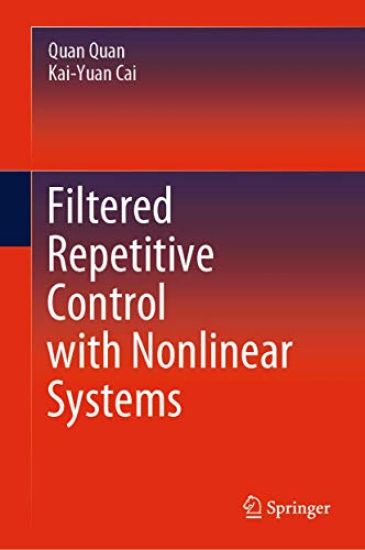
Filtered Repetitive Control with Nonlinear Systems

Filtered Repetitive Control with Nonlinear Systems

Quan Quan; Kai-Yuan Cai

Springer Verlag, Singapore
2021
nidottu
Though there have been significant advances in the theory and applications of linear time-invariant systems, developments regarding repetitive control have been sporadic. At the same time, there is a dearth of literature on repetitive control (RC) for nonlinear systems. Addressing that gap, this book discusses a range of basic methods for solving RC problems in nonlinear systems, including two commonly used methods and three original ones. Providing valuable tools for researchers working on the development of repetitive control, these new and fundamental methods are one of the major features of the book, which will benefit researchers, engineers, and graduate students in e.g. the field of control theory.
Filtered Repetitive Control with Nonlinear Systems

Filtered Repetitive Control with Nonlinear Systems

Quan Quan; Kai-Yuan Cai

Springer Verlag, Singapore
2020
sidottu
Though there have been significant advances in the theory and applications of linear time-invariant systems, developments regarding repetitive control have been sporadic. At the same time, there is a dearth of literature on repetitive control (RC) for nonlinear systems. Addressing that gap, this book discusses a range of basic methods for solving RC problems in nonlinear systems, including two commonly used methods and three original ones. Providing valuable tools for researchers working on the development of repetitive control, these new and fundamental methods are one of the major features of the book, which will benefit researchers, engineers, and graduate students in e.g. the field of control theory.
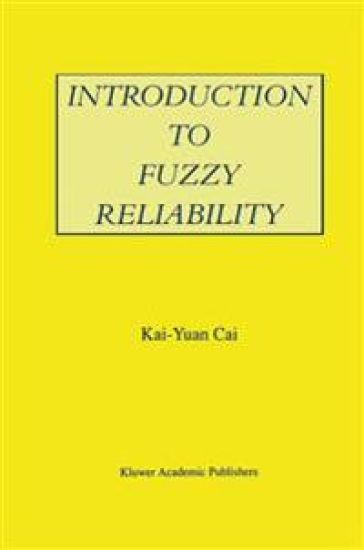
Introduction to Fuzzy Reliability

Introduction to Fuzzy Reliability

Kai-Yuan Cai

Springer-Verlag New York Inc.
2011
nidottu
Introduction to Fuzzy Reliability treats fuzzy methodology in hardware reliability and software reliability in a relatively systematic manner. The contents of this book are organized as follows. Chapter 1 places reliability engineering in the scope of a broader area, i.e. system failure engineering. Readers will find that although this book is confined to hardware and software reliability, it may be useful for other aspects of system failure engineering, like maintenance and quality control. Chapter 2 contains the elementary knowledge of fuzzy sets and possibility spaces which are required reading for the rest of this book. This chapter is included for the overall completeness of the book, but a few points (e.g. definition of conditional possibility and existence theorem of possibility space) may be new. Chapter 3 discusses how to calculate probist system reliability when the component reliabilities are represented by fuzzy numbers, and how to analyze fault trees when probabilities of basic events are fuzzy. Chapter 4 presents the basic theory of profust reliability, whereas Chapter 5 analyzes the profust reliability behavior of a number of engineering systems. Chapters 6 and 7 are devoted to probist reliability theory from two different perspectives. Chapter 8 discusses how to model software reliability behavior by using fuzzy methodology. Chapter 9 includes a number of mathematical problems which are raised by applications of fuzzy methodology in hardware and software reliability, but may be important for fuzzy set and possibility theories.
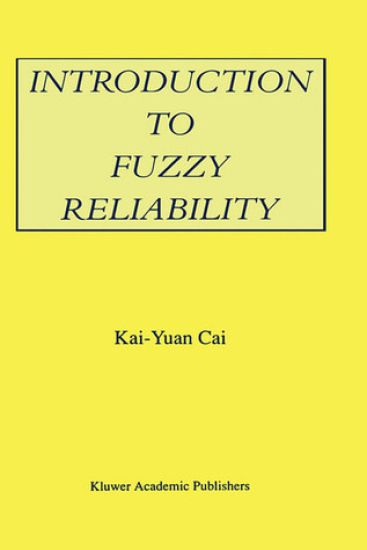
Introduction to Fuzzy Reliability
Introduction to Fuzzy Reliability treats fuzzy methodology in hardware reliability and software reliability in a relatively systematic manner. The contents of this book are organized as follows. Chapter 1 places reliability engineering in the scope of a broader area, i.e. system failure engineering. Readers will find that although this book is confined to hardware and software reliability, it may be useful for other aspects of system failure engineering, like maintenance and quality control. Chapter 2 contains the elementary knowledge of fuzzy sets and possibility spaces which are required reading for the rest of this book. This chapter is included for the overall completeness of the book, but a few points (e.g. definition of conditional possibility and existence theorem of possibility space) may be new. Chapter 3 discusses how to calculate probist system reliability when the component reliabilities are represented by fuzzy numbers, and how to analyze fault trees when probabilities of basic events are fuzzy. Chapter 4 presents the basic theory of profust reliability, whereas Chapter 5 analyzes the profust reliability behavior of a number of engineering systems. Chapters 6 and 7 are devoted to probist reliability theory from two different perspectives. Chapter 8 discusses how to model software reliability behavior by using fuzzy methodology. Chapter 9 includes a number of mathematical problems which are raised by applications of fuzzy methodology in hardware and software reliability, but may be important for fuzzy set and possibility theories.