Kirjojen hintavertailu – 12 875 817 kirjaa ja 26 kauppaa

Kirjailija

Kaius Tuori

Kirjat ja teokset yhdessä paikassa: 5 kirjaa, julkaisuja vuosilta 2007–2020, suosituimpiin kuuluu Lawyers and Savages. Vertaile teosten hintoja ja tarkista saatavuus suomalaisista kirjakaupoista.

5 kirjaa

Kirjojen julkaisuvuodet: 2007–2020.

Empire of Law

Empire of Law

Kaius Tuori

Cambridge University Press
2020
sidottu
European legal integration is often justified with reference to the inherent unity of European legal traditions that extend to ancient Rome. This book explores the invention of this tradition, tracing it to a group of legal scholars divided by the onslaught of Nazi terror and totalitarianism in Europe. As exiles in Britain and the US, its formulators worked to build bridges between the Continental and the Atlantic legal traditions, incorporating ideas such as rule of law, liberty and equality to the European heritage. Others joined the Nazi revolution, which promoted its own idea of European unity. At the end of World War Two, natural law and human rights were incorporated into the European project. The resulting narrative of Europe, one that outlined human rights, rule of law and equality, became consequently a unifying factor during the Cold War as the self-definition against the challenge of communism.
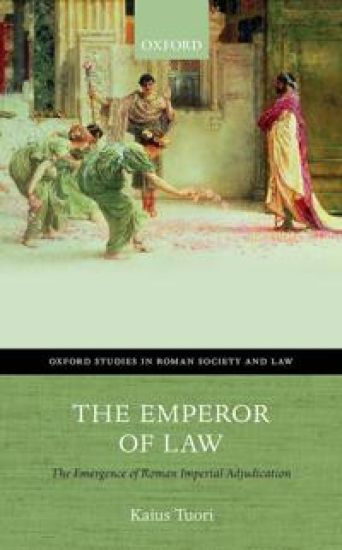
The Emperor of Law

The Emperor of Law

Kaius Tuori

Oxford University Press
2016
sidottu
In the days of the Roman Empire, the emperor was considered not only the ruler of the state, but also its supreme legal authority, fulfilling the multiple roles of supreme court, legislator, and administrator. The Emperor of Law explores how the emperor came to assume the mantle of a judge, beginning with Augustus, the first emperor, and spanning the years leading up to Caracalla and the Severan dynasty. While earlier studies have attempted to explain this change either through legislation or behaviour, this volume undertakes a novel analysis of the gradual expansion and elaboration of the emperor's adjudication and jurisdiction: by analysing the process through historical narratives, it argues that the emergence of imperial adjudication was a discourse that involved not only the emperors, but also petitioners who sought their rulings, lawyers who aided them, the senatorial elite, and the Roman historians and commentators who described it. Stories of emperors settling lawsuits and demonstrating their power through law, including those depicting 'mad' emperors engaging in violent repressions, played an important part in creating a shared conviction that the emperor was indeed the supreme judge alongside the empirical shift in the legal and political dynamic. Imperial adjudication reflected equally the growth of imperial power during the Principate and the centrality of the emperor in public life, and constitutional legitimation was thus created through the examples of previous actions - examples that historical authors did much to shape. Aimed at readers of classics, Roman law, and ancient history, The Emperor of Law offers a fundamental reinterpretation of the much debated problem of the advent of imperial supremacy in law that illuminates the importance of narrative studies to the field of legal history.
Lawyers and Savages

Lawyers and Savages

Kaius Tuori

Routledge
2016
nidottu
Legal primitivism was a complex phenomenon that combined the study of early European legal traditions with studies of the legal customs of indigenous peoples. Lawyers and Savages: Ancient History and Legal Realism in the Making of Legal Anthropology explores the rise and fall of legal primitivism, and its connection to the colonial encounter. Through examples such as blood feuds, communalism, ordeals, ritual formalism and polygamy, this book traces the intellectual revolution of legal anthropology and demonstrates how this scholarship had a clear impact in legitimating the colonial experience. Detailing how legal realism drew on anthropology in order to help counter the hypothetical constructs of legal formalism, this book also shows how, despite their explicit rejection, the central themes of primitive law continue to influence current ideas – about indigenous legal systems, but also of the place and role of law in development. Written in an engaging style and rich in examples from history and literature, this book will be invaluable to those with interests in legal realism, legal history or legal anthropology.
Lawyers and Savages

Lawyers and Savages

Kaius Tuori

Routledge
2014
sidottu
Legal primitivism was a complex phenomenon that combined the study of early European legal traditions with studies of the legal customs of indigenous peoples. Lawyers and Savages: Ancient History and Legal Realism in the Making of Legal Anthropology explores the rise and fall of legal primitivism, and its connection to the colonial encounter. Through examples such as blood feuds, communalism, ordeals, ritual formalism and polygamy, this book traces the intellectual revolution of legal anthropology and demonstrates how this scholarship had a clear impact in legitimating the colonial experience. Detailing how legal realism drew on anthropology in order to help counter the hypothetical constructs of legal formalism, this book also shows how, despite their explicit rejection, the central themes of primitive law continue to influence current ideas – about indigenous legal systems, but also of the place and role of law in development. Written in an engaging style and rich in examples from history and literature, this book will be invaluable to those with interests in legal realism, legal history or legal anthropology.
Lakimieslatinan käsikirja

Lakimieslatinan käsikirja

Kaius Tuori

Edilex Lakitieto
2007
nidottu

Halvin toimitettuna 32,20 €

Lakimieslatinan hallinta on juristin perustaito, jonka merkitys on oikeustieteen kansainvälistyessä koko ajan lisääntynyt. Kirjaan on koottu yli 400 yleisintä ja tärkeää oikeudellisen latinan termiä ja fraasia. Aineisto on koottu pääosin suomalaisesta oikeuskirjallisuudesta, mutta mukana ovat myös merkittävimmät kansainväliset käsitteet, joita sovelletaan esimerkiksi EY-tuomioistuinten ratkaisukäytännössä. Kirja on nimetty käsikirjaksi nimenomaan käyttöä silmällä pitäen, joten sanastossa on keskitytty suomalaisen juristin arkipäivän tiedontarpeeseen. Teos on erinomainen apuväline jokaiselle juristille tai sellaiseksi haluavalle. Myös juristien kanssa työskentelevät saavat kirjasta korvaamatonta apua oikeudellisiin keskusteluihin. Kirjan kirjoittaja OTT, FM Kaius Tuori toimii Helsingin yliopistossa oikeushistorian yliopistonlehtorina (mvs.). Hänellä on pitkä kokemus roomalaisen oikeuden tutkimuksesta.