Kirjojen hintavertailu – 12 859 818 kirjaa ja 27 kauppaa

Kirjailija

Kaj Skoldberg

Kirjat ja teokset yhdessä paikassa: 6 kirjaa, julkaisuja vuosilta 2002–2017, suosituimpiin kuuluu Reflexive Methodology. Vertaile teosten hintoja ja tarkista saatavuus suomalaisista kirjakaupoista.

Nimi esiintyy myös muodoissa: Kaj Sköldberg

6 kirjaa

Kirjojen julkaisuvuodet: 2002–2017.

Reflexive Methodology

Reflexive Methodology

Mats Alvesson; Kaj Skoldberg

SAGE Publications Ltd
2017
nidottu

Halvin toimitettuna 77,30 €

Praise for the Second Edition: "In opposition to most literature on how to conduct good social science research which is either empirically oriented or gives priority to theoretical and philosophical considerations, which tends to make empirical research look odd or irrelevant, this volume on 'Reflexive Methodology' explicitly turns towards a consideration of the perceptual, cognitive, theoretical, linguistic, political and cultural circumstances as backdrop of data interpretation and research design. It showed up to be the most important and informative resource and a source of enlightenment to my lecture on methodology at our institute. I can highly recommend the volume to lecturers and students alike." Professor Sabine Troeger, Geography Institute - Library, University of Bonn Reflexivity is an essential part of the research process. Mats Alvesson and Kaj Sköldberg make explicit the links between techniques used in empirical research and different research traditions, giving a theoretically informed approach to qualitative research. The authors provide balanced reviews and critiques of the major schools of grounded theory, ethnography, hermeneutics, critical theory, postmodernism and poststructuralism, discourse analysis, genealogy and feminism. Useful reading for students and researchers across the social sciences. The first edition established itself as a ground-breaking success, providing researchers with an invaluable guide to a central problem in research methodology - namely, how to put field research and interpretations in perspective, paying attention to the interpretive, political and rhetorical nature of empirical research. The second edition introduced a new chapter on positivism, social constructionism and critical realism, and offered new conclusions on the applications of methodology. This third edition of Reflexive Methodology provides further updates on new research, including neorealism, and illustrations and applications of reflexive methodology in formulating research strategies, that build on the acclaimed and successful previous editions
Reflexive Methodology

Reflexive Methodology

Mats Alvesson; Kaj Skoldberg

SAGE Publications Ltd
2017
sidottu
Praise for the Second Edition: "In opposition to most literature on how to conduct good social science research which is either empirically oriented or gives priority to theoretical and philosophical considerations, which tends to make empirical research look odd or irrelevant, this volume on 'Reflexive Methodology' explicitly turns towards a consideration of the perceptual, cognitive, theoretical, linguistic, political and cultural circumstances as backdrop of data interpretation and research design. It showed up to be the most important and informative resource and a source of enlightenment to my lecture on methodology at our institute. I can highly recommend the volume to lecturers and students alike." Professor Sabine Troeger, Geography Institute - Library, University of Bonn Reflexivity is an essential part of the research process. Mats Alvesson and Kaj Sköldberg make explicit the links between techniques used in empirical research and different research traditions, giving a theoretically informed approach to qualitative research. The authors provide balanced reviews and critiques of the major schools of grounded theory, ethnography, hermeneutics, critical theory, postmodernism and poststructuralism, discourse analysis, genealogy and feminism. Useful reading for students and researchers across the social sciences. The first edition established itself as a ground-breaking success, providing researchers with an invaluable guide to a central problem in research methodology - namely, how to put field research and interpretations in perspective, paying attention to the interpretive, political and rhetorical nature of empirical research. The second edition introduced a new chapter on positivism, social constructionism and critical realism, and offered new conclusions on the applications of methodology. This third edition of Reflexive Methodology provides further updates on new research, including neorealism, and illustrations and applications of reflexive methodology in formulating research strategies, that build on the acclaimed and successful previous editions
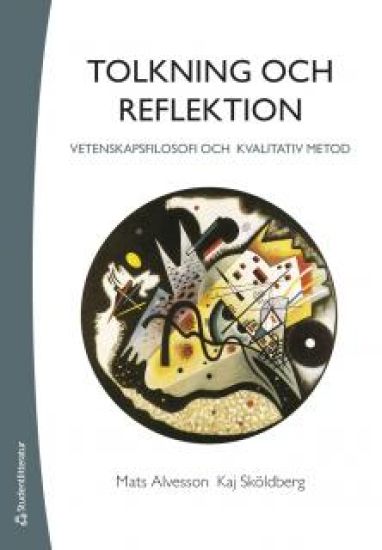
Tolkning och reflektion : vetenskapsfilosofi och kvalitativ metod

Tolkning och reflektion : vetenskapsfilosofi och kvalitativ metod

Mats Alvesson; Kaj Sköldberg

Studentlitteratur AB
2017
nidottu
När första upplagan av Tolkning och reflektion utkom 1994 bröt den nya vägar inom kvalitativ samhällsforskning. Boken blev snabbt något av en modern klassiker och används flitigt på metodkurser vid universitet och högskolor. En engelsk översättning, Reflexive Methodology, har haft stor internationell genomslagskraft. En grundtanke i boken är att data alltid är tolkade mot bakgrund av de personliga, kulturella, ideologiska och språkliga referensramar vi bär med oss. Reflektion innebär att ta ett steg bakåt från tolkningen: att tolka sina egna tolkningar, perspektivera sitt eget perspektiv, ställa sin egen auktoritet som forskare i självkritisk belysning. I boken navigerar författarna i utrymmet mellan den abstrakta filosofin och den metodologiska kokboken. Avsikten är att lyfta nivån på kvalitativ metod genom att foga in vetenskapsfilosofi som ett centralt och fortlöpande inslag i empiriskt förankrad samhällsvetenskap. Omvänt är syftet att göra abstrakta vetenskapsfilosofiska tankegångar konkret tillämpliga för kvalitativ forskning. Detta betyder en intellektualisering av kvalitativ metod och samtidigt en pragmatisering av vetenskapsfilosofi. Boken innehåller nytolkningar och kritiska diskussioner av viktigare kvalitativa ansatser, särskilt grundad teori, hermeneutik, kritisk teori och postmodernism. Denna tredje upplaga av boken har uppdaterats med aktuell forskning inom de berörda områdena. Helt nyskrivet är ett avsnitt om Manuel DeLandas aktuella, provokativa assemblageteori. Flera nyskrivna avsnitt behandlar den reflexiva metodologins tillämpningar för att nå ökad kreativitet i forskning jämfört med gängse metoder: konsten att finna och lösa mysterier, grundvalskritik, skapa djärva synteser och nya sammanlänkande hybridbegrepp.
Maktens många ansikten : teorier och idéer om makt under två och ett halvt tusen år
Makt är ett av de viktigaste begreppen inom samhällsvetenskapen, för att inte säga det allra viktigaste. En samlad framställning av tänkande kring detta fyller därför ett länge eftersatt behov. Den här boken utforskar idéer och teorier om makt, från historiens gryning fram till vår egen samtid. Boken består av tre delar. Den första delen utgörs av en historisk exposé över olika maktteorier samt en diskussion av makt som begrepp. Andra delen tar upp klassiska problemställningar i litteraturen, framförallt med fokus på den industriella och postindustriella eran. Den tredje delen berör teorier och idéer om makt i relation till paradoxalitet, kroppar, diskurs och moralisk rätt. I ett avslutande kapitel presenterar författaren sin egen teori om ”maktens sju ringar”. Maktens många ansikten är att rekommendera för alla som vill fördjupa sig i frågor som rör makt. Boken vänder sig främst till studenter och forskare i samhällsvetenskapliga ämnen.
The Poetic Logic of Administration

The Poetic Logic of Administration

Kaj Skoldberg

Routledge
2014
nidottu

Halvin toimitettuna 95,90 €

The Poetic Logic of Administration is an investigation of the most important organizational forms of our time, theoretically as well as practically. Central to the presentation are four main trends: the rational bureaucracy, the human network, the harmonious system and the strong culture. The book provides a new and challenging picture of these organizational forms. Difficult to capture in common logical terms, they appear to follow a certain pattern: a 'poetic logic'. They are, for example, enacted as various literary dramas: comedy, tragedy etc. They are also marked by different conceptions of the world - such as the metaphorical and the ironic - and by different explanatory ideals. Kaj Skoldberg's book contains a rhetorical analysis of the styles of modern administration and the changes they have undergone. This is a groundbreaking work, offering new interpretations and critical re-evaluations of the individual approaches to organization, including their 'gurus' and current importance, within the framework of a highly-original, overarching analysis. No previous book has tried to capture the major forms of organizing, and their dynamics, in terms of their rhetorical master tropes, main narrative genres, and explanatory ideals, and also uses this as an interpretive scheme for understanding individual organizational theories and practices within those main approaches. Examples are given from both the private and the public sectors and various forms of efficiency and effectiveness are also discussed.
The Poetic Logic of Administration

The Poetic Logic of Administration

Kaj Skoldberg

Routledge
2002
sidottu
The Poetic Logic of Administration is an investigation of the most important organizational forms of our time, theoretically as well as practically. Central to the presentation are four main trends: the rational bureaucracy, the human network, the harmonious system and the strong culture. The book provides a new and challenging picture of these organizational forms. Difficult to capture in common logical terms, they appear to follow a certain pattern: a 'poetic logic'. They are, for example, enacted as various literary dramas: comedy, tragedy etc. They are also marked by different conceptions of the world - such as the metaphorical and the ironic - and by different explanatory ideals. Kaj Skoldberg's book contains a rhetorical analysis of the styles of modern administration and the changes they have undergone. This is a groundbreaking work, offering new interpretations and critical re-evaluations of the individual approaches to organization, including their 'gurus' and current importance, within the framework of a highly-original, overarching analysis. No previous book has tried to capture the major forms of organizing, and their dynamics, in terms of their rhetorical master tropes, main narrative genres, and explanatory ideals, and also uses this as an interpretive scheme for understanding individual organizational theories and practices within those main approaches. Examples are given from both the private and the public sectors and various forms of efficiency and effectiveness are also discussed.