Kirjojen hintavertailu – 12 903 725 kirjaa ja 27 kauppaa

Kirjailija

Kanstantsin Dzehtsiarou

Kirjat ja teokset yhdessä paikassa: 9 kirjaa, julkaisuja vuosilta 2015–2025, suosituimpiin kuuluu European Yearbook on Human Rights 2018. Vertaile teosten hintoja ja tarkista saatavuus suomalaisista kirjakaupoista.

9 kirjaa

Kirjojen julkaisuvuodet: 2015–2025.

Russia, the Council of Europe and the European Convention on Human Rights

Russia, the Council of Europe and the European Convention on Human Rights

Ed Bates; Kanstantsin Dzehtsiarou; Andrew Forde

Bristol University Press
2025
nidottu
In March 2022, following the invasion of Ukraine, Russia was expelled from the Council of Europe after 26 years as a member. This timely and in-depth analysis explores Russia's tumultuous relationship with the Council of Europe and European Court of Human Rights. It examines Russia’s membership record and the profound impacts of its expulsion for Europe’s human rights system. The authors provide valuable insights for future policy to safeguard the integrity of international human rights institutions. The book fills an important gap in legal scholarship by exploring the legality and legitimacy of Russia’s membership and expulsion, and represents a key reference in understanding the challenge of protecting human rights in the face of rising authoritarianism.

Russia, the Council of Europe and the European Convention on Human Rights

Russia, the Council of Europe and the European Convention on Human Rights

Ed Bates; Kanstantsin Dzehtsiarou; Andrew Forde

Bristol University Press
2025
sidottu

Halvin toimitettuna 113,40 €

In March 2022, following the invasion of Ukraine, Russia was expelled from the Council of Europe after 26 years as a member. This timely and in-depth analysis explores Russia's tumultuous relationship with the Council of Europe and European Court of Human Rights. It examines Russia’s membership record and the profound impacts of its expulsion for Europe’s human rights system. The authors provide valuable insights for future policy to safeguard the integrity of international human rights institutions. The book fills an important gap in legal scholarship by exploring the legality and legitimacy of Russia’s membership and expulsion, and represents a key reference in understanding the challenge of protecting human rights in the face of rising authoritarianism.

European Yearbook on Human Rights 2018

European Yearbook on Human Rights 2018

Lize Glas; Filippo Fontanelli; Theodor Rathgeber; Monika Mayrhofer; Agnieszka Szklanna; Vladislava Stoyanova; Hans-Peter Folz; Alma Stankovic; Adina Portaru; David Reichel; Mathieu Leluup; Claudia Elion; Jean P. Froehly; Gregor Fischer; Joyce De Coninck; Johanna Pruessing; Ewa Sapiezynska; Jacopo Leone; Christian Strohal; Stefan Kieber; Mathilde Duhaâ; Miroslaw Wyrzykowski; Danaé Coquelet; Ajla van Heel; Elspeth Guild; Gareth Davies; Kanstantsin Dzehtsiarou

Intersentia Ltd
2018
nidottu
Both in Europe and around the world, 2017 has been another difficult year for the protection of human rights. Examples of the increased pressure on the European human rights system are apparent: the attack on the independence of the judiciary in Poland, which was responded to by the first time initiation of the rule of law procedure by the European Commission; the increasing human rights issues arising from European migration policy; Russia's suspension of its financial contribution to the Council of Europe and Turkey's lowering of its contribution; and the difficulties in appointing key human rights positions in the Organization for Security and Cooperation in Europe. Split into its customary four parts and complemented by book reviews of recent publications on human rights in Europe, the tenth volume of the European Yearbook on Human Rights brings together renowned scholars to analyse some of the most pressing and topical human rights issues being faced in Europe today.
Great Debates on the European Convention on Human Rights

Great Debates on the European Convention on Human Rights

Fiona de Londras; Kanstantsin Dzehtsiarou

BLOOMSBURY PUBLISHING PLC
2025
nidottu

Halvin toimitettuna 40,30 €

The 2nd edition of Great Debates on the European Convention on Human Rights encourages deep and critical engagement with the Convention, the Court, and the European system for human rights protection. The European Convention on Human Rights (ECHR) is widely hailed as the most successful regional human rights instrument. The decisions of its European Court of Human Rights (ECtHR) are cited all around the world, and every year tens of thousands of people turn to the Court for relief and aid when they consider their human rights have been violated. In each of the 46 countries contracted to the Convention, the ECHR has an everyday impact, shaping law and public policy and being argued in domestic courts. Law schools in the UK and Europe generally focus on the case law of the Convention and approach it on an article-by-article basis. This grounding in the Convention, the jurisprudence of the Court, and the emerging contestations around whether the Convention properly protects the rights of marginalised and vulnerable groups is a vital foundation for understanding the Convention. However, the law relating to the ECHR is voluminous, and many courses are only able to concentrate on some of the most well-known case law, and some topics of particular contention (such as LGBTQIA+ rights, states of emergency, and freedom of the press). Great Debates on the European Convention on Human Rights builds upon the 'nuts and bolts' grounding in the Convention and workings of the Court. It offers a unique thematic approach to thinking and learning about the Convention. Each of the key debates is illuminated by taking a wide lens on the ECHR: some points of contention are illustrated by reaching across Articles, others by examining national and international arenas, and still others by exploring the ECHR’s organisational structure and working practices.
Great Debates on the European Convention on Human Rights

Great Debates on the European Convention on Human Rights

Fiona de Londras; Kanstantsin Dzehtsiarou

BLOOMSBURY PUBLISHING PLC
2025
sidottu
The 2nd edition of Great Debates on the European Convention on Human Rights encourages deep and critical engagement with the Convention, the Court, and the European system for human rights protection. The European Convention on Human Rights (ECHR) is widely hailed as the most successful regional human rights instrument. The decisions of its European Court of Human Rights (ECtHR) are cited all around the world, and every year tens of thousands of people turn to the Court for relief and aid when they consider their human rights have been violated. In each of the 46 countries contracted to the Convention, the ECHR has an everyday impact, shaping law and public policy and being argued in domestic courts. Law schools in the UK and Europe generally focus on the case law of the Convention and approach it on an article-by-article basis. This grounding in the Convention, the jurisprudence of the Court, and the emerging contestations around whether the Convention properly protects the rights of marginalised and vulnerable groups is a vital foundation for understanding the Convention. However, the law relating to the ECHR is voluminous, and many courses are only able to concentrate on some of the most well-known case law, and some topics of particular contention (such as LGBTQIA+ rights, states of emergency, and freedom of the press). Great Debates on the European Convention on Human Rights builds upon the 'nuts and bolts' grounding in the Convention and workings of the Court. It offers a unique thematic approach to thinking and learning about the Convention. Each of the key debates are illuminated by taking a wide lens on the ECHR, reaching across Articles to illustrate some points of contention, and examining national and international arenas for others, and reaching into the ‘back’ of the ECHR — its organisation and working practices — for others.
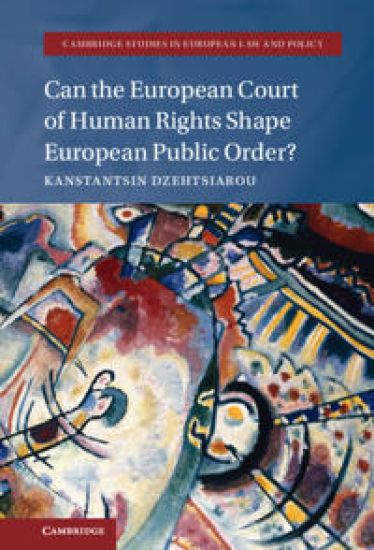
Can the European Court of Human Rights Shape European Public Order?

Can the European Court of Human Rights Shape European Public Order?

Kanstantsin Dzehtsiarou

Cambridge University Press
2021
sidottu
In this book, Kanstantsin Dzehtsiarou argues that, from the legal perspective, the formula 'European public order' is excessively vague and does not have an identifiable meaning; therefore, it should not be used by the European Court of Human Rights (ECtHR) in its reasoning. However, European public order can also be understood as an analytical concept which does not require a clearly defined content. In this sense, the ECtHR can impact European public order but cannot strategically shape it. The Court's impact is a by-product of individual cases which create a feedback loop with the contracting states. European public order is influenced as a result of interaction between the Court and the contracting parties. This book uses a wide range of sources and evidence to substantiate its core arguments: from a comprehensive analysis of the Court's case law to research interviews with the judges of the ECtHR.
Great Debates on the European Convention on Human Rights

Great Debates on the European Convention on Human Rights

Fiona de Londras; Kanstantsin Dzehtsiarou

Red Globe Press
2018
nidottu

Halvin toimitettuna 49,70 €

This engaging textbook provides a critical analysis of the legitimacy and effectiveness of the European Convention on Human Rights and its practical operation. In a succinct way, the book investigates questions around the legitimacy of how the European Court of Human Rights develops its law, the obligations of states to comply with its judgments, the adequacy of the Convention in securing basic goods, and the effectiveness of the system in protecting rights ‘in the real world’. It assesses some under-explored areas of the Convention that are often overlooked. Presenting a number of debates about the legitimacy and effectiveness of the system in a provocative and critical style, this book encourages debate, discussion, and self-reflection on how, when and why the Convention protects human rights in Europe. An ideal text for Law students at English and Welsh universities and higher education institutions taking a module in The European Convention on Human Rights (LLB or LLM level), and for GDL/CPE students and those taking the postgraduate LPC training course.
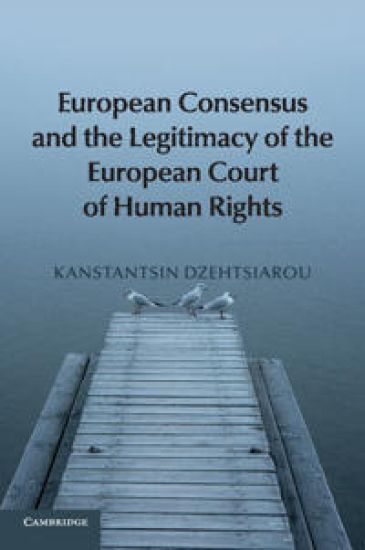
European Consensus and the Legitimacy of the European Court of Human Rights

European Consensus and the Legitimacy of the European Court of Human Rights

Kanstantsin Dzehtsiarou

Cambridge University Press
2016
pokkari

Halvin toimitettuna 43,70 €

In order to be effective, international tribunals should be perceived as legitimate adjudicators. European Consensus and the Legitimacy of the European Court of Human Rights provides in-depth analyses on whether European consensus is capable of enhancing the legitimacy of the European Court of Human Rights (ECtHR). Focusing on the method and value of European consensus, it examines the practicalities of consensus identification and application and discusses whether State-counting is appropriate in human rights adjudication. With over 30 interviews from judges of the ECtHR and qualitative analyses of the case law, this book gives readers access to firsthand and up-to-date information, and provides an understanding of how the European Court of Human Rights in Strasbourg interprets the European Convention on Human Rights.
European Consensus and the Legitimacy of the European Court of Human Rights
In order to be effective, international tribunals should be perceived as legitimate adjudicators. European Consensus and the Legitimacy of the European Court of Human Rights provides in-depth analyses on whether European consensus is capable of enhancing the legitimacy of the European Court of Human Rights (ECtHR). Focusing on the method and value of European consensus, it examines the practicalities of consensus identification and application and discusses whether State-counting is appropriate in human rights adjudication. With over 30 interviews from judges of the ECtHR and qualitative analyses of the case law, this book gives readers access to firsthand and up-to-date information, and provides an understanding of how the European Court of Human Rights in Strasbourg interprets the European Convention on Human Rights.