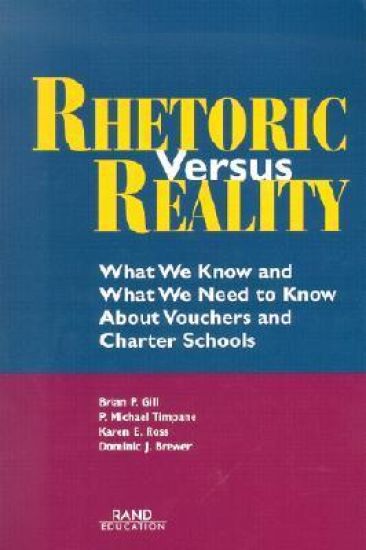
How can public schools be improved? One radical solution that has been proposed is to provide parents with a voucher for a specified dollar amount for use at any public or private school (both religious and non-religious). Proponents argue that those children using the voucher would be able to attend more effective and efficient private schools, and that the loss of students (and revenue) to public schools would force them to respond by improving their programmes. Everyone would then be better off. In what has become a fiercely contentious and highly political debate opponents claim that moving to such a voucher system on a large scale would destroy public schools and exacerbate inequities in student outcomes by class and race/ethnicity. Both sides use research evidence from a small number of voucher experiments, and other sources, to bolster their claims. In this RAND Education book, the authors take a hard look at the evidence on vouchers in education. They consider what we know and what we would like to know more about: how vouchers would affect the academic achievement of participating and non-participating students, which students might use vouchers, who would supply and regulate schooling under a voucher system, and how much a voucher system would cost. After an exhaustive and critical review, the authors conclude that the evidence for many of the positions taken by either side in the debate is remarkably weak. For example, there is little rigorous empirical analysis that suggests public schools do any better job than private schools in promoting civic values or racial/ethnic integration, and that moving to a voucher system would have disastrous consequences. However, the evidence on the positive effects of vouchers on participating students is modest at best, and there is almost no grounded analysis of the key policy questions that policymakers need to consider before moving to a large-scale voucher experiment. This book should be a useful, unbiased primer for all those interested in this controversial topic.