Kirjojen hintavertailu – 12 859 828 kirjaa ja 27 kauppaa

Kirjailija

Karen Evans

Kirjat ja teokset yhdessä paikassa: 36 kirjaa, julkaisuja vuosilta 1996–2024, suosituimpiin kuuluu A Tale Of Two Cities. Vertaile teosten hintoja ja tarkista saatavuus suomalaisista kirjakaupoista.

36 kirjaa

Kirjojen julkaisuvuodet: 1996–2024.

How Non-Permanent Workers Learn and Develop

How Non-Permanent Workers Learn and Develop

Helen Bound; Karen Evans; Sahara Sadik; Annie Karmel

Routledge
2018
sidottu
How Non-Permanent Workers Learn and Develop is an empirically based exploration of the challenges and opportunities non-permanent workers face in accessing quality work, learning, developing occupational identities and striving for sustainable working lives. Based on a study of 100 non-permanent workers in Singapore, it offers a model to guide thinking about workers’ learning and development in terms of an ‘integrated practice’ of craft, entrepreneurial and personal learning-to-learn skills. The book considers how strategies for continuing education and training can better fit with the realities of non-permanent work. Through its use of case studies, the book exams the significance of non-permanent work and its rise as a global phenomenon. It considers the reality of being a non-permanent worker and reactions to learning opportunities for these individuals. The book draws these aspects together to present a conceptual frame of ‘integrated practices’, challenging educational institutions and training providers to design and deliver learning and the enacted curriculum not as separate pieces of a puzzle, but as an integrated whole. With conclusions that have wider salience for public policy responses to the rise of non-permanent work, this book will be of great interest to academics and researchers in the fields of adult education, educational policy and lifelong learning.
Gender Responsive Justice

Gender Responsive Justice

Karen Evans

Routledge
2017
sidottu
At the end of the twentieth century a step-change in thinking about the offending behaviour of women began to impact on policy-makers concerned with the treatment of female offenders. A growing number of nations, states and organisations both national and supra-national in nature began to acknowledge that existing criminal justice and especially penal practices had not been sufficiently attentive to women’s needs and had discriminated against women as a result. The concept of ‘gender-responsive justice’ – an orientation to working with women and girls based around a consideration of the special needs of women as prisoners and their particular pathways to offending – has been developed as a result. This book explores the development of this concept, the theories which have informed it, policy arenas in which gender-responsive justice has been attempted and the practices of gender-responsive justice which have subsequently emerged. This book takes a global perspective as it outlines the different international and national arenas within which gender-responsive justice gained favour and considers what has been learned from this novel and feminist-inspired approach. Gender-responsive justice has not been without its critics, however, and this book also examines the different arguments which have been used to attack or critique the concept from varied perspectives. This book lays down a clear theoretical framework for understanding gender-responsive justice and will be useful in assessing current and future policy-making in this area.
Community and the Problem of Crime
The relationship between crime and community has a long history in criminological thought, from the early notion of the criminogenic community developed by the Chicago sociologists through to various crime prevention models in research and policy. This book offers a useful theoretical overview of key approaches to the subject of crime and community and considers the ways in which these have been applied in more practical settings. Written by an expert in the field and drawing on a range of international case studies from Europe, North America, Australia and Asia, this book explores both why and how crime and community have been linked and the implications of their relationship within criminology and crime prevention policy. Topics covered in the book include: the different crime prevention paradigms which have been utilised in the 'fight against crime', the turn to community in crime prevention policy, which took place during the 1980s in the UK and US and its subsequent development, the particular theoretical and ideological underpinnings to crime prevention work in and with different communities, the significance and impact of fear of crime on crime prevention policy, different institutional responses to working with community in crime prevention and community safety, the ways in which the experience of the UK and US have been translated into the European context, a comparison between traditional Western responses to the growing interest in restorative and community-based approaches in other regions. This book offers essential reading for students taking courses on crime and community, crime prevention and community safety, and community corrections.
A Grim Almanac of Birmingham

A Grim Almanac of Birmingham

Karen Evans

The History Press Ltd
2015
nidottu
Discover 366 gruesome tales from Birmingham’s past. With appalling accidents, frightful crimes and extraordinary deaths, there’s something to surprise even the most hardened reader. Featured here is the man who deliberately swallowed his wooden walking stick, a nineteenth-century horsemeat scandal, a drunken dispute that led to a man being stabbed in the eye with a table fork, and the lightning storm which hit a fog-signalling factory, setting off 43,000 explosions. True accounts of fires, catastrophes, murders, executions and a variety of nasty goings-on in the Birmingham of yesteryear await you within.
A Grim Almanac of Staffordshire

A Grim Almanac of Staffordshire

Karen Evans

The History Press Ltd
2014
nidottu
A Grim Almanac of Staffordshire is a day-by-day catalogue of 366 ghastly tales from around the county. Full of dreadful deeds, strange disappearances and a multitude of murders, this almanac explores the darker side of Staffordshire’s past. Here are stories of tragedy, torment and the truly unfortunate with diverse tales of freak weather, bizarre deaths and terrible accidents, including the young girl cut to pieces by a machinery explosion, the tragic deaths of 155 men in the Minnie Pit disaster of 1918, and the theatre performance where the gun really did go off, mangling the actor’s hand and causing a severed finger to fly across the stage. Uncover tales of fires, catastrophes, suicides, thefts and executions – it’s all here. Generously illustrated, this chronicle is an entertaining and readable record of Staffordshire’s grim past. Read on ... if you dare!
Improving Literacy at Work

Improving Literacy at Work

Alison Wolf; Karen Evans

Routledge
2010
sidottu
Modern societies demand high levels of literacy. The written word is pervasive; individuals with poor literacy skills are deeply disadvantaged; and governments are increasingly pre-occupied with the contribution that skills can make to economic growth. As a result, the basic skills of adult workers are of concern as never before, a focus for workplace and education policy and practice. While Improving Literacy at Work builds on detailed research from the UK, the issue is a universal one and rising skill requirements mean the conclusions drawn will be of equal interest elsewhere in Europe, USA, Canada, Australia and New Zealand. The research findings have very direct implications and practical relevance for teaching and learning, as this valuable book demonstrates, providing clear advice on how to develop effective provision and how best to support learners at work. Throughout the study, the authors address the following fundamental questions:How do adults’ literacy skills impact on their working lives, and on the enterprises where they work? How can we develop these essential skills in the workforce? When and how can literacy instruction change individuals’ employability and engagement with further learning? Essential reading for trainers and managers in industry, teachers, researchers and lecturers in adult and further education and stakeholders implementing evidence-based policy, this book maps the fundamental changes taking place in workplace literacy.
Improving Literacy at Work

Improving Literacy at Work

Alison Wolf; Karen Evans

Routledge
2010
nidottu
Modern societies demand high levels of literacy. The written word is pervasive; individuals with poor literacy skills are deeply disadvantaged; and governments are increasingly pre-occupied with the contribution that skills can make to economic growth. As a result, the basic skills of adult workers are of concern as never before, a focus for workplace and education policy and practice. While Improving Literacy at Work builds on detailed research from the UK, the issue is a universal one and rising skill requirements mean the conclusions drawn will be of equal interest elsewhere in Europe, USA, Canada, Australia and New Zealand. The research findings have very direct implications and practical relevance for teaching and learning, as this valuable book demonstrates, providing clear advice on how to develop effective provision and how best to support learners at work. Throughout the study, the authors address the following fundamental questions:How do adults’ literacy skills impact on their working lives, and on the enterprises where they work? How can we develop these essential skills in the workforce? When and how can literacy instruction change individuals’ employability and engagement with further learning? Essential reading for trainers and managers in industry, teachers, researchers and lecturers in adult and further education and stakeholders implementing evidence-based policy, this book maps the fundamental changes taking place in workplace literacy.
Learning, Work and Social Responsibility
The concept of individual responsibility has taken on a signi?cance comparable to that of ‘choice’ in the global rise of neo-liberalism of the late 20th and early 21st centuries. The rise of neo-liberalism is most often analysed through the lenses of theory, governmentality and societal structures. There has been a tendency for an- ysis to become overly abstract with the subjective experiences of the social actors missing dimensions in the literature. This book draws on more than 20 years of international research that has focused on the subjective experiences of people as actors in changing social landscapes. These landscapes are differently positioned politically, economically and socially, in relation to the rise of neo-liberalism. Comparisons enable the differences in people’s experiences to be located, explored and explained in relation to different soc- economic landscapes, thus throwing into relief the effects of neo-liberal policies where they are found. My approach is to create an extended dialogue between ideas and evidence, starting close to home, and then extending to speci?c international comparisons and to wider explorations of the central themes of the book: human agency and social responsibility. Finally, I return to social landscapes of Britain, to review the position and potential for social change in societies that exemplify what Sennett has termed ‘Anglo-American regimes’, in contrast to ‘Rhine regimes’ as exempli?ed by Germany.
Learning, Work and Social Responsibility

Learning, Work and Social Responsibility

Karen Evans

Springer-Verlag New York Inc.
2009
sidottu
The concept of individual responsibility has taken on a signi?cance comparable to that of ‘choice’ in the global rise of neo-liberalism of the late 20th and early 21st centuries. The rise of neo-liberalism is most often analysed through the lenses of theory, governmentality and societal structures. There has been a tendency for an- ysis to become overly abstract with the subjective experiences of the social actors missing dimensions in the literature. This book draws on more than 20 years of international research that has focused on the subjective experiences of people as actors in changing social landscapes. These landscapes are differently positioned politically, economically and socially, in relation to the rise of neo-liberalism. Comparisons enable the differences in people’s experiences to be located, explored and explained in relation to different soc- economic landscapes, thus throwing into relief the effects of neo-liberal policies where they are found. My approach is to create an extended dialogue between ideas and evidence, starting close to home, and then extending to speci?c international comparisons and to wider explorations of the central themes of the book: human agency and social responsibility. Finally, I return to social landscapes of Britain, to review the position and potential for social change in societies that exemplify what Sennett has termed ‘Anglo-American regimes’, in contrast to ‘Rhine regimes’ as exempli?ed by Germany.
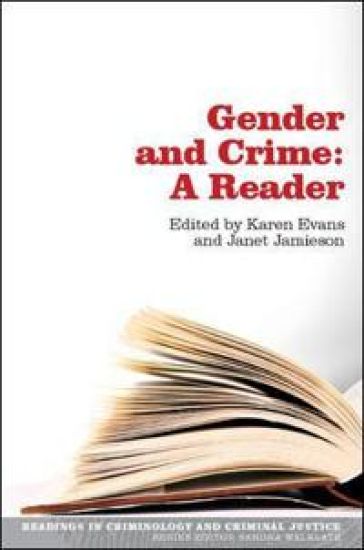
Gender and Crime: A Reader

Gender and Crime: A Reader

Karen Evans; Jamieson Janet

Open University Press
2008
nidottu
Focusing explicitly on questions of gender and crime, Evans and Jamieson guide the reader through a range of classic and groundbreaking studies, highlighting key contributions and debates and providing an indication of the new directions an engendered criminology may take us in coming years. This engaging reader is divided into five sections, mapping the theoretical, empirical, and practical developments that have endeavoured to identify the ways in which gender informs criminology. Issues addressed by the readings include: Female offendingGendered patterns of victimisationThe gendered nature of social control Masculinity and crime Placing gender in an international contextEvans and Jamieson’s powerful concluding chapter clearly sets out the achievements and the challenges that the gender and crime question has posed for criminology. They argue that unless the question of gender remains at the forefront of criminological endeavours, criminology will fail to offer an agenda informed by an understanding of social justice that strives to be attentive to both victims and offenders, whether they be male or female. Gender and Crime is key reading for students of criminology, criminal justice and gender studies.
Improving Workplace Learning

Improving Workplace Learning

Karen Evans; Phil Hodkinson; Helen Rainbird; Lorna Unwin

Routledge
2006
sidottu
Across the western world, there is a growing awareness of the importance of workplace learning, seen at the level of national and international policy, as well as in the developing practices of employers, training providers and Trades Unions. Authoritative, accessible, and appealing, it presents key findings on work-based learning, bringing together conclusions and investigating a variety of workplace contexts to show how such learning can be improved. An extensive practical treatment, brought to life with illustrations from both the public and private sectors, this book has a unique combination of breadth of coverage and depth of understanding. Grounded in rich and detailed empirical studies, this volume challenges conventional thinking. An important new addition to the Improving Learning series, it focuses on guidelines for improving learning by marrying the very best theory and practice to provide an accessible and authoritative guide to workplace learning. Practitioners, policy makers, students and academics with an interest in learning at work will find this an invaluable addition to their bookshelves.
Improving Workplace Learning

Improving Workplace Learning

Karen Evans; Phil Hodkinson; Helen Rainbird; Lorna Unwin

Routledge
2006
nidottu
Across the western world, there is a growing awareness of the importance of workplace learning, seen at the level of national and international policy, as well as in the developing practices of employers, training providers and Trades Unions. Authoritative, accessible, and appealing, it presents key findings on work-based learning, bringing together conclusions and investigating a variety of workplace contexts to show how such learning can be improved. An extensive practical treatment, brought to life with illustrations from both the public and private sectors, this book has a unique combination of breadth of coverage and depth of understanding. Grounded in rich and detailed empirical studies, this volume challenges conventional thinking. An important new addition to the Improving Learning series, it focuses on guidelines for improving learning by marrying the very best theory and practice to provide an accessible and authoritative guide to workplace learning. Practitioners, policy makers, students and academics with an interest in learning at work will find this an invaluable addition to their bookshelves.
Studying Society

Studying Society

Karen Evans; Dave King

Routledge
2005
sidottu
This introductory text combines study skills and research methods to provide students with an invaluable guide to the techniques, practical skills and methods of study that will enable them to achieve success in their academic courses and become effective 'students of society'. It covers key topics such as: asking questions – how to formulate questions and think about essay and exam questionslooking for answers – the strengths and limitations of different information sourcescollecting and organizing information – how to get the best from indexes, contents pages and electronic search enginesevaluating the authority, currency and validity of the information collected communicating through essays, reports and oral presentations. Throughout the book there is an emphasis on applying the problems and solutions presented, to ‘real world’ issues, including the use of examples and exercises immediately relevant to the undergraduate experience, everyday life and the contemporary concepts studied by the social scientist. Coherent and up-to-date, this text will be an invaluable learning tool for students of any discipline involving the study of human beings and their societies.
Studying Society

Studying Society

Karen Evans; Dave King

Routledge
2005
nidottu
This introductory text combines study skills and research methods to provide students with an invaluable guide to the techniques, practical skills and methods of study that will enable them to achieve success in their academic courses and become effective 'students of society'. It covers key topics such as: asking questions – how to formulate questions and think about essay and exam questionslooking for answers – the strengths and limitations of different information sourcescollecting and organizing information – how to get the best from indexes, contents pages and electronic search enginesevaluating the authority, currency and validity of the information collected communicating through essays, reports and oral presentations. Throughout the book there is an emphasis on applying the problems and solutions presented, to ‘real world’ issues, including the use of examples and exercises immediately relevant to the undergraduate experience, everyday life and the contemporary concepts studied by the social scientist. Coherent and up-to-date, this text will be an invaluable learning tool for students of any discipline involving the study of human beings and their societies.