Kirjojen hintavertailu – 12 859 818 kirjaa ja 27 kauppaa

Kirjailija

Karin Kukkonen

Kirjat ja teokset yhdessä paikassa: 9 kirjaa, julkaisuja vuosilta 2013–2026, suosituimpiin kuuluu Probability Designs. Vertaile teosten hintoja ja tarkista saatavuus suomalaisista kirjakaupoista.

9 kirjaa

Kirjojen julkaisuvuodet: 2013–2026.

Creativity and Contingency in Literary Writing

Creativity and Contingency in Literary Writing

Karin Kukkonen

BLOOMSBURY PUBLISHING PLC
2026
sidottu

Halvin toimitettuna 133,10 €

The first book to investigate, analyze and theorize the creative processes of literary writers, Creativity and Contingency in Literary Writing uses author interviews, manuscript genetics and textual evidence to explore creativity from the authorial perspective. Studying an author’s practice, literary form and contextual contingencies as elements that affect literary creativity, Karin Kukkoken develops theoretical models for examining the age-old problem of artistic creation and how it has been put to works by authors from the nineteenth century to the age of digital fiction, across a range of languages. With insights from the cognitive sciences, anthropology and philosophy of mind as well as literary studies, the book calls upon interviews with Siri Hustvedt, Marina Warner, Anne Weber, Camille Laurens, Gwenaëlle Aubry, Kate Pullinger, Gunnhild Øyehaug, Maria Stepanova and György Dragomán and studies the manuscripts of Charlotte Brontë, Cora Sandel, Elsa Morante and Italo Calvino. Overcoming the traditional distinction between creative agent, process and creative product, Creativity and Contingency in Literary Writing is as accessible and illuminating as it is important to understandings of human creativity.
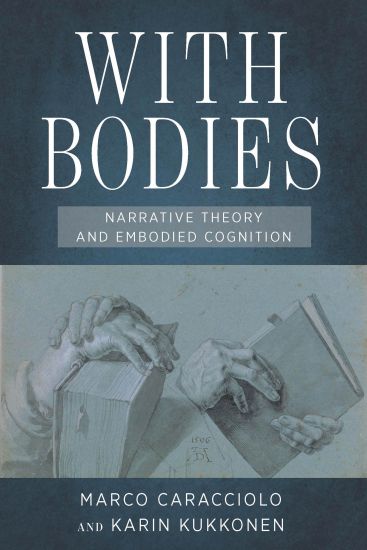
With Bodies

With Bodies

Marco Caracciolo; Karin Kukkonen

OHIO STATE UNIVERSITY PRESS
2021
pokkari

Halvin toimitettuna 49,20 €

We read not only with our eyes and minds, but with our entire body. In With Bodies, Marco Caracciolo and Karin Kukkonen move systematically through all elements of narrative and put them into dialogue with recent research in neuroscience, cognitive psychology, cognitive linguistics, and philosophy of mind to investigate what it means to read literary narratives bodily. They draw their findings from a wide corpus of material-narratives from antiquity to the present and composed in various languages, from Apuleius's Metamorphoses to Hilary Mantel's Wolf Hall-and craft their embodied narratology to retool current theories about authors, narrators and characters, time and space in storyworlds, and plot. Their investigation serves as a foundation for wider discussions on embodied narratology's contributions to literary history, computation and AI, posthumanism, gender studies, and world literature.
With Bodies

With Bodies

Marco Caracciolo; Karin Kukkonen

OHIO STATE UNIVERSITY PRESS
2021
sidottu
We read not only with our eyes and minds, but with our entire body. In With Bodies, Marco Caracciolo and Karin Kukkonen move systematically through all elements of narrative and put them into dialogue with recent research in neuroscience, cognitive psychology, cognitive linguistics, and philosophy of mind to investigate what it means to read literary narratives bodily. They draw their findings from a wide corpus of material-narratives from antiquity to the present and composed in various languages, from Apuleius's Metamorphoses to Hilary Mantel's Wolf Hall-and craft their embodied narratology to retool current theories about authors, narrators and characters, time and space in storyworlds, and plot. Their investigation serves as a foundation for wider discussions on embodied narratology's contributions to literary history, computation and AI, posthumanism, gender studies, and world literature.
Litteraturvetenskap II

Litteraturvetenskap II

Sigrid Schottenius Cullhed; Andreas Hedberg; Johan Svedjedal; Karl Berglund; Margaretha Fahlgren; Carin Franzén; Thomas Götselius; Paula Henrikson; Sam Holmqvist; Karin Kukkonen; Christian Lenemark; Jerry Määttä; Magnus Nilsson; Anna Nordenstam; Ann Steiner; Marie Öhman

Studentlitteratur AB
2020
nidottu
Litteraturvetenskap II fördjupar och breddar kunskaperna om olika teorier och metoder inom det litteraturvetenskapliga forskningsområdet. Boken omfattar tretton kapitel, skrivna av specialister inom olika litteraturvetenskapliga fält. Syftet är bland annat att ge vägledning och inspiration för studenter som planerar att skriva en påbyggnadsuppsats. Kapitlen behandlar sedan länge etablerade fält inom litteratur­­forskningen som textkritik, studier av författares själv­fram­ställning och autofiktion, populärlitteratur, forskning kring kön, genus, klass och etnicitet, litteraturdidaktik, psykoanalytiska perspektiv och diskursanalys. I boken finns också översikter av områden som har diskuteras särskilt under de senaste åren: queerstudier, medieteori, kognitionsforskning, samt digital humaniora och fjärrläsning. Litteraturvetenskap II vänder sig främst till studenter på avancerad nivå inom litteraturvetenskap och lärarutbildningens litteraturkurser. Syskonvolymen Litteraturvetenskap I är avsedd för studenter på grundläggande nivå.
Probability Designs

Probability Designs

Karin Kukkonen

Oxford University Press Inc
2020
sidottu
In Probability Designs, Karin Kukkonen proposes a new perspective on the complex role of predictions and probabilities in the dynamics of literary narrative. Predictive processing, an emerging account of cognition in neuroscience, psychology, and philosophy, provides the theoretical backdrop for an investigation of how literary texts shape readers' expectations and experience. Through deft analysis of the literary canon in a variety of cultures and languages, she constructs a comprehensive model of probability in a novel's plots, immersive appeal, and potential for reflection. Linking predictive processing to the idea that culture and cognition always develop in tandem, Kukkonen then sketches a place for literature and literary form in this exchange - a mode of exploratory thinking that takes language and writing to the next level. Chance encounters, last-minute rescues, and coincidences launch Kukkonen's investigation of the literary manipulation of predictions. Through an enlightening blend of cognitive sciences and literary theory, Probability Designs enriches scholarly debates in literary studies and sheds light on how vital literature is for human thought.
4E Cognition and Eighteenth-Century Fiction

4E Cognition and Eighteenth-Century Fiction

Karin Kukkonen

Oxford University Press Inc
2019
sidottu
When the novel broke into cultural prominence in the eighteenth century, it became notorious for the gripping, immersive style of its narratives. In this book, Karin Kukkonen explores this phenomenon through the embodied style in Eliza Haywood's flamboyant amatory fiction, Charlotte Lennox's work as a cultural broker between Britain and France, Sarah Fielding's experimental novels, and Frances Burney's practice of life-writing and fiction-writing. Four female authors who are often written out of the history of the genre are here foregrounded in a critical account that emphasizes the importance of engaging readers' minds and bodies, and which invites us to revisit our understanding of the rise of the modern novel. Kukkonen's innovative theoretical approach is based on the approach of 4E cognition, which views thinking as profoundly embodied and embedded in social and material contexts, extending into technologies and material devices (such as a pen), and enactive in the inherent links between perceiving the world and moving around in it. 4E Cognition and Eighteenth-Century Fiction investigates the eighteenth-century novel through each of these trajectories and shows how language explores its embodied dimension by increasing the descriptions of inner perception, or the bodily gestures around spoken dialogue. The embodied dimension is then related to the media ecologies of letter-writing, book learning, and theatricality. As the novel feeds off and into these social and material contexts, it comes into its own as a lifeworld technology that might not answer to standards of nineteenth-century realism but that feels 'real' because it is integrated into the lifeworld and embodied experiences. 4E cognition answers one of the central challenges to cognitive literary studies: how to integrate historical and cultural contexts into cognitive approaches.
A Prehistory of Cognitive Poetics

A Prehistory of Cognitive Poetics

Karin Kukkonen

Oxford University Press Inc
2017
sidottu
This study provides an introduction to the neoclassical debates around how literature is shaped in concert with the thinking and feeling human mind. Three key rules of neoclassicism, namely, poetic justice (the rewards and punishments of characters in the plot), the unities (the coherence of the fictional world and its extensions through the imagination) and decorum (the inferential connections between characters and their likely actions), are reconsidered in light of social cognition, embodied cognition and probabilistic, predictive cognition. The meeting between neoclassical criticism and today's research psychology, neurology and philosophy of mind yields a new perspective for cognitive literary study. Neoclassicism has a crucial contribution to make to current debates around the role of literature in cultural and cognition. Literary critics writing at the time of the scientific revolution developed a perspective on literature the question of how literature engages minds and bodies as its central concern. A Prehistory of Cognitive Poetics traces the cognitive dimension of these critical debates in seventeenth- and eighteenth-century Britain and puts them into conversation with today's cognitive approaches to literature. Neoclassical theory is then connected to the praxis of eighteenth-century writers in a series of case studies that trace how these principles shaped the emerging narrative form of the novel. The continuing relevance of neoclassicism also shows itself in the rise of the novel, as A Prehistory of Cognitive Poetics illustrates through examples including Pamela, Tom Jones and the Gothic novel.
Contemporary Comics Storytelling

Contemporary Comics Storytelling

Karin Kukkonen

University of Nebraska Press
2013
sidottu
What if fairy-tale characters lived in New York City? What if a superhero knew he was a fictional character? What if you could dispense your own justice with one hundred untraceable bullets? These are the questions asked and answered in the course of the challenging storytelling in Fables, Tom Strong, and 100 Bullets, the three twenty-first-century comics series that Karin Kukkonen considers in depth in her exploration of how and why the storytelling in comics is more than merely entertaining. Applying a cognitive approach to reading comics in all their narrative richness and intricacy, Contemporary Comics Storytelling opens an intriguing perspective on how these works engage the legacy of postmodernism—its subversion, self-reflexivity, and moral contingency. Its three case studies trace how contemporary comics tie into deep traditions of visual and verbal storytelling, how they reevaluate their own status as fiction, and how the fictional minds of their characters generate complex ethical thought experiments. At a time when the medium is taken more and more seriously as intricate and compelling literary art, this book lays the groundwork for an analysis of the ways in which comics challenge and engage readers' minds. It brings together comics studies with narratology and literary criticism and, in so doing, provides a new set of tools for evaluating the graphic novel as an emergent literary form.
Studying Comics and Graphic Novels

Studying Comics and Graphic Novels

Karin Kukkonen

John Wiley Sons Inc
2013
nidottu

Halvin toimitettuna 34,20 €

This introduction to studying comics and graphic novels is a structured guide to a popular topic. It deploys new cognitive methods of textual analysis and features activities and exercises throughout. Deploys novel cognitive approaches to analyze the importance of psychological and physical aspects of reader experienceCarefully structured to build a sequenced, rounded introduction to the subjectIncludes study activities, writing exercises, and essay topics throughoutDedicated chapters cover popular sub-genres such as autobiography and literary adaptation