Kirjojen hintavertailu – 12 903 725 kirjaa ja 27 kauppaa

Kirjailija

Karl Boyd Brooks

Kirjat ja teokset yhdessä paikassa: 4 kirjaa, julkaisuja vuosilta 2006–2009, suosituimpiin kuuluu Public Power, Private Dams. Vertaile teosten hintoja ja tarkista saatavuus suomalaisista kirjakaupoista.

4 kirjaa

Kirjojen julkaisuvuodet: 2006–2009.

Before Earth Day

Before Earth Day

Karl Boyd Brooks

University Press of Kansas
2009
nidottu
Most Americans—even environmentalists—date the emergence of laws protecting nature to the early 1970s. But Karl Boyd Brooks shows that, far from being a product of that activist decade, American environmental law emerged well before the first Earth Day, often in unexpected places far from Capitol Hill. Surveying the landscape from the end of World War II to Earth Day 1970, Brooks traces a dramatic shift in Americans’ relationship to the environment and the emergence of new environmental statutes. He takes readers into legislative hearing rooms, lawyers’ conferences, and administrators’ offices to describe how Americans forged a new body of law that reflected their hopes for rescuing the land from air pollution, deforestation, and other potential threats. For while previous law had treated nature as a commodity, more and more Americans had come to see it as a national treasure worth preserving. Brooks explores the way key features of the New Deal’s legal legacy influenced environmental law. This path-breaking environmental history examines how cultural, intellectual, and economic changes in postwar America brought about new solutions to environmental problems that threatened public health and degraded natural aesthetics. Visiting riverbanks and freeways, duck blinds and airsheds, Before Earth Day reveals the new strategies and efforts by which the unceasing process of legal change created environmental law. And through real-world examples—how Los Angelenos pressed cases about water and air quality, how an Idaho lawyer helped clients pursue new environmental regulations, how citizens challenged government and corporate plans to dam rivers—Brooks demonstrates that key changes in property, procedure, contract, and other legal rules in those early years stimulated the national environmental laws to come. Gracefully written and meticulously researched, Brooks’s work dramatically updates our understanding of the origins of environmental law. By taking the postwar years more seriously, he shows that earlier actions across the country played a central role in shaping the structure and goals of well-known federal laws passed during the “environmental decade” of the seventies. Before Earth Day describes nothing less than an entirely new way of thinking, as environmental law emerged from local jurisdictions to reshape national agendas, firing the popular imagination and only then remodelling law school curricula.
Before Earth Day

Before Earth Day

Karl Boyd Brooks

University Press of Kansas
2009
sidottu
Most Americans - even environmentalists - date the emergence of laws protecting nature to the early 1970s. But Karl Boyd Brooks shows that, far from being a product of that activist decade, American environmental law emerged well before the first Earth Day, often in unexpected places far from Capitol Hill. Surveying the landscape from the end of World War II to Earth Day 1970, Brooks traces a dramatic shift in Americans' relationship to the environment and the emergence of new environmental statutes. He takes readers into legislative hearing rooms, lawyers' conferences, and administrators' offices to describe how Americans forged a new body of law that reflected their hopes for rescuing the land from air pollution, deforestation, and other potential threats. For while previous law had treated nature as a commodity, more and more Americans had come to see it as a national treasure worth preserving. Brooks explores the way key features of the New Deal's legal legacy influenced environmental law. This path-breaking environmental history examines how cultural, intellectual, and economic changes in postwar America brought about new solutions to environmental problems that threatened public health and degraded natural aesthetics. Visiting riverbanks and free ways, duck blinds and air sheds, Before Earth Day reveals the new strategies and efforts by which the unceasing process of legal change created environmental law. And through real-world examples - how Los Angelenos pressed cases about water and air quality, how an Idaho lawyer helped clients pursue new environmental regulations, how citizens challenged government and corporate plans to dam rivers - Brooks demonstrates that key changes in property, procedure, contract, and other legal rules in those early years stimulated the national environmental laws to come. Gracefully written and meticulously researched, Brooks' work dramatically updates our understanding of the origins of environmental law. By taking the postwar years more seriously, he shows that earlier actions across the country played a central role in shaping the structure and goals of well-known federal laws passed during the 'environmental decade' of the seventies. ""Before Earth Day"" describes nothing less than an entirely new way of thinking, as environmental law emerged from local jurisdictions to reshape national agendas, firing the popular imagination and only then remodeling law school curricula.
Public Power, Private Dams

Public Power, Private Dams

Karl Boyd Brooks; William Cronon

University of Washington Press
2009
pokkari
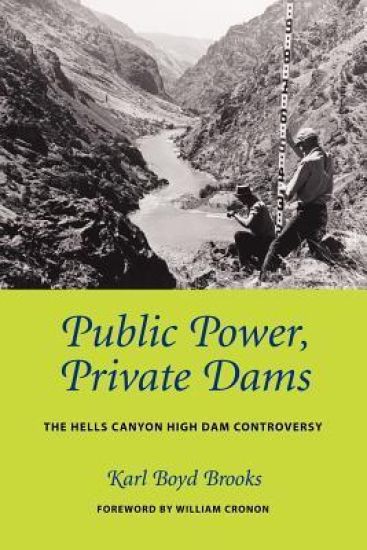
In the years following World War II, the world's biggest dam was almost built in Hells Canyon on the Snake River in Idaho. Karl Boyd Brooks tells the story of the dam controversy, which became a referendum not only on public-power expansion but also on the environmental implications of the New Deal's natural resources and economic policy. Private-power critics of the Hells Canyon High Dam posed difficult questions about the implications of damming rivers to create power and to grow crops. Activists, attorneys, and scientists pioneered legal tactics and political rhetoric that would help to define the environmental movement in the 1960s. The debate, however, was less about endangered salmon or threatened wild country and more about who would control land and water and whether state enterprise or private capital would oversee the supply of electricity. By thwarting the dam's construction, Snake Basin irrigators retained control over water as well as economic and political power in Idaho, putting the state on a postwar path that diverged markedly from that of bordering states. In the end, the opponents of the dam were responsible for preserving high deserts and mountain rivers from radical change. With Public Power, Private Dams, Karl Brooks makes an important contribution not only to the history of the Pacific Northwest and the region's anadromous fisheries but also to the environmental history of the United States in the period after World War II.
Public Power, Private Dams

Public Power, Private Dams

Karl Boyd Brooks; William Cronon

University of Washington Press
2006
sidottu
In the years following World War II, the world's biggest dam was almost built in Hells Canyon on the Snake River in Idaho. Karl Boyd Brooks tells the story of the dam controversy, which became a referendum not only on public-power expansion but also on the environmental implications of the New Deal's natural resources and economic policy. Private-power critics of the Hells Canyon High Dam posed difficult questions about the implications of damming rivers to create power and to grow crops. Activists, attorneys, and scientists pioneered legal tactics and political rhetoric that would help to define the environmental movement in the 1960s. The debate, however, was less about endangered salmon or threatened wild country and more about who would control land and water and whether state enterprise or private capital would oversee the supply of electricity. By thwarting the dam's construction, Snake Basin irrigators retained control over water as well as economic and political power in Idaho, putting the state on a postwar path that diverged markedly from that of bordering states. In the end, the opponents of the dam were responsible for preserving high deserts and mountain rivers from radical change. With Public Power, Private Dams, Karl Brooks makes an important contribution not only to the history of the Pacific Northwest and the region's anadromous fisheries but also to the environmental history of the United States in the period after World War II.