Kirjojen hintavertailu – 12 903 725 kirjaa ja 27 kauppaa

Kirjailija

Karl Freudenberg

Kirjat ja teokset yhdessä paikassa: 8 kirjaa, julkaisuja vuosilta 1927–2022, suosituimpiin kuuluu Natural Weapons. Vertaile teosten hintoja ja tarkista saatavuus suomalaisista kirjakaupoista.

8 kirjaa

Kirjojen julkaisuvuodet: 1927–2022.

Natural Weapons

Natural Weapons

Karl Freudenberg

BudoWorks
2022
pokkari
Many Americans who would like to learn Karate, Judo, and Jujitsu have neither the time nor the money to devote to studying them. Thus those who teach these techniques throughout the United States are continually being asked to compile a single course of instruction in attack and defense. One such teacher, Karl Freudenberg-a prominent exponent of all three techniques-has here prepared a manual of essentials to help the man who wants to increase his fighting potential, a manual that, if studied diligently, will provide the reader with the means to make the best of his "natural weapons." Mr. Freudenberg's book offers chapters on using the hands as weapons, effective karate punching, the "Kung-fu chop," throwing preparation and techniques, and restraining methods. It should serve as an excellent introduction to the art and science of Karate, Judo, and Jujitsu.

Natural Weapons: Manual of Karate, Judo and Jujitsu

Natural Weapons: Manual of Karate, Judo and Jujitsu

Karl Freudenberg; Richard Price

Literary Licensing, LLC
2011
sidottu
""Natural Weapons: Manual Of Karate, Judo And Jujitsu"" is a comprehensive guide to three martial arts disciplines, written by Karl Freudenberg. The book is designed to provide readers with a practical understanding of the techniques and principles of karate, judo, and jujitsu, and how they can be used for self-defense. The book begins with an introduction to each of the three martial arts, including their history and origins. It then delves into the fundamental principles of each discipline, such as stance, footwork, and striking techniques. The author provides detailed instructions and illustrations for each technique, making it easy for readers to follow along and practice on their own. Throughout the book, Freudenberg emphasizes the importance of discipline, focus, and mental toughness in martial arts training. He also stresses the importance of safety and respect for one's opponents, both in training and in real-life situations. Whether you are a beginner or an experienced martial artist, ""Natural Weapons: Manual Of Karate, Judo And Jujitsu"" is a valuable resource for anyone looking to improve their skills and knowledge of these powerful self-defense disciplines. This scarce antiquarian book is a facsimile reprint of the old original and may contain some imperfections such as library marks and notations. Because we believe this work is culturally important, we have made it available as part of our commitment for protecting, preserving, and promoting the world's literature in affordable, high quality, modern editions, that are true to their original work.
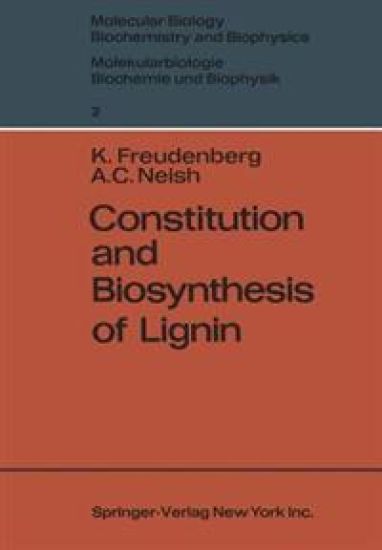
Constitution and Biosynthesis of Lignin

Constitution and Biosynthesis of Lignin

Karl Freudenberg; A. C. Neish

Springer-Verlag Berlin and Heidelberg GmbH Co. K
1968
nidottu
Among terrestrial plants the vascular plants are the largest and the most con­ spicuous. Because of the presence of lignified supporting and conducting tissues such as xylem, terrestrial vascular plants can develop large upright forms. Composed mainly of xylem tissue, the stems of trees are characterized by elongated cells with thickened walls, impregnated by lignin. Diagrams of xylem cells (vessels, tracheids and fibers) can be seen in textbooks of plant anatomy (e. g. ESAU, 1953). A cross section of xylem tissue is shown in the section of this volume written by Professor FREUDENBERG (Fig. 1, p. 98). In general the occurrence of lignin in the plant kingdom is associated with the presence of these cells which comprise xylem. Thus lignin is found in vascular plants such as lycopods, ferns, gymnosperms and angiosperms, whereas it is absent from simple plants such as fungi, and from all other organisms. The mosses are an exceptional group which do not have the cells characteristic of xylem tissue but which contain lignin-like materials. These "moss lignins" have been discussed by Professor FREUDENBERG in this volume, and some doubts have been expressed as to whether or not they are true lignins (FR. * pp. 113-114). Work on the chemistry of lignin indicates that it is a polymer derived from the phenylpropanoid compound, coniferyl alcohol and related alcohols.