Kirjojen hintavertailu – 12 903 724 kirjaa ja 27 kauppaa

Kirjailija

Karl Henrik Sivesind

Kirjat ja teokset yhdessä paikassa: 6 kirjaa, julkaisuja vuosilta 2004–2024, suosituimpiin kuuluu Management in Scandinavia. Vertaile teosten hintoja ja tarkista saatavuus suomalaisista kirjakaupoista.

6 kirjaa

Kirjojen julkaisuvuodet: 2004–2024.

Management in Scandinavia

Management in Scandinavia

Jette Schramm-Nielsen; Peter Lawrence; Karl Henrik Sivesind

Edward Elgar Publishing Ltd
2004
sidottu
This book contributes to the expanding field of cross-cultural and comparative management, and addresses the issue of whether the main Scandinavian countries - Denmark, Norway and Sweden - exhibit such similarities in management style and practice as to constitute a country cluster. It is based on a qualitative, interview-driven study of managers in companies matched by industry in the three countries and seeks to contextualise the research findings in a general discussion of the Scandinavian countries, showing their intertwined histories and similar institutions and values. The book argues that the central values of these managers are equality, informality, decency, and conflict avoidance; it shows that the behaviour of Scandinavian managers is inspired by these values and that they can be attributed to national culture and not to the peculiarities of any particular industry. Management in Scandinavia will be of interest to students and teachers of international management, as well as practitioners of business and management.

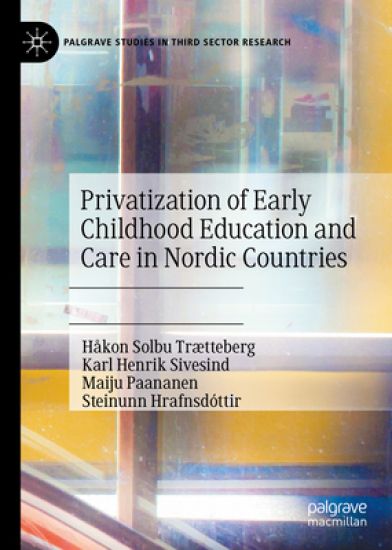
Privatization of Early Childhood Education and Care in Nordic Countries

Privatization of Early Childhood Education and Care in Nordic Countries

Håkon Solbu Trætteberg; Karl Henrik Sivesind; Maiju Paananen; Steinunn Hrafnsdóttir

Springer International Publishing AG
2023
sidottu
This book explores the increasing role of private providers in early childhood education and care (ECEC) as they become a core part of the Nordic welfare model—one that once rejected for-profit involvement in public welfare. Within this context, ECEC has become the key battleground over private providers’ role in the welfare system. Chapters compare five Nordic countries: Iceland, Finland, Denmark, Sweden, and Norway, to discuss possible benefits from having different types of providers—public, nonprofit, and for-profit—in the welfare mix. To conclude, the authors also provide a comparative perspective on governance of the ECEC sector and on the development and functions of the Nordic welfare model.
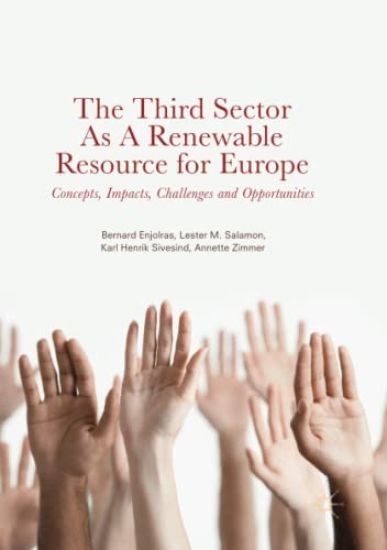
The Third Sector as a Renewable Resource for Europe

The Third Sector as a Renewable Resource for Europe

Bernard Enjolras; Lester M. Salamon; Karl Henrik Sivesind; Annette Zimmer

Springer Nature Switzerland AG
2018
nidottu
This book provides a critical account of the third sector and its future in Europe. It offers an original conceptualization of the third sector in its European manifestations alongside an overview of its major contours, including its structure, sources of support, and recent trends. It also assesses the impact of this sector in Europe which considers its contributions to European economic development, citizen well-being and human development. The Third Sector As A Renewable Resource for Europe presents the findings of the Third Sector Impact (TSI) project funded by the European Union’s Seventh Framework Program (FP7). It recognises that in a time of social and economic distress, as well as enormous pressures on governmental budgets, the third sector and volunteering represent a unique ‘renewable resource’ for social and economic problem-solving and civic engagement in Europe.
The Third Sector as a Renewable Resource for Europe

The Third Sector as a Renewable Resource for Europe

Bernard Enjolras; Lester M. Salamon; Karl Henrik Sivesind; Annette Zimmer

Springer International Publishing AG
2018
sidottu
This book provides a critical account of the third sector and its future in Europe. It offers an original conceptualization of the third sector in its European manifestations alongside an overview of its major contours, including its structure, sources of support, and recent trends. It also assesses the impact of this sector in Europe which considers its contributions to European economic development, citizen well-being and human development. The Third Sector As A Renewable Resource for Europe presents the findings of the Third Sector Impact (TSI) project funded by the European Union’s Seventh Framework Program (FP7). It recognises that in a time of social and economic distress, as well as enormous pressures on governmental budgets, the third sector and volunteering represent a unique ‘renewable resource’ for social and economic problem-solving and civic engagement in Europe.
Civil Society in Comparative Perspective

Civil Society in Comparative Perspective

Bernard Enjolras; Karl Henrik Sivesind

Emerald Publishing Limited
2009
sidottu
This book presents a collection of comparative studies of civil society around two main issues: the comparison and analysis of civil society regimes in relation to different constructions of citizenship and welfare states and the role of civil society in governance and active participation of citizens. The first part of the book is concerned with comparisons of civil society institutional frameworks and regimes. In this section the contributions address the ways institutional cross-countries comparisons may be undertaken and discuss the extent to which common trends or divergent tendencies characterize national civil societies. The second part focuses on the role of civil society as a vector of citizens' participation and as an avenue for democracy. Democratic citizenship is often considered as requiring, in addition to a set of formal rights and obligations, a public sphere within which citizens can actively participate within and beyond the state. Building on international comparisons the articles in this section discuss the extent to and the modalities by which civil society is crucial to the functioning of democracy and the plain exercise of citizenship.