Kirjojen hintavertailu – 12 859 819 kirjaa ja 27 kauppaa

Kirjailija

Karl von Holdt

Kirjat ja teokset yhdessä paikassa: 6 kirjaa, julkaisuja vuosilta 2003–2025, suosituimpiin kuuluu New South African Review 2. Vertaile teosten hintoja ja tarkista saatavuus suomalaisista kirjakaupoista.

6 kirjaa

Kirjojen julkaisuvuodet: 2003–2025.

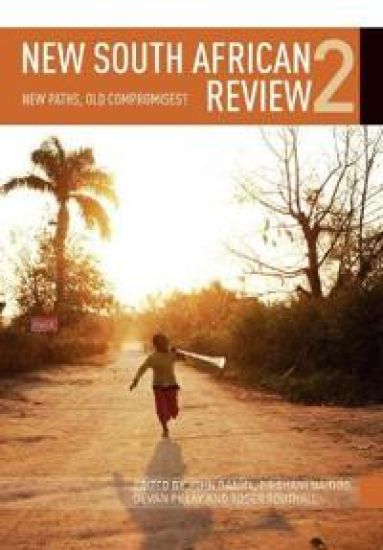
New South African Review 2

New South African Review 2

William Attwell; Leslie Bank; Naidoo Prishani; Patrick Bond; Imraan Buccus; John Daniel; Jane Duncan; Fig David; Hamill James; Janine Hicks; John Hoffman; Paul Hoffman; Malose Langa; Lindsay Don; Clifford Mabhena; Rajohane Matshedisho; Pillay Devan; Saloojee Haroon; Satgar Vishwas; Christopher Saunders; Sharife Khadija; Skinner Kate; Southall Roger; Neil Southern; Karl von Holdt; Edward Webster; Williams Michelle

Wits University Press
2011
nidottu
The second volume of the New South African Review (NSAR) continues a tradition of debate and critical, analytical scholarship about contemporary South Africa. Drawing on authors from academia and beyond, it aims to be informative, discursive and provocative. In this volume, the New Growth Path (NGP) adopted by the South African government in 2010 provides the basis for a debate about whether 'decent work' is the best possible solution to South Africa's problems of low economic growth and high unemployment. Rising inequality is explored against the backdrop of the failings of Black Economic Empowerment (BEE) and Broad-Based Black Economic Empowerment (BBBEE). The NGP's proposals for 'greening the economy' are discussed, with emphasis on the creation of 'green jobs' and biofuels. The volume also includes investigations into the crisis of acid mine drainage on the Witwatersrand, and other persistent environmental challenges. Possibilities for participatory forms of government are surveyed, and civil society activism is explored in relation to the South African Broadcasting Corporation (SABC) and environmental campaigns. The crisis in child care in public hospitals, the difficulties that characterise attempts at building relationships between the police and a township community, and the problems related to the absence of legislation to govern the powers of traditional authorities over land allocation (through the experience of the Eastern Cape) are also featured. Asking whether the NGP reflects a set of new policies or an attempt to re-dress old (com)promises in new clothes, this volume brings together different voices in debate about possibilities for alternatives to neo-liberal and capitalist development in South Africa.
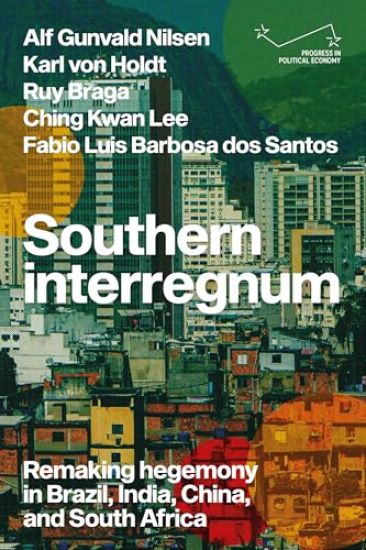
Southern Interregnum

Southern Interregnum

Alf Gunvald Nilsen; Karl von Holdt; Ruy Braga; Ching Kwan Lee; Fabio Luis Barbosa dos Santos

MANCHESTER UNIVERSITY PRESS
2025
sidottu
How do governing elites in the global South attempt to remake hegemony in a conjuncture of durable crisis? This is the question at the core of Southern interregnum, a comparative conjunctural analysis of hegemonic projects in Brazil, India, China, and South Africa. Working with a Gramscian notion of crisis, centred on the interregnum as an enduring period of instability and uncertainty, in which hegemonic authority erodes and competing projects for crisis resolution emerge, the book proposes a novel critical reading of the convulsions that are currently reshaping the political economy of the global South and the world-system. Mapping the variegated trajectories of elite projects to reconcile accumulation and legitimation – and probing the limits of these projects – the book breaks new ground in the study of the contemporary global South.
State Capture in South Africa

State Capture in South Africa

Mbongiseni Buthelezi; Peter Vale; Karl von Holdt; Robyn Foley; Ryan Brunette; Jonathan Klaaren; Cherese Thakur; Devi Pillay; Luke Spiropoulos; Reg Rumney; Sizwe Mpofu-Walsh; Michael Marchant; Hennie van Vuuren; Patrick Heller; Barney Pityana

WITS UNIVERSITY PRESS
2023
pokkari
A multidisciplinary analysis of how state capture unfolded in South Africa and was contested within both civil society and the state itself. It presents a scholarly and empirical understanding of how things went awry, even with various regulating bodies in place, and how to prevent state capture from happening again in the future. The metaphor of 'state capture' has dominated South Africa's political discourse in the post-Zuma presidency era. What is state capture and how does it manifest? Is it just another example of a newly independent, failed African state? And is it unique to South Africa? The contributors in this collection try to explain the phenomenon from a variety of viewpoints and disciplines. All hold fast to the belief that the democracy that promised the country so much when apartheid ended has been significantly eroded, resulting in most citizens expressing a loss of hope for the future. Read together, the essays cumulatively show not only how state capture was enabled and who benefitted, but also how and by whom it was scrutinised and exposed in order to hold those in power accountable. The book aims to present a scholarly and empirical understanding of how things went awry, even with various regulating bodies in place, and how to prevent state capture from happening again in the future.
State Capture in South Africa

State Capture in South Africa

Mbongiseni Buthelezi; Peter Vale; Karl Von Holdt; Robyn Foley; Ryan Brunette; Jonathan Klaaren; Cherese Thakur; Devi Pillay; Luke Spiropoulos; Reg Rumney; Sizwe Mpofu-Walsh; Michael Marchant; Hennie Van Vuuren; Patrick Heller; Barney Pityana

WITS UNIVERSITY PRESS
2023
sidottu
A multidisciplinary analysis of how state capture unfolded in South Africa and was contested within both civil society and the state itself. It presents a scholarly and empirical understanding of how things went awry, even with various regulating bodies in place, and how to prevent state capture from happening again in the future. The metaphor of 'state capture' has dominated South Africa's political discourse in the post-Zuma presidency era. What is state capture and how does it manifest? Is it just another example of a newly independent, failed African state? And is it unique to South Africa? The contributors in this collection try to explain the phenomenon from a variety of viewpoints and disciplines. All hold fast to the belief that the democracy that promised the country so much when apartheid ended has been significantly eroded, resulting in most citizens expressing a loss of hope for the future. Read together, the essays cumulatively show not only how state capture was enabled and who benefitted, but also how and by whom it was scrutinised and exposed in order to hold those in power accountable. The book aims to present a scholarly and empirical understanding of how things went awry, even with various regulating bodies in place, and how to prevent state capture from happening again in the future.
Conversations with Bourdieu

Conversations with Bourdieu

Burawoy Michael; Karl von Holdt

Wits University Press
2011
nidottu
Pierre Bourdieu (1930-2002) is the most influential sociologist of our time. His works take in education, culture, sport, literature, painting, class, philosophy, religion, law, media, intellectuals, methodology, photography, universities, colonialism, kinship, schooling and politics. Not much remains outside Bourdieu's sociological eye. His works are widely read across disciplines and he was one of the most prominent public intellectuals in France. Conversations with Bourdieu presents the first comprehensive attempt at a critical engagement with Bourdieu's theory as a totality. Michael Burawoy constructs a series of imaginary conversations between Bourdieu and his nemesis, Marxism, from which he silently borrowed so much. Starting with Marx, and proceeding through Gramsci, Fanon, Freire, de Beauvoir, and Mills, Burawoy takes up the challenge Bourdieu presents to Marxism, simultaneously developing a critique of Bourdieu and a reconstruction of Marxism. Karl Von Holdt, in turn, brings these conversations to South Africa, showing the relevance of Bourdieu's ideas to a country he never visited. Armed with Bourdieu, Von Holdt takes up some of the most pressing social and political issues of contemporary South Africa: the relation between symbolic and real violence, the place of intellectuals in public life, the intervention of gender in politics, the grappling with race, the critique of education, the importance of habitus, the history and future of class mobilisation, and the legacy of the liberation struggle. Conversations with Bourdieu pioneers a distinctive approach to doing social theory that is neither a combat sport nor an artificial synthesis, but a way of pushing theory to its limits through dialogue; dialogue between theorists and dialogue between theory and the world it represents. The book is distinctive too in pointing towards a new global sociology consciously rooted in a dialogue between the social realities and theoretical perspectives of North and South. The conversations were first presented as Mellon Lectures at the University of the Witwatersrand, Johannesburg in 2010
Transition from Below

Transition from Below

Karl von Holdt

University of KwaZulu-Natal Press
2003
nidottu
This title takes a very different approach, exploring the transition from below at a micro-institutional level. It analyses the militant struggle of black workers against the despotism and racism of white power in the workplace, and of their participation in the broader political struggle against apartheid; the triumphant democratic breakthrough which culminated in the election of an ANC government in 1994; and the workers' strategy for reconstruction in the workplace and in local politics. The author explores the chaos and ungovernability in workplace and community as activists endeavoured to disrupt the order of apartheid, as well as the outlines of a new order that emerged from this turbulence. Simultaneously, it examines the divisions and contestation within the union - between political activists and shop stewards, between migrant outsiders and urban locals - that erupted in open conflict and violence between workers. The struggle against white power was simultaneously a struggle to build trade union organisation in a continuous process of forging and reforging the meaning and 'law' of the union. This title shows how trade union collective identity in the 1980s consisted of a complex amalgam of popular, class and workplace identities, many of which - popular political identity and migrant identity in particular - were forged beyond the workplace.