Kirjojen hintavertailu – 12 859 824 kirjaa ja 27 kauppaa

Kirjailija

Kartik Roy

Kirjat ja teokset yhdessä paikassa: 6 kirjaa, julkaisuja vuosilta 1996–2023, suosituimpiin kuuluu Economic Reform in China and India. Vertaile teosten hintoja ja tarkista saatavuus suomalaisista kirjakaupoista.

6 kirjaa

Kirjojen julkaisuvuodet: 1996–2023.

Global Hegemomy Etc Political Governance, Economic Pursuit
This treatise presents a critical discourse on the formulation and implementation of economic development policies as well as on the outcome of the implementation of such policies in terms of the attainment of the (i) rate of economic growth and of the (ii) rise in the size of GDP and of the (iii) attainment of economic and social wellbeing of the citizenry of both China and India. The author has analyzed the pattern of economic development of China and India in terms of the (i) growth in factors of production and of the (ii) growth in expenditures. The reasons for the spectacular rise in economic power of authoritarian China and the subdued rise in economic power of highly decentralized democratic India have been explained. The growth and development outcome story of China shows that the limited political freedom of citizens and of officials of provincial governments has acted as a panacea for the realization of the country's developmental goals but in India, the unlimited and uncontrolled political freedom of citizens and provincial rulers has acted as a powerful recipe for the growth of anarchy and for the realization of circumscribed goals of economic development. In 1970, the per capita income of China and India stood at $US 70.00 and $US 60.00 but in 2022 the per capita income of China and India currently stands at $US 12,536.00 and $US 2691.20. The share of India's per capita income in China's per capita income in 1970 stood at 85.71 percent. In 2022, the share of India's per capita income in China's per capita income has declined to 21.46 percent. In this book the author has discussed all these issues. Furthermore the author has also presented a short commentary on the possibility of the rapid decline of economic and political status of China by 2030 and of a steady rise of India as an economic and political Super Power.
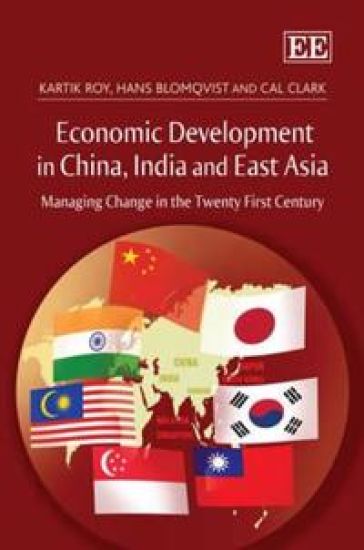
Economic Development in China, India and East Asia

Economic Development in China, India and East Asia

Kartik Roy; Hans Blomqvist; Cal Clark

Edward Elgar Publishing Ltd
2012
sidottu
This is a thorough and comprehensive study - both in terms of country coverage and in-depth analysis - covering the economic development of all the major economies in the Asian continent, namely China, India, Japan, South Korea, Taiwan, Malaysia and Singapore. Before embarking on analyses of different aspects of economic growth and development of these countries, the authors present a thought-provoking analysis of how institutional factors such as geography, history of religion, culture and political governance have been deeply interwoven with development dynamics to shape the growth and development trajectory that each country has subsequently followed. Each country’s development path consequently appeared almost be pre-determined. Japan’s role as the lead-country in technology transfer under the flying-geese pattern of development is discussed, however the emphasis has shifted of late to China, India, Korea, Malaysia and Singapore. The authors also propose that instead of discussing the failure of India to catch up with China in growth and development outcomes, economists should be commenting on whether China, bestowed with India’s highly decentralized democratic governance structure and institutional rigidities, would have been able to achieve the same results as that of India. Only then will a true understanding and appreciation of India’s achievements in economic growth and development emerge. Economic Development in China, India and East Asia will be warmly welcomed and appreciated by academics and researchers of international and development economics as well as Asian development and economics. Policy makers and those involved in NGOs in the development and aid arenas will also find this of great interest.
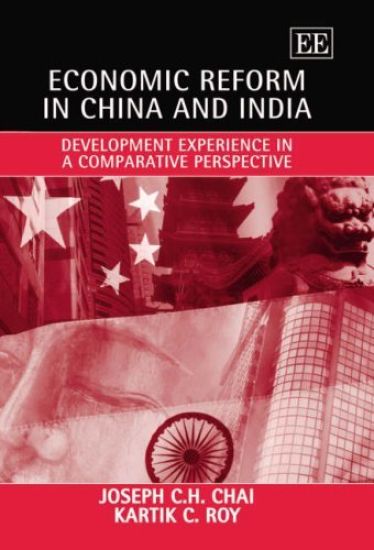
Economic Reform in China and India

Economic Reform in China and India

Joseph C.H. Chai; Kartik Roy

Edward Elgar Publishing Ltd
2006
sidottu
Recent acceleration of the Indian economic growth rate from 6 to 8 per cent has sparked worldwide speculation that India is about to catch up with China and become another Asian miracle economy. Economic Reform in China and India examines this prospect, reviewing the development strategies pursued by the two countries over the last 50 years in general and exploring recently introduced reform measures in particular. The culmination of many years of research by specialists in these economies, this book assesses the performance of China and India at both macro and sectoral levels (including economic, social, political and environmental aspects). It illustrates the reasons why China has outperformed India in the past and identifies the obstacles that India will face in its attempts to catch up with China. Providing solutions for China and India that can be applied to other developing countries, this book will be invaluable for researchers, academics and students focussing on economic development and Asian studies. It will also receive much attention from investors and government analysts interested in the strategic implications of the emergence of the two Asian economic giants.
Economic Development and Women in the World Community

Economic Development and Women in the World Community

Hans C. Blomqvist; Kartik Roy; Clement A. Tisdell

Praeger Publishers Inc
1999
nidottu
After reviewing theories about how women are likely to fare as a result of economic development, the editors and their contributors focus on the socioeconomic status of women and changes in it as a result of processes of economic development in individual countries in five continents. Economic development is supposed to remove impediments to the improvement in women's status. In some developing countries researchers have found that instead of lessening the forces of restrictions, economic development may, in fact, have strengthened them. The editors call for a greater involvement of women as active participants in the process of dismantling social, legal, and institutional barriers to women's development.
Poverty, Female-Headed Households, and Sustainable Economic Development

Poverty, Female-Headed Households, and Sustainable Economic Development

Kartik Roy; Nerina Vecchio

Praeger Publishers Inc
1998
sidottu
This book examines female-headed households (FHHs) in the world economy, aspects of their poverty, and the implications of those for sustainable development. Following a general discussion of FHHs in the world community, the work discusses FHHs in two regions of India, one being an example of unsuccesssful development and the other of successful development. The research is based on fieldwork in five rural villages. One village, comprising mostly female-headed households, provided a unique case study. The other four villages include both male- and female-headed households with a high proportion of female-headed households. The authors found that female-headed households dominate the poorer sections of the community, and women's access to resources is limited by cultural, social, and economic influences. Women, particularly those in FHHs, bear the heaviest burdens in times of economic hardship. These women face more forms of discrimination outside the home than women from male-headed households. They have fewer customary rights but greater freedom of movement and more opportunities for paid employment. The authors go on to show that the benefits of government development programs have not reached remote areas. The trickle-down approach has not worked, but sustainable development programs focusing on women's development and self-responsiblity have helped to lift the economic status of women in general and FHHs in particular.
Economic Development and Women in the World Community

Economic Development and Women in the World Community

Hans C. Blomqvist; Kartik Roy; Clement A. Tisdell

Praeger Publishers Inc
1996
sidottu
After reviewing theories about how women are likely to fare as a result of economic development, the editors and their contributors focus on the socioeconomic status of women and changes in it as a result of processes of economic development in individual countries in five continents. Economic development is supposed to remove impediments to the improvement in women's status. In some developing countries researchers have found that instead of lessening the forces of restrictions, economic development may, in fact, have strengthened them. The editors call for a greater involvement of women as active participants in the process of dismantling social, legal, and institutional barriers to women's development.