Kirjojen hintavertailu – 12 865 998 kirjaa ja 27 kauppaa

Kirjailija

Kate Palmer Albers

Kirjat ja teokset yhdessä paikassa: 4 kirjaa, julkaisuja vuosilta 2014–2021, suosituimpiin kuuluu Broken : environmental photography. Vertaile teosten hintoja ja tarkista saatavuus suomalaisista kirjakaupoista.

4 kirjaa

Kirjojen julkaisuvuodet: 2014–2021.

Broken : environmental photography

Broken : environmental photography

Kate Palmer Albers; Colin Westerbeck; Mark Klett; Liz Wells; Chris Wainwright; Anne Noble

Art and Theory
2014
nidottu
The impact of our industrialized culture on nature - including the exploitation of natural resources, global warming, and climate change - is one of the most crucial and urgent issues of our times. Environmental centers have developed within several scientific disciplines with a common global interest - trying to secure the future of our existence in the world as we know it. The book Broken sets out to investigate environmental change and explore our relation to nature. It also follows in the photographic tradition of raising awareness and supporting policymakers, politicians, researchers, environmentalists, and activists. Featuring texts by seminal environmental photographers and theorists, the book Broken re-evaluates early environmental photography and investigates new ways of experiencing and visualizing landscapes in an interdisciplinary context.
The Night Albums

The Night Albums

Kate Palmer Albers

University of California Press
2021
pokkari
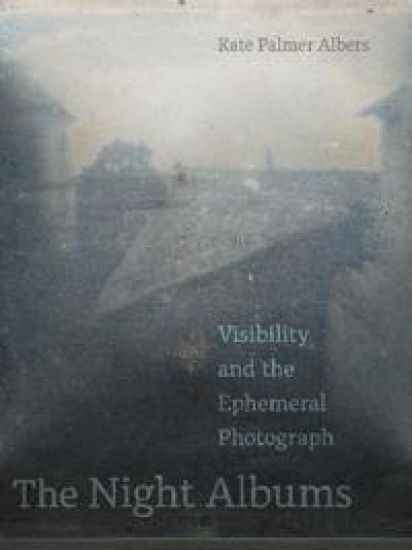
We live in an era of abundant photography. Is it then counterintuitive to study photographs that disappear or are difficult to discern? Kate Palmer Albers argues that it is precisely this current cultural moment that allows us to recognize what has always been a basic and foundational, yet unseen, condition of photography: its ephemerality. Through a series of case studies spanning the history of photography, The Night Albums takes up the provocations of artists who collectively redefine how we experience visibility. From the protracted hesitancies of photography’s origins, to conceptual and performative art that has emerged since the 1960s, to the waves of technological experimentation flourishing today, Albers foregrounds artists who offer fleeting, hidden, conditional, and future modes of visibility. By unveiling how ephemerality shapes the photographic experience, she ultimately proposes an expanded framework for the medium.
The Night Albums

The Night Albums

Kate Palmer Albers

University of California Press
2021
sidottu
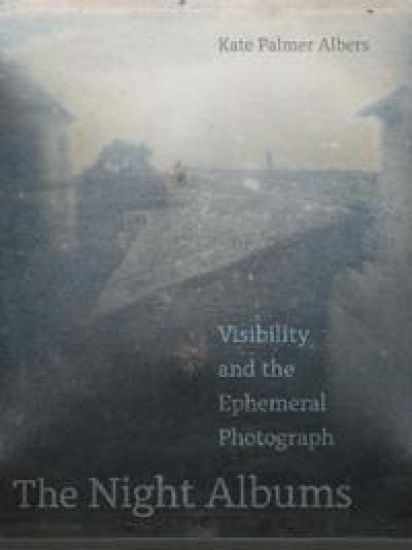
We live in an era of abundant photography. Is it then counterintuitive to study photographs that disappear or are difficult to discern? Kate Palmer Albers argues that it is precisely this current cultural moment that allows us to recognize what has always been a basic and foundational, yet unseen, condition of photography: its ephemerality. Through a series of case studies spanning the history of photography, The Night Albums takes up the provocations of artists who collectively redefine how we experience visibility. From the protracted hesitancies of photography’s origins, to conceptual and performative art that has emerged since the 1960s, to the waves of technological experimentation flourishing today, Albers foregrounds artists who offer fleeting, hidden, conditional, and future modes of visibility. By unveiling how ephemerality shapes the photographic experience, she ultimately proposes an expanded framework for the medium.
Uncertain Histories

Uncertain Histories

Kate Palmer Albers

University of California Press
2015
sidottu
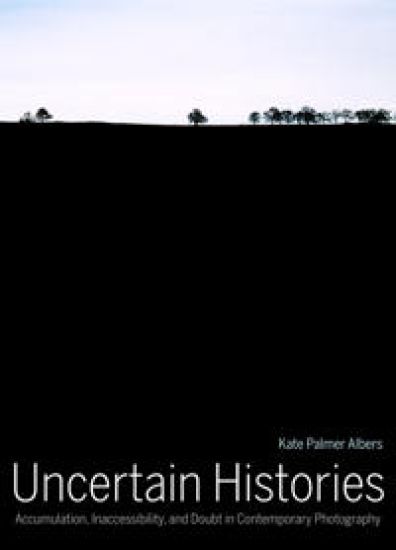
The compulsion to dwell on history on how it is recorded, stored, saved, forgotten, narrated, lost, remembered, and made public has been at the heart of artists' engagement with the photographic medium since the late 1960s. Uncertain Histories considers some of that work, ranging from installations that incorporate vast numbers of personal and vernacular photographs by Christian Boltanski, Dinh Q. Le, and Gerhard Richter to confrontations with absence in the work of Joel Sternfeld and Ken Gonzales-Day. Projects such as these revolve around a photographic paradox that hinges equally on knowing and not knowing, on definitive proof coupled with uncertainty, on abundance of imagery being met squarely with its own inadequacy. Photography is seen as a fundamentally ambiguous medium that can be evocative of the historical past while at the same time limited in the stories it can convey. Rather than proclaiming definitively what photography is, the work discussed here posits photographs as objects always held in suspension, perpetually oscillating in their ability to tell history. Yet this ultimately leads to a new kind of knowledge production: uncertainty is not a dead end but a generative space for the viewer's engagement with the construction of history.