Kirjojen hintavertailu – 12 903 725 kirjaa ja 27 kauppaa

Kirjailija

Katharina Boele-Woelki

Kirjat ja teokset yhdessä paikassa: 10 kirjaa, julkaisuja vuosilta 1998–2025, suosituimpiin kuuluu Principles of European Family Law Regarding Divorce and Maintenance Between Former Spouses. Vertaile teosten hintoja ja tarkista saatavuus suomalaisista kirjakaupoista.

10 kirjaa

Kirjojen julkaisuvuodet: 1998–2025.

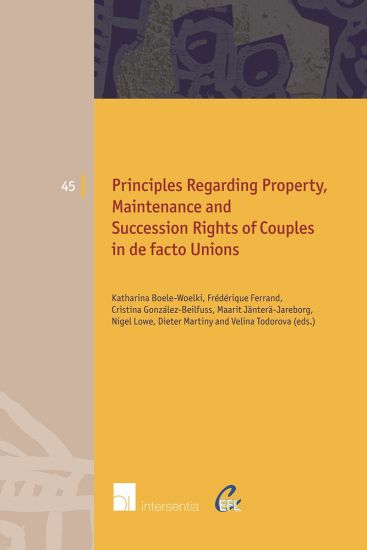
Principles of European Family Law Regarding Property, Maintenance and Succession Rights of Couples in de facto Unions

Principles of European Family Law Regarding Property, Maintenance and Succession Rights of Couples in de facto Unions

Katharina Boele-Woelki; Frédérique Ferrand; Cristina González Beilfuss; Maarit Jänterä-Jareborg; Nigel Lowe; Dieter Martiny; Velina Todorova

Intersentia Ltd
2019
nidottu
A book series dedicated to the harmonisation and unification of family and succession law in Europe. The series includes comparative legal studies and materials as well as studies on the effects of international and European law making within the national legal systems in Europe. The books are published in English, French or German under the auspices of the Organising Committee of the Commission on European Family Law (CEFL). The Principles of European Family Law drafted by the CEFL are aimed at contributing to the harmonisation of family law in Europe. The first sets of Principles cover Divorce and Maintenance between Former Spouses, Parental Responsibilities and Property Relations between Spouses respectively. This book focuses on Principles Regarding Property, Maintenance and Succession Rights of Couples in de facto Unions. The CEFL has developed a comprehensive and original set of rules which may be a source of inspiration for legislating the rights and duties of couples who have not formalised their relationship. In their provisions on specific issues, the Principles opt for workable solutions which aim to avoid unnecessary hardship and disputes. The Principles should be used as a frame of reference by policy makers and legislators.
Teaching Comparative Law: Experiences and Reflections

Teaching Comparative Law: Experiences and Reflections

Katharina Boele-Woelki

Eleven International Publishing
2024
nidottu
Author Katharina Boele-Woelki reports on her many years of teaching comparative law. This volume is addressed to (young) academics teaching comparative law and to all those interested in the questions of what, when, who, why and how. Three aspects need to be considered. In terms of the subject matter, the challenge is to focus either on the history and use of comparative law, on introductions to different legal systems, on teaching a particular area of law from a comparative perspective, or on comparative methodology. The latter should always be included, since it is only by knowing how to compare that a course in comparative law can develop its potential with lasting impact on students' future careers as legal scholars, lawyers or decision-makers. The expertise of the lecturer, the time available and the target group determine the environment which requires forethought and a flexible approach to course content and teaching format. With regard to the way in which comparative law is taught, four different methods are explained, based on the motto "learning by doing" explaining one's own jurisdiction to fellow-students, comparing on the basis of pre-selected material, comparing of comparative legal studies carried out by others and, finally, undertaking a comparative legal study by the students themselves.
From Catholic Outlook to Modern State Regulation

From Catholic Outlook to Modern State Regulation

Maebh Harding; Katharina Boele-Woelki

Intersentia Ltd
2023
nidottu
This book focuses on the development of marriage law in Ireland from 1937 to the present day, examining the relevant historical legal background to changes in the law in the 20th and early 21st centuries. It draws on legal sources and historical and empirical evidence about the reality of family life in Ireland, to raise broader questions about the appropriate role of law in establishing, preserving and developing inclusive social understandings of marriage. The impact of accurate empirical data about family life, external international influence and sustained activism as drivers in achieving meaningful social change is also evaluated. This original viewpoint highlights the initial ideological importance of marriage regulation in Ireland and its connection to national identity in a Catholic country. Historically, asymmetric social rules concerning marriage allowed those in power to favour particular religious groups; first the Protestant elite and then the Roman Catholic majority. Protecting a Catholic idea of marriage was an important consideration when drafting the founding documents of the Irish state. Article 41.3.1 of the 1937 Irish Constitution enshrines the institution of marriage as the only recognised basis for the family and pledges to protect marriage from 'attack'. This protection has acted throughout the late 20th and early 21st centuries both as a basis for liberal judicial development of family law principles and an obstacle to meaningful statutory modernisation, fossilising a traditional understanding of marriage as the bedrock of Irish family law. Up until the end of the 20th century, the state's 'secular' understanding of marriage was generally inseparable from its acceptance of traditional Catholic norms. However, the adoption of same-sex marriage in Ireland in 2015 marked a substantial change in traditional attitudes to marriage and the social role of the family unit. From Catholic Outlook to Modern State Regulation critically highlights the role played by the ideal of constitutional protection of marriage and existing legislative structures in initiating and delaying family law reform. The history and development of Irish marriage law, since the founding of the Irish state, has received little critical academic attention and this work makes a significant contribution to the fields of European family law and legal history. The book is timely and resonates not only with recent critical work about the development of Irish family law but also with broader debates about marriage and the role of state regulation that are currently taking place in numerous jurisdictions around the world.
Cross-Border Recognition of Formalized Same-Sex Relationships

Cross-Border Recognition of Formalized Same-Sex Relationships

Laima Vaige; Katharina Boele-Woelki

Intersentia Ltd
2022
nidottu
Same-sex relationships have successively qualified for formalization through marriage or registered partnership in many European countries. However, some EU Member States still refuse to give them any form of recognition or only allow very limited legal effects. The irregular speed of development in domestic family laws in EU Member States results in limping family relations, that is, family relations that are recognised as creating a formal civil status in many EU Member States, but not in all of them. The ordre public safeguard of private international law has widely been used to justify why a same-sex marriage or registered partnership cannot be recognised. The pretext tends to be that national identity, allegedly, becomes threatened. Nevertheless, the case-law of the European Court of Human Rights and the Court of Justice of European Union provides new standards for recognition, which create legal obligations for EU Member States. The author focuses on the interaction between human rights standards and private international law, carrying out a deft investigation of the impact of Europeanization on this interaction, analysing legal effects of same-sex marriages and registered partnerships in the Baltic States and Poland in a cross-border context. The central theme in this book is the elusive and ever-changing concept of ordre public, and the interplay between its understanding(s) at the national and European levels. The aim of this book is to evaluate the impact of culture in this area of study, within the context of the analysed States recent histories, societal developments, and religions. This book is published at a time of clashes between traditional family values and gender equality in Europe. In States like Lithuania and Poland, the heterosexual nature of marriage is considered to be a fundamental component of the States national identity and public policy. Nevertheless, the book reveals how different legal understandings of national identity, ordre public, and the family can co-exist in parallel.
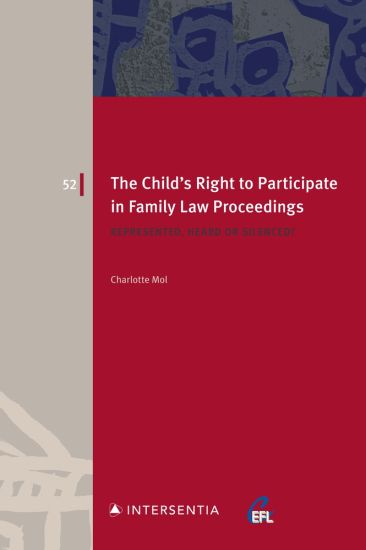
The Child's Right to Participate in Family Law Proceedings

The Child's Right to Participate in Family Law Proceedings

Charlotte Mol; Katharina Boele-Woelki

Intersentia Ltd
2022
nidottu
This book contains an in-depth legal analysis of Article 12 of the UN Convention on the Rights of the Child, the European Convention on Human Rights, the European Convention on the Exercise of Children's Rights, the Council of Europe's Guidelines on Child-Friendly Justice and Recommendation on the participation of children, and the European Union Charter of Fundamental Rights. The result is a comprehensive assessment of the child's right to participate in family law proceedings, providing the first complete analysis of the international and European human rights instruments in this field. Of note, the book's analysis of the case law of the European Court of Human Rights is unique, in both the inclusion of all of the Court's judgments and decisions on child participation as well as the application of an innovative and rigorous method of qualitative content analysis. This book therefore provides a greater understanding of the child's right to participate under Article 8 of the European Convention on Human Rights. Throughout the book, five key themes are addressed: the right to express views, due weight accorded to a child's views, the relevance of the child's age and maturity, the issue of undue influence, and the relevance of information and practical affairs. The standards provided in each of the instruments studied are compared and critically reflected upon. This book sets out the international and European framework for child participation and discusses critically how this framework can be further aligned and strengthened. New insights are reflected upon and recommendations made for the implementation and improvement of child participation rights at national and international levels. The Child's Right to Participate in Family Law Family Law Proceedings: Represented, Heard or Silenced? is a must read for scholars, family justice professionals, policy makers, and all persons working in the fields of children's rights and family law.
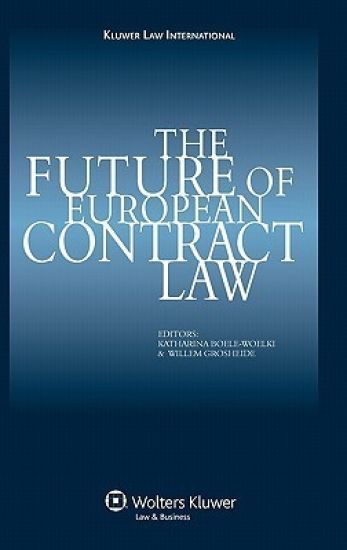
The Future of European Contract Law

The Future of European Contract Law

Katharina Boele-Woelki; F.W. Grosheide

Kluwer Law International
2007
sidottu
Professor Ewoud Hondius has been one of the most successful architects of comparative law research and education in the Netherlands. He has undertaken numerous efforts to advocate the unification and harmonization of private law by means of comparative studies which during his career have been welcomed all over the world. His understanding of the law of many jurisdictions is exceptional and his global network is impressive. He is a great European legal scholar and an ambassador for Dutch law, as witnessed by his innumerable publications. This book has been compiled in order to appropriately admire Hondius inspiring contributions to the elaboration of European Contract Law. The general topic of "The Future of European Contract Law" has been divided into five themes, many of them coinciding with the special interests of the honored scholar himself: European Contract Law: Its Possibility, Feasibility and Desirability; The Common Frame of Reference and the Principles of Contract Law; The Europeanization of National Contract Law; The Better Law Approach in European Contract Law; and Consumer Contracts in Europe. The wealth of material in this book contains a treasure of observations and visions of where contract law in Europe currently stands, as well as on how it should develop in the future. A collection of outstanding authors have contributed to this book.
Internet: Which Court Decides? Which Law Applies?

Internet: Which Court Decides? Which Law Applies?

Katharina Boele-Woelki; Catherine Kessedjian

Kluwer Law International
1998
sidottu
Cyberspace, the electronic super-highway or the Internet, as it is most commonly known, is a globally-networked, computer-sustained, computer-accessed and computer-generated multidimensional virtual reality, the use of which is increasing at a tremendous rate. Although much has been written on the legal issues relating to this virtual reality, this book provides coverage of the private international aspects. The work aims to address two basic questions, namely, which court has jurisdiction and which law is to be applied when litigation arises from activity on the Internet? The book comprises seven key papers, presented at an international symposium organised by Utrecht University's Molengraaff Institute of Private Law and the Hague Conference on Private International Law, which was held in Utrecht in June 1997. The main topics covered include: the role of law in cyberspace; experiences in the field of intellectual property; can private international law provide order to the chaos?; problems concerning jurisdiction and applicable law; and conclusions and recommendations.