Kirjojen hintavertailu – 12 859 827 kirjaa ja 27 kauppaa

Kirjailija

Kathleen M. Eisenhardt

Kirjat ja teokset yhdessä paikassa: 6 kirjaa, julkaisuja vuosilta 1998–2016, suosituimpiin kuuluu HBR's 10 Must Reads on Teams (with featured article "The Discipline of Teams," by Jon R. Katzenbach and Douglas K. Smith). Vertaile teosten hintoja ja tarkista saatavuus suomalaisista kirjakaupoista.

6 kirjaa

Kirjojen julkaisuvuodet: 1998–2016.

HBR's 10 Must Reads on Teams (with featured article "The Discipline of Teams," by Jon R. Katzenbach and Douglas K. Smith)

HBR's 10 Must Reads on Teams (with featured article "The Discipline of Teams," by Jon R. Katzenbach and Douglas K. Smith)

Harvard Business Review; Jon R. Katzenbach; Lynda Gratton; Kathleen M. Eisenhardt

Harvard Business Review Press
2013
pokkari
NEW from the bestselling HBR's 10 Must Reads series. Most teams underperform. Yours can beat the odds. If you read nothing else on building better teams, read these 10 articles. We've combed through hundreds of articles in the Harvard Business Review archive and selected the most important ones to help you assemble and steer teams that get results. Leading experts such as Jon Katzenbach, Teresa Amabile, and Tamara Erickson provide the insights and advice you need to: * Boost team performance through mutual accountability * Motivate large, diverse groups to tackle complex projects * Increase your teams' emotional intelligence * Prevent decision deadlock * Extract results from a bunch of touchy superstars * Fight constructively with top-management colleagues Looking for more Must Read articles from Harvard Business Review? Check out these titles in the popular series: HBR's 10 Must Reads: The Essentials HBR's 10 Must Reads on Communication HBR's 10 Must Reads on Collaboration HBR's 10 Must Reads on Innovation HBR's 10 Must Reads on Leadership HBR's 10 Must Reads on Making Smart Decisions HBR's 10 Must Reads on Managing Yourself HBR's 10 Must Reads on Strategic Marketing
HBR's 10 Must Reads on Teams (with featured article "The Discipline of Teams," by Jon R. Katzenbach and Douglas K. Smith)

HBR's 10 Must Reads on Teams (with featured article "The Discipline of Teams," by Jon R. Katzenbach and Douglas K. Smith)

Harvard Business Review; Jon R. Katzenbach; Lynda Gratton; Kathleen M. Eisenhardt

Harvard Business Review Press
2013
sidottu
Most teams underperform. Yours can beat the odds. If you read nothing else on building better teams, read these 10 articles. We’ve combed through hundreds of articles in the Harvard Business Review archive and selected the most important ones to help you assemble and steer teams that get results. Leading experts such as Jon Katzenbach, Teresa Amabile, and Tamara Erickson provide the insights and advice you need to: Boost team performance through mutual accountabilityMotivate large, diverse groups to tackle complex projectsIncrease your teams’ emotional intelligencePrevent decision deadlockExtract results from a bunch of touchy superstarsFight constructively with top-management colleagues
Simple Rules: How to Thrive in a Complex World

Simple Rules: How to Thrive in a Complex World

Donald Sull; Kathleen M. Eisenhardt

HARPER BUSINESS
2016
nidottu

Halvin toimitettuna 21,10 €

"The nerd book of the summer."--Tom Keene, Bloomberg TV "Whether you run an organization or are simply trying to survive modern life, this book is gold."--Chris Anderson, curator of TED Talks Armed with a few simple rules, you can tackle even the most complex of problems. Drawing on more than a decade of rigorous research, Sull and Eisenhardt provide a clear framework for developing effective rules and making them better over time. They find insights in unexpected places, from the way Tina Fey codified her experience working at Saturday Night Live into rules for producing 30 Rock (rule five: never tell a crazy person he's crazy), to Japanese engineers using the foraging rules of slime molds to optimize Tokyo's rail system. This is the definitive playbook for living simply and efficiently in every sphere of life. "Simple Rules . . . will help you spot unnecessary complexity, eliminate maddening frustration, make the right decisions faster, and have a whole lot more fun along way."--Robert I. Sutton, best-selling author of The No Asshole Rule and coauthor of Scaling Up Excellence "We all deal with complexity now, and this book will show you how you can do more with less."--Michael J. Mauboussin, head of global financial strategies, Credit Suisse "Simple Rules explains how we can manage to make meaningful progress in a world that exceeds human understanding . . . This is a harbinger of the information economy to come." --Steve Jurvetson, managing director of Draper Fisher Jurvetson A WASHINGTON POST LEADERSHIP BOOK TO WATCH FOR 2015 - A BLOOMBERG BUSINESSWEEK MUST-READ BOOK OF THE SUMMER
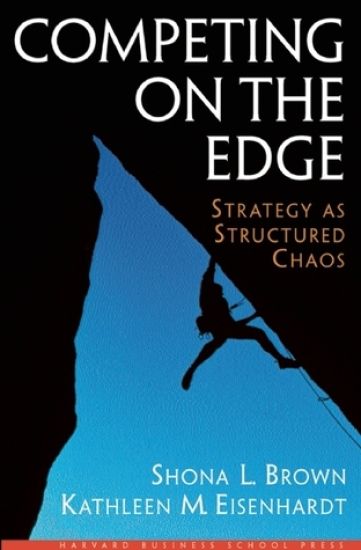
Competing on the Edge

Competing on the Edge

Shona L. Brown; Kathleen M. Eisenhardt

Harvard Business Review Press
1998
sidottu
Unstable markets, fierce competition, and relentless change are the only certainties in today's chaotic business world. In their startling new book, authors Brown and Eisenhardt contend that to prosper in such volatile conditions, standard survival strategies must be tossed aside in favor of a revolutionary new paradigm--competing on the edge. To compete on the edge is to relentlessly reinvent, and it's the only way to navigate the treacherous waters of tumultuous markets. Competing on the edge is an unpredictable, sometimes even inefficient strategy, yet a singularly effective one in an era driven by change. It requires charting a course along the edge of chaos, where a delicate compromise is struck between anarchy and order, to the edge of time, where current business is the primary focus, but actions are shaped by past legacies and future opportunities. By adroitly maneuvering through chaos and time, managers can avoid constantly reacting to nonstop change and instead set a rhythmic pace that others must follow, thereby shaping the competitive landscape--and their own destiny. In the first book to translate leading edge concepts from complexity theory into management practice, each chapter focuses on a specific management dilemma and illustrates a solution. Linking where do you want to go? With how will you get there? Here's a bold and surprising strategy that works--when the name of the game is change.