Kirjailija
Keith Hill
Kirjat ja teokset yhdessä paikassa: 37 kirjaa, julkaisuja vuosilta 2011–2026, suosituimpiin kuuluu The Ecstasy of Cabeza de Vaca. Vertaile teosten hintoja ja tarkista saatavuus suomalaisista kirjakaupoista.
37 kirjaa
Kirjojen julkaisuvuodet: 2011–2026.
Traditionally, acquiring wisdom has involved becoming wise in the ways of the world and developing deep insight into what drives human existence. Notable among the wise in the Western tradition are Solomon, in whose name Jewish wisdom literature was composed, and Pythagoras, whose enquiries led him to invent the word philosophy, a composite of two Greek words, philo (love) and sophia (wisdom). Pythagorean philosophy has two major themes: that number, not divine power, structures the world, and that we reincarnate repeatedly with the goal of acquiring wisdom. On Acquiring Wisdom is a philosophic work in the Pythagorean sense, written to accord with our contemporary outlook. The discussions include using current terminology to redefine how we acquire wisdom, examining our purpose in reincarnating, weighing how our search for ecstasy, intimacy, serenity and balance are impeded and fostered, and the role of moral judgement in evaluating life choices. Models, some utilising number, show how progress may be identified and measured. Comment is also offered on post-death choices and the reluctance of some to disconnect themselves from their most recent life. This is a book for those who are looking for a deep dive into what propels their existence. It is a thought-provoking work that combines metaphysical insights with pragmatic observations. The insights are sourced from a collective of human beings who have completed their incarnational cycles and are sharing their thoughts on humanity's spiritual dimension.
Traditionally, acquiring wisdom has involved becoming wise in the ways of the world and developing deep insight into what drives human existence. Notable among the wise in the Western tradition are Solomon, in whose name Jewish wisdom literature was composed, and Pythagoras, whose enquiries led him to invent the word philosophy, a composite of two Greek words, philo (love) and sophia (wisdom). Pythagorean philosophy has two major themes: that number, not divine power, structures the world, and that we reincarnate repeatedly with the goal of acquiring wisdom. On Acquiring Wisdom is a philosophic work in the Pythagorean sense, written to accord with our contemporary outlook. The discussions include using current terminology to redefine how we acquire wisdom, examining our purpose in reincarnating, weighing how our search for ecstasy, intimacy, serenity and balance are impeded and fostered, and the role of moral judgement in evaluating life choices. Models, some utilising number, show how progress may be identified and measured. Comment is also offered on post-death choices and the reluctance of some to disconnect themselves from their most recent life. This is a book for those who are looking for a deep dive into what propels their existence. It is a thought-provoking work that combines metaphysical insights with pragmatic observations. The insights are sourced from a collective of human beings who have completed their incarnational cycles and are sharing their thoughts on humanity's spiritual dimension.

Interrogations selects the best of Keith Hill's early writing to showcase fourteen years of literary, cultural and spiritual exploration. Inspired by traditional poetic forms and the avant-garde, drawing on influences that range from Blake to Beckett, Rumi to Jarry, Mirabai to Artaud, Bashō to Bly, Hill's work interrogates key myths that have shaped Western culture. Displaying a seriously irreverent sense of humour, leaping from mystic idealism to sly satire, this collection will delight readers with its probing critiques, surprising genre shifts and visionary daring.

Interrogations selects the best of Keith Hill's early writing to showcase fourteen years of literary, cultural and spiritual exploration. Inspired by traditional poetic forms and the avant-garde, drawing on influences that range from Blake to Beckett, Rumi to Jarry, Mirabai to Artaud, Bashō to Bly, Hill's work interrogates key myths that have shaped Western culture. Displaying a seriously irreverent sense of humour, leaping from mystic idealism to sly satire, this collection will delight readers with its probing critiques, surprising genre shifts and visionary daring.

Day in and day out, never resting, Puck played. Having no body, he flitted from star to star, solar system to solar system. Ever at fun, he gambolled through the ten thousand veils of reality. Life to him was a joy, and that joy was his life's whole meaning. Yet he whose time-span was measured in units far exceeding an earthly aeon found that, in the end, he could not escape time. And one day a message came to Puck from the very centre of the Starways, commanding that he attend on the Gods. So away flew Puck. Away through the ten thousand layers of reality. And in a trice he was bowing before the Starways' Gods." Puck," said the Gods, "there is a world of which you know nothing. This world is called the Land of the Happy. Always the Land of the Happy has been true to its name. But now doubt and pain have entered the lives of those who live there. Go to the Land of the Happy, Puck. On behalf of the Gods, go and discover why one living there is sad." So begin the adventures of Puck. In a series of linked stories, Puck delights in the wonders, comedies, sorrows and joys that enrich human existence. Spinning tales that delight and confound, playfully mixing magic with metaphysics, the fabulous with moral questions, this is an inspired addition to fantasy story-telling in the tradition of Lord Dunsay, Alberto Calvino and Ursula Le Guin.

Simon Magus is an enigma. Long derided as a heretic magician, the truth is much more complex. And fascinating. Keith Hill's dramatic retelling of Simon's story draws on documentary and legendary materials that show him to be a misunderstood pioneer of Western spirituality. An in-depth background essay explores his connection to Gnostic thought and how he came to be declared an enemy of Christianity. The Gnosis of Simon Magus is set in Jerusalem in 52 CE. The city is occupied by Rome, a puppet king sits in the palace, the populace is seething, and the Roman army's presence is provoking rebellion rather than instilling peace. In this cauldron, Jesus' apostle Kepa is struggling to guide the first Christian community. Enter Simon Magus. After the death of John the Baptist, Simon travelled to Egypt to study spiritual philosophy and penetrate the mysteries of magic. Twenty years after Jesus' crucifixion, he returns to Jerusalem with a former prostitute who knew Jesus well and lights another fuse in a city ready to explode.

Simon Magus is an enigma. Long derided as a heretic magician, the truth is much more complex. And fascinating. Keith Hill's dramatic retelling of Simon's story draws on documentary and legendary materials that show him to be a misunderstood pioneer of Western spirituality. An in-depth background essay explores his connection to Gnostic thought and how he came to be declared an enemy of Christianity. The Gnosis of Simon Magus is set in Jerusalem in 52 CE. The city is occupied by Rome, a puppet king sits in the palace, the populace is seething, and the Roman army's presence is provoking rebellion rather than instilling peace. In this cauldron, Jesus' apostle Kepa is struggling to guide the first Christian community. Enter Simon Magus. After the death of John the Baptist, Simon travelled to Egypt to study spiritual philosophy and penetrate the mysteries of magic. Twenty years after Jesus' crucifixion, he returns to Jerusalem with a former prostitute who knew Jesus well and lights another fuse in a city ready to explode.
We live in the midst of a vast universe. Currently, our sciences enable us to perceive less than 5% of it. The rest is designated dark energy and dark matter. This means 95% of the universe effectively remains a mystery. In "The Kosmic Web" human beings who have completed their cycles of incarnation offer intriguing insights into the mystery of all existence. Drawing on the ideas and vocabulary of current scientific and evolutionary thinking, they present fascinating yet often challenging observations on how the spiritual, biological, energetic, material and metaphysical aspects of reality interlace to form and sustain the extended kosmos. Ideas explored include: The origin of our universe as part of a multiverse The multiverse as an experiment in evolving consciousnessThe interlaced energetic layers that underpin all that existsThe origins and developmental nature of human identityThe ways spiritual identities co-associate with biological speciesThe purpose and process of reincarnationThe aura's developmental and communicative functionsThe concept of spiritual space and humanity s place in itThe ultimate intention and meaning of human existenceFor those seeking to understand the what, how and why of their lives, "The Kosmic Web" provides thrilling new concepts for understanding humanity's position in the multi-layered web of life. From the book]: "What if you could access trans-human explanations of reality? Human beings need to break free of the constant flow of their everyday impressions, feelings and thoughts in order to perceive what lies beyond the everyday, whereas we, as non-embodied identities, automatically have an overview of human existence that extends far beyond what any human can perceive. In asserting this, we make no claim for God-like knowledge. We are just another form of spiritual identity, the same type as you but at a different phase of our growth cycle. Our role is currently that of informant and guide. In this book we focus on two specific aspects of pertinent information. These are the nature of reality, and the source and purpose of human identity."
"Up-to-the-minute reportage on our fraught zeitgeist, conveyed with vitality and satirical humour." - Hugh MajorRanging from an individual's birth to the death of the planet, this urgent collection reflects back to us the perilous state of our world. Written by a fed up boomer determined to call out our collective stupidity, Out of the way world is simultaneously justifiably cynical, cavalierly mocking and bitingly realistic. Picture humanity crammed into a gigantic kick-ass double cab ute burning through fossil fuel like there's no tomorrowour symbol of what's important- crucifix tractor Buddha furry kiwibullet dollar sign fluffy red dice -bouncing under the rear-view mirroras we drive like crazyveering right then left indifferent to the roadkill ..." Hauntingly on the nose. I love this collection. I think everyone should read it right now Many lines bear rereading and copying for future quotation. I stopped making my list before the end and just enjoyed. It is wonderful " - Judith Hoch"New Zealand literature has no one quite like Keith Hill. Always surprising, a genuine original." - Roger Horrocks
"Up-to-the-minute reportage on our fraught zeitgeist, conveyed with vitality and satirical humour." - Hugh MajorRanging from an individual's birth to the death of the planet, this urgent collection reflects back to us the perilous state of our world. Written by a fed up boomer determined to call out our collective stupidity, Out of the way world is simultaneously justifiably cynical, cavalierly mocking and bitingly realistic. Picture humanity crammed into a gigantic kick-ass double cab ute burning through fossil fuel like there's no tomorrowour symbol of what's important- crucifix tractor Buddha furry kiwibullet dollar sign fluffy red dice -bouncing under the rear-view mirroras we drive like crazyveering right then left indifferent to the roadkill ..." Hauntingly on the nose. I love this collection. I think everyone should read it right now Many lines bear rereading and copying for future quotation. I stopped making my list before the end and just enjoyed. It is wonderful " - Judith Hoch"New Zealand literature has no one quite like Keith Hill. Always surprising, a genuine original." - Roger Horrocks
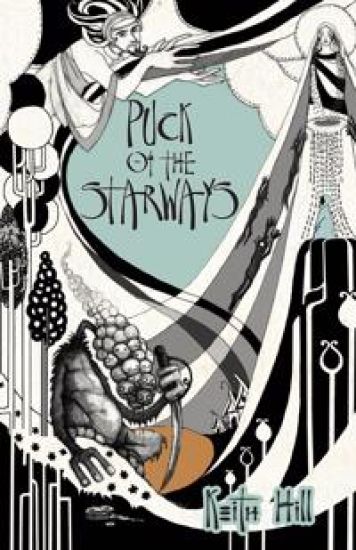
In a series of linked stories, Puck delights in the wonders, comedies, sorrows and joys that enrich human existence. Spinning tales that delight and confound, playfully mixing magic with metaphysics, the fabulous with moral questions, this is an inspired addition to fantasy story-telling in the tradition of Lord Dunsay, Alberto Calvino and Ursula Le Guin. Day in and day out, never resting, Puck played. Having no body, he flitted from star to star, solar system to solar system. Ever at fun, he gambolled through the ten thousand veils of reality. Life to him was a joy, and that joy was his life's whole meaning. Yet he whose time-span was measured in units far exceeding an earthly aeon found that, in the end, he could not escape time. And one day a message came to Puck from the very centre of the Starways, commanding that he attend on the Gods. So away flew Puck. Away through the ten thousand layers of reality. And in a trice he was bowing before the Starways' Gods." Puck," said the Gods, "there is a world of which you know nothing. This world is called the Land of the Happy. Always the Land of the Happy has been true to its name. But now doubt and pain have entered the lives of those who live there. Go to the Land of the Happy, Puck. On behalf of the Gods, go and discover why one living there is sad." So begin the adventures of Puck of the Starways in a world that soon becomes the Land of the Sad.


The greatest personal difficulties we face, along with the psychological strengths and weaknesses that loom largest in our life, have their roots in previous life experience. This makes our personal psychology the tip of an iceberg that has been profoundly shaped by our past life undertakings, reactions and choices. Only by adopting a multi-life perspective can we get to the heart of who we are at our deepest level, and learn what is driving us in this life. Psychological Spirituality focuses on human psychology as viewed from a reincarnational perspective. It offers practical insights into human psychology, advocating the use of self-observation and analysis to understand how traits form in response to current and past life situations. Providing a number of interlinked frameworks, it shows how to first identify key traits, then transform them. This book will be of particular benefit to those seeking to learn more about their deep selves, and therapists who include past life analysis in their psychotherapy. Psychological Spirituality is the third in a series of channelled books that offer a psychospiritual approach to inner development. Designed for twenty-first century seekers, it draws on a number of established spiritual traditions, notably G. I. Gurdjieff's Fourth Way and the channelled Michael Teachings, to clarify the developmental process. Key concepts presented here include: How the concepts of false and true personality help us understand our psyche The nature of fear and how it provides the basis for self-defensive traits The essence self and its roots in accumulated human identity Individual preferences in the development of skills, abilities and talents The multi-life trajectories individuals adopt during their reincarnation cycle How false personality and fear combine to stop us achieving our life plan The way life goal, orientation and attitude interlink to steer us through a life How to use self-enquiry to maximise our achievement in this life