Kirjojen hintavertailu – 12 903 724 kirjaa ja 27 kauppaa

Kirjailija

Ken Conboy

Kirjat ja teokset yhdessä paikassa: 7 kirjaa, julkaisuja vuosilta 2011–2022, suosituimpiin kuuluu The Erawan War. Vertaile teosten hintoja ja tarkista saatavuus suomalaisista kirjakaupoista.

7 kirjaa

Kirjojen julkaisuvuodet: 2011–2022.

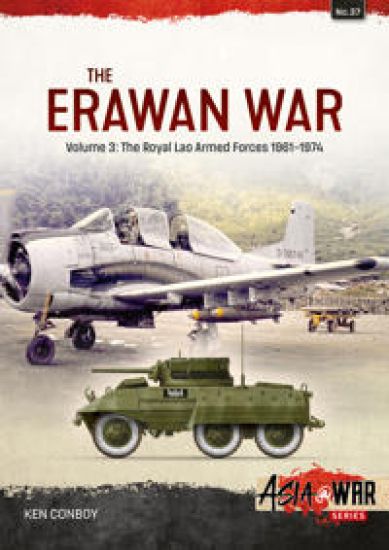
The Erawan War

The Erawan War

Ken Conboy

HELION COMPANY
2022
pokkari

Halvin toimitettuna 33,90 €

Best known by their French acronym for Forces Arm es du Royaume - FAR - the Royal Lao Armed Forces were the official defense force of the Kingdom of Laos - what is now the Lao People's Democratic Republic - from 1949 until 1975. Founded in 1947, when King Sisavang Vong declared Laos an independent nation (and a Kingdom from 1949), the FAR originally included a collection of pre-existing Lao police and militarized constabulary units, regular indigenous colonial troops and locally raised irregular auxiliaries. While the latter two were described in the first two volumes of this mini-series, the emphasis in The Erawan War, Volume 3 is on the FAR, the build-up of which was constantly hampered by the developments in the First Indochina War in neighboring Vietnam. Unsurprisingly, it was only in 1952 that the National Laotian Army - the predecessor of the Royal Lao Army - began to take shape, and only in 1961 that the Laotian Armed Forces were officially renamed the Royal Armed Forces. Plagued by an ineffective leadership at senior levels, and often suffering from chain-of-command problems, the FAR exerted little control over the regional commands and local military commanders for much of the 1960s. A country with a long-standing tradition of warlords - or local power-brokers - and the strong influence of an urban elite aristocracy, Laos took time to build-up effective armed forces, which reached their high tide in the second half of the 1960s, thanks to growing amounts of military aid from the USA. Eventually, the Royal Lao Armed Forces included not only a number of training centers, and several elite units, but the Royal Lao Army, the Royal Lao Air Force and the Royal Lao Navy, all of which fought a bitter war against the North Vietnamese and their local allies until the downfall of the Laotian Kingdom in 1975. Richly illustrated with authentic photography and custom-drawn color artworks, The Erawan War, Volume 3 is a highly authoritative single-point source of reference on the build-up and operational history of the FAR.
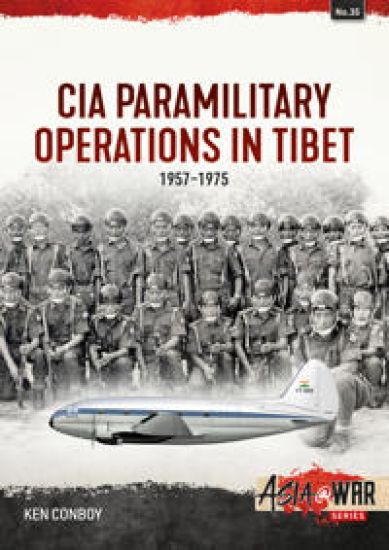
CIA Operations in Tibet, 1957-1974

CIA Operations in Tibet, 1957-1974

Ken Conboy

HELION COMPANY
2022
pokkari
This is the story of how the US government -- primarily through the CIA and often in cooperation with India -- came to harness, nurture, and encourage Tibetan defiance in one of the most extreme covert campaigns of the Cold War. In particular, it details an important chapter in the CIA's paramilitary history. In Tibet, new kinds of equipment -- aircraft and parachutes, for example -- were combat-tested under the most extreme conditions imaginable. New communications techniques were tried and perfected. In many cases, these lessons learned would be applied to other Cold War battlefields like Vietnam, Laos, and elsewhere. Tibet, therefore, became a vital proving ground for CIA case officers and their spycraft.
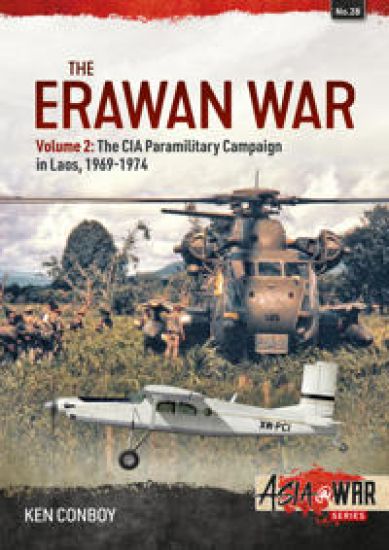
The Erawan War

The Erawan War

Ken Conboy

Helion Company
2021
nidottu
During a National Security Council meeting in March 1971, Henry Kissinger commented to those around the table, "When the CIA reaches the point of having the largest army in Southeast Asia, we better review the program!" He was referring to the secret war brewing in Laos, where the Central Intelligence Agency was training, funding, and leading tens of thousands of indigenous guerrillas within the kingdom and, occasionally, across its borders. The Erawan War mini-series strips away the veil surrounding this conflict, recounting in detail the CIA's largest paramilitary operation of the Cold War, as well as the Royalist armed forces that battled for decades against communist opponents. It includes hundreds of outstanding photos featuring case officers, military hardware, and battle scenes. These volumes are a must for anyone interested in the Vietnam War, military history, special forces units, and CIA paramilitary operations.
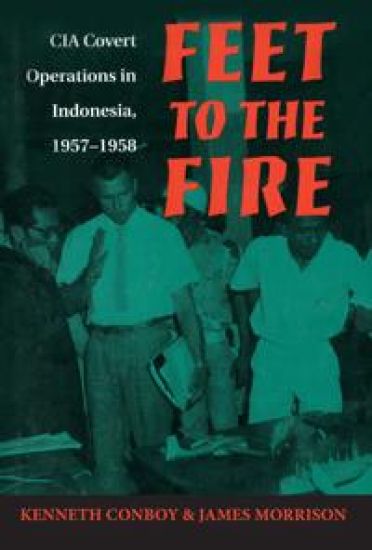
Feet to the Fire

Feet to the Fire

Ken Conboy; James Morrison

Naval Institute Press
2018
pokkari
Today the vast archipelago of Southeast Asia islands known as Indonesia is in the headlines because of political instability, religious tension, and violence in the streets. Forty years ago similar conditions led the Central Intelligence Agency to mount a top-secret covert action campaign designed to hold that nation's left-leaning President Sukarno's feet to the fire and prevent a strategic crossroad from falling into the communist camp. The Agency supported rebels with weapons, planes, and a memorable cast of bigger-than-life American agents. In a fast-paced, engrossing narrative evoking the novels of John LeCarré and Graham Greene, the authors provide the first unclassified, detailed case study of an operation that has escaped public scrutiny for decades. Their work adds significantly to our understanding of the CIA and American involvement in Asia. Drawing on declassified documents and an extraordinary number of interviews with CIA and Indonesian participants, Kenneth Conboy and James Morrison reconstruct the delicate, dangerous game played by American intelligence agents across the Indonesian archipelago. This is a story of ideologues and soldiers of fortune--historic CIA legends like Allen Dulles and Franklin Wisner, and notorious special operators like Tony ""Poe"" Poshepny, whose reputation reached mythic proportions later in Laos, and Allen Pope, an indefatigable B-26 pilot who was captured and sentenced to die. But it also includes the transfixing exploits of Montana smokejumpers, Polish aircrews, Muslim anti-communist guerrillas, U. S. Navy submarine crews, and Filipino mercenary pilots flying P-51 Mustangs. With the problems in today's Indonesia far from solved and the complex U. S.-Indonesian relationship coming under close scrutiny, this fascinating account of an American covert operation gone bad will play a significant role in shedding new light on the CIA's efforts in Southeast Asia.
Divine Spears

Divine Spears

Ken Conboy

Equinox Publishing (Indonesia)
2017
pokkari
IN A NATION where the military has played an influential social and political role since its founding, perhaps no unit has wielded more power - and seen more combat - than Kopassus, Indonesia's Special Forces. And perhaps nowhere did it experience more challenging assignments than in the mountains and jungles of East Timor. Here, two Kopassus teams - codenamed nanggala, a Sanskrit term for "divine spear" - are documented in detail during the earliest phase of the East Timor campaign. Coming when Fretilin insurgents were at their most powerful, these Special Forces teams took on assignments ranging from airborne assaults to psychological warfare. This book is essential reading for anyone interested in unconventional warfare, contemporary Indonesian history, the struggle of Timor Leste, and the brushfire wars that have swept the Indonesian archipelago. KEN CONBOY is currently country manager for a private security and risk consultancy in Jakarta. Prior to that, he served as deputy director at the Asian Studies Center, an influential Washington-based think tank, where his duties included writing policy papers for the US Congress and Executive on economic and strategic relations with the nations of South and Southeast Asia. The author of nearly twenty books about Asian military history and intelligence operations, Conboy's most recent title The Cambodian Wars has been called "riveting and brilliantly researched." Conboy, a graduate of Georgetown University's School of Foreign Service and of Johns Hopkins' School of Advanced International Studies, was also a visiting fellow at Chulalongkorn University in Bangkok. He has lived in Indonesia since 1992.