Kirjojen hintavertailu – 12 859 829 kirjaa ja 27 kauppaa

Kirjailija

Ken Pease

Kirjat ja teokset yhdessä paikassa: 6 kirjaa, julkaisuja vuosilta 2013–2025, suosituimpiin kuuluu Evolution and Crime. Vertaile teosten hintoja ja tarkista saatavuus suomalaisista kirjakaupoista.

6 kirjaa

Kirjojen julkaisuvuodet: 2013–2025.

Police Work

Police Work

Peter B. Ainsworth; Ken Pease

TAYLOR FRANCIS LTD
2025
nidottu
Why don’t people rush to help at an accident? Why do eyewitnesses give different accounts of the same event? Is there such a thing as a ‘born criminal’? How can you get people to cooperate with police investigations? Can you tell if someone is lying? How can police officers reduce their own levels of stress? Originally published in 1987, these are just some of the questions that Police Work answers. Using practical, everyday examples from real life, Police Work shows serving and training police officers how a better understanding of why people do the things they do can make their own work more efficient. Without jargon or unnecessary technical language Police Work spells out the practical implications of current thinking on such topics as communication, behaviour in groups, the treatment of crime victims, crisis intervention techniques, countering prejudice and fear of crime.
Police Work

Police Work

Peter B. Ainsworth; Ken Pease

TAYLOR FRANCIS LTD
2023
sidottu
Why don’t people rush to help at an accident? Why do eyewitnesses give different accounts of the same event? Is there such a thing as a ‘born criminal’? How can you get people to cooperate with police investigations? Can you tell if someone is lying? How can police officers reduce their own levels of stress? Originally published in 1987, these are just some of the questions that Police Work answers. Using practical, everyday examples from real life, Police Work shows serving and training police officers how a better understanding of why people do the things they do can make their own work more efficient. Without jargon or unnecessary technical language Police Work spells out the practical implications of current thinking on such topics as communication, behaviour in groups, the treatment of crime victims, crisis intervention techniques, countering prejudice and fear of crime.
Self-Selection Policing

Self-Selection Policing

Jason Roach; Ken Pease

Palgrave Macmillan
2016
sidottu
Self-Selection Policing introduces and explores an approach for crime control which seeks to identify active, serious offenders by attending to the minor offences they commit. A foundation of theory and evidence is first supplied for the assertion that ‘those who do big bad things also do little bad things’. Original research presented in the book includes a study of offending by visitors to a prison, and the concurrent criminality of those committing common driving offences and failure to produce driving documents as required. It illustrates how self-selection can complement other police methods of identifying active, serious criminals by focusing on what offenders do rather than who they are and what they have done in the past. Concentrating on the ‘usual suspects’ in the conventional way is often criticised as harassment and self-selection policing largely bypasses the issue of fairness this raises. The book concludes with a call for the consideration, development and wider adoption of the self-selection approach, and particularly the identification of other common minor offences which flag concurrent active criminality. The authors make important suggestions for the progression of SSP research and practice, including the identification of barriers to the implementation of the approach in wider police thinking, practice and policy. Practical guidance is also provided for those thinking of developing, testing and implementing the approach. In doing so, the book will be of particular interest for policing practitioners, as well as students and scholars of policing and crime control.
Using Modeling to Predict and Prevent Victimization

Using Modeling to Predict and Prevent Victimization

Ken Pease; Andromachi Tseloni

Springer International Publishing AG
2014
nidottu
This work provides clear application of a new statistical modeling technique that can be used to recognize patterns in victimization and prevent repeat victimization. The history of crime prevention techniques range from offender-based, to environment/situation-based, to victim-based. The authors of this work have found more accurate ways to predict and prevent victimization using a statistical modeling, based around crime concentration and sub-group profiling with regard to crime vulnerability levels, to predict areas and individuals vulnerable to crime. Following from this prediction, they propose policing strategies to improve crime prevention based on these predictions. With a combination of immediate actions and longer-term research recommendations, this work will be of interest to researchers and policy makers in focused on crime prevention, police studies, victimology and statistical applications.
Evolution and Crime

Evolution and Crime

Jason Roach; Ken Pease

Willan Publishing
2013
sidottu
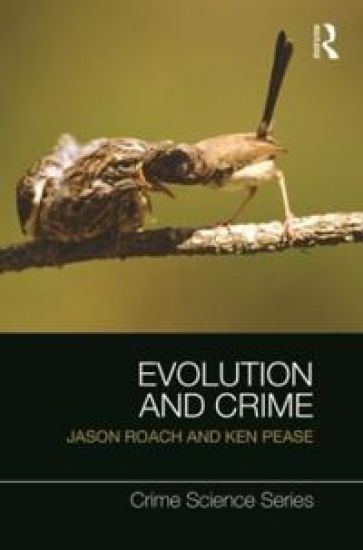
Human physique and behaviour has been shaped by the pressures of natural selection. This is received wisdom in all scientifically informed circles. Currently, the topic of crime is rarely touched upon in textbooks on evolution and the topic of evolution rarely even mentioned in criminology textbooks. This book for the first time explores how an evolution informed criminology has clear implications for enhancing our understanding of the criminal law, crime and criminal behaviour. This book is directed more towards students of criminology than students of evolution. It is suggested that there is scope for more collaborative work, with criminologists and crime scientists exposed to Darwinian thought having much to gain. What is suggested is simply that such thinking provides a fresh perspective. If that perspective yields only a fraction of the understanding when applied to crime as it has elsewhere in science, the effort will have been worthwhile. The authors attempt to provide a modest appraisal of the potential contribution that a more welcoming approach to the evolutionary perspective would make to criminology; both theoretically (by expanding understanding of the complexity of the origins of behaviour labelled criminal) and practically (where the evolutionary approach can be utilised to inform crime control policy and practice). An evolutionary lens is applied to diverse criminological topics such as the origins of criminal law, female crime, violence, and environmental factors involved in crime causation.
Evolution and Crime

Evolution and Crime

Jason Roach; Ken Pease

Willan Publishing
2013
nidottu
Human physique and behaviour has been shaped by the pressures of natural selection. This is received wisdom in all scientifically informed circles. Currently, the topic of crime is rarely touched upon in textbooks on evolution and the topic of evolution rarely even mentioned in criminology textbooks. This book for the first time explores how an evolution informed criminology has clear implications for enhancing our understanding of the criminal law, crime and criminal behaviour. This book is directed more towards students of criminology than students of evolution. It is suggested that there is scope for more collaborative work, with criminologists and crime scientists exposed to Darwinian thought having much to gain. What is suggested is simply that such thinking provides a fresh perspective. If that perspective yields only a fraction of the understanding when applied to crime as it has elsewhere in science, the effort will have been worthwhile. The authors attempt to provide a modest appraisal of the potential contribution that a more welcoming approach to the evolutionary perspective would make to criminology; both theoretically (by expanding understanding of the complexity of the origins of behaviour labelled criminal) and practically (where the evolutionary approach can be utilised to inform crime control policy and practice). An evolutionary lens is applied to diverse criminological topics such as the origins of criminal law, female crime, violence, and environmental factors involved in crime causation.