Kirjojen hintavertailu – 12 859 829 kirjaa ja 27 kauppaa

Kirjailija

Ken Yeang

Kirjat ja teokset yhdessä paikassa: 9 kirjaa, julkaisuja vuosilta 2009–2025, suosituimpiin kuuluu Sustainable Retrofitting of Commercial Buildings. Vertaile teosten hintoja ja tarkista saatavuus suomalaisista kirjakaupoista.

9 kirjaa

Kirjojen julkaisuvuodet: 2009–2025.

Tips from the Top

Tips from the Top

Clifford Pearson; Ken Yeang; Raghda AlHayali

CHRONICLE BOOKS
2025
sidottu

Halvin toimitettuna 23,90 €

Tips from the Top is a collection of advice from more than sixty architects who have earned the respect of their peers and are willing to share their knowledge on building a successful and meaningful career in architecture. This book compiles more than sixty tips from a broad range of successful architects and design professionals from around the world. Organized by theme in seven broad categories—Beginnings, Inspiration, Values, Engagement, Process, Personal Development, and Determination—this book of advice offers thoughtful and thought-provoking guidance on such topics as: Designing what you believe in Learning from other disciplines Serving humanity Learning how to say “no” Viewing artificial intelligence as an asset, not an enemy And much more For those just exploring the idea of architecture as a career, students in architecture school, and graduates entering the profession, this book should be treated as a snack box—a source of nourishing advice that can be raided whenever one is hungry and in need of some help.
At One with Nature

At One with Nature

Ken Yeang; Edwina Threipland

Wiley-Blackwell
2021
sidottu
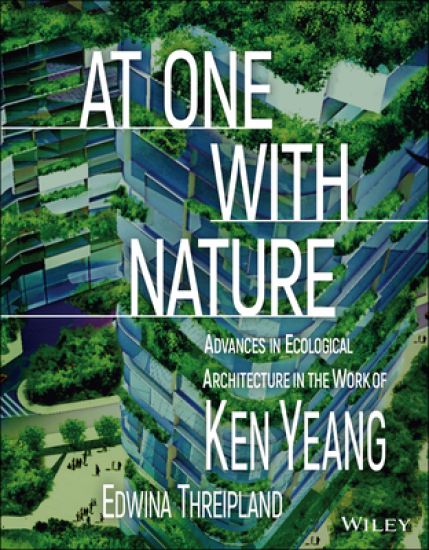
"At One with Nature is an inspiring collection of the latest work of Ken Yeang that further advances sustainable architecture and design. This collection features recent projects as he explores how we can achieve harmony between the natural and our built environments to create a better planet by design. Each project features and highlights not only the systems and devices adopted, but also outlines the intentions and ecological considerations demonstrating best practices for how we can proceed moving forward. The book role models our living Earth and shows how we can behave as stewards of our planet."--Cassia Patel, Oceanic Global Foundation At One with Nature showcases Ken Yeang's latest ideas, built projects designs, research work and advances in the field of designing with nature, a topic that Yeang has pioneered and developed over many decades since receiving his doctorate in ecological design and planning from Cambridge University. His ideas and work are even more pertinent today with the current state of devastation of Earth's natural systems and a biogeochemical cycle that has been extensively and severely impacted by human society. The global environment today is in a state of crisis, but what can society do to address the issues? Yeang's recent projects are presented with instructive diagrams that provide a basis for action for architects, planners, designers, engineers, and anyone whose daily work impinges on the natural environment. Offered in a highly visual, annotated format, with instructive illustrations of Yeang's theoretical books on the topic, At One with Nature is an invaluable resource that students and academics interested in designing with nature will find both informative and relevant.
Sustainable Retrofitting of Commercial Buildings

Sustainable Retrofitting of Commercial Buildings

Richard Hyde; Nathan Groenhout; Francis Barram; Ken Yeang

Routledge
2020
nidottu
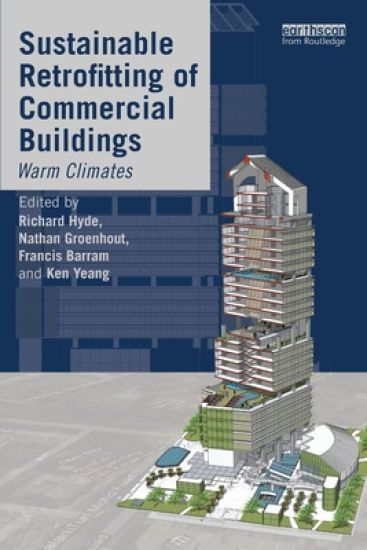
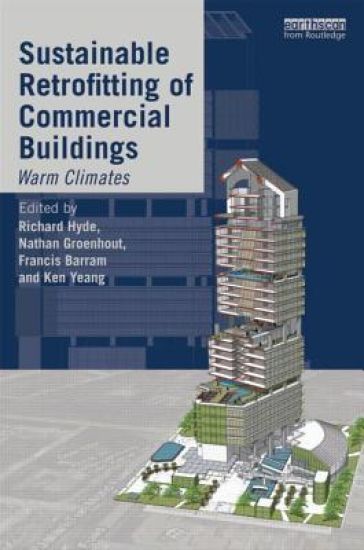
Despite recent improvements in energy efficiency being made in new build, it is important that the existing commercial building sector also take action to meet emission reduction targets. The objectives and challenges of such action will reduce the risk of the sector becoming obsolete due to high energy use and poor environmental performance. This book presents a theory-based, practice-support methodology to deal with sustainable retrofitting opportunities for existing commercial buildings in warm climates using bioclimatic design as the basis. The book has four main parts, focusing on eco-design and renovation, bioclimatic retrofitting, technological and behavioural change and case studies of retrofitting exemplars. In the first part, the context of climate change effects on design and renovation at the city scale is discussed. The second part looks at bioclimatic retrofitting as a 'design guide' for existing buildings, highlighting the significance of architectural design and engineering systems for energy performance. The technological and behavioural contexts of the existing building sector – policies, modelling, monitoring and trend analysis in respect to energy and environmental performance – are covered in part three. The final part gives some case studies showing the effectiveness of strategies suggested for effective environmental performance. This book is a must-have guide for all involved in the design and engineering of retrofitting projects in warm climates.
Saving The Planet By Design

Saving The Planet By Design

Ken Yeang

Routledge
2019
nidottu
Can we ‘save the Planet’? For a resilient, durable and sustainable future for human society, we need to repurpose, reinvent, redesign, remake and recover our human-made world so that our built environment is benignly and seamlessly biointegrated with Nature to function synergistically with it. These are the multiple tasks that humanity must carry out imminently if there is to be a future for human society and all lifeforms and their environments on the Planet. Addressing this is the most compelling question for those whose daily work impacts on Nature, such as architects, engineers, landscape architects, town planners, environmental policy makers, builders and others, but it is a question that all of humanity needs to urgently address. Presented here are two key principles as the means to carry out these tasks – ‘ecocentricity’ being guided by the science of ecology, and ‘ecomimesis’ as designing and making the built environment including all artefacts based on the emulation and replication of the ‘ecosystem’ concept. Designing with ecology is contended here as the authentic approach to green design from which the next generation of green design will emerge, going beyond current use of accreditation systems. For those who subscribe to this principle, this is articulated here, showing how it can be implemented by design. Adopting these principles is fundamental in our endeavour to save our Planet Earth, and changes profoundly and in entirety the way we design, make, manage and operate our built environment.
Saving The Planet By Design

Saving The Planet By Design

Ken Yeang

Routledge
2019
sidottu
Can we ‘save the Planet’? For a resilient, durable and sustainable future for human society, we need to repurpose, reinvent, redesign, remake and recover our human-made world so that our built environment is benignly and seamlessly biointegrated with Nature to function synergistically with it. These are the multiple tasks that humanity must carry out imminently if there is to be a future for human society and all lifeforms and their environments on the Planet. Addressing this is the most compelling question for those whose daily work impacts on Nature, such as architects, engineers, landscape architects, town planners, environmental policy makers, builders and others, but it is a question that all of humanity needs to urgently address. Presented here are two key principles as the means to carry out these tasks – ‘ecocentricity’ being guided by the science of ecology, and ‘ecomimesis’ as designing and making the built environment including all artefacts based on the emulation and replication of the ‘ecosystem’ concept. Designing with ecology is contended here as the authentic approach to green design from which the next generation of green design will emerge, going beyond current use of accreditation systems. For those who subscribe to this principle, this is articulated here, showing how it can be implemented by design. Adopting these principles is fundamental in our endeavour to save our Planet Earth, and changes profoundly and in entirety the way we design, make, manage and operate our built environment.
It's Not Easy Being Green

It's Not Easy Being Green

Ken Yeang

Goff Books
2017
nidottu
It's Not Easy Being Green tells the reader, quite simply, that 'Green Architecture' is not as simple as many of its promoters expect. It is not solely about energy efficiency or cultivating different levels of vegetation. It is an extensive dedication, involving cautious action that takes into account the needs of both the natural and the built environment. Ken Yeang's work demonstrates a comprehensive set of strategies making Green Architecture feasible and practical for architects and professionals from other fields, to understand the importance of saving the world from environmental devastation. The book intends to raise awareness and concern on environmental issues, and suggests how architecture can be designed now in favour of a benign living environment for the future.
Sustainable Retrofitting of Commercial Buildings

Sustainable Retrofitting of Commercial Buildings

Richard Hyde; Nathan Groenhout; Francis Barram; Ken Yeang

Earthscan Ltd
2012
sidottu
Despite recent improvements in energy efficiency being made in new build, it is important that the existing commercial building sector also take action to meet emission reduction targets. The objectives and challenges of such action will reduce the risk of the sector becoming obsolete due to high energy use and poor environmental performance. This book presents a theory-based, practice-support methodology to deal with sustainable retrofitting opportunities for existing commercial buildings in warm climates using bioclimatic design as the basis. The book has four main parts, focusing on eco-design and renovation, bioclimatic retrofitting, technological and behavioural change and case studies of retrofitting exemplars. In the first part, the context of climate change effects on design and renovation at the city scale is discussed. The second part looks at bioclimatic retrofitting as a 'design guide' for existing buildings, highlighting the significance of architectural design and engineering systems for energy performance. The technological and behavioural contexts of the existing building sector – policies, modelling, monitoring and trend analysis in respect to energy and environmental performance – are covered in part three. The final part gives some case studies showing the effectiveness of strategies suggested for effective environmental performance. This book is a must-have guide for all involved in the design and engineering of retrofitting projects in warm climates.
Dictionary of Ecodesign

Dictionary of Ecodesign

Ken Yeang; Lillian Woo

Routledge
2010
sidottu
The first guide to the terminology of sustainable design. Written by an internationally renowned expert in the field, this illustrated dictionary provides over 1500 definitions and explanations of ecodesign terms. Providing a unique resource for the practitioner and student, this book leaves the reader free to 'dip' in and out of the book allowing for 'bite-sized' learning at their own convenience. It is an essential reference for all architects, engineers, planners and environmentalists involved in designing and planning projects and schemes in the built environment.
EcoMasterplanning

EcoMasterplanning

Ken Yeang

John Wiley Sons Inc
2009
sidottu
In planning for a sustainable future for our planet, it is vital that we achieve a seamless and benign biointegration of all human interventions in the natural environment. Finding green design solutions for our built environment must start from the wider scale of regional and urban planning and must then be carried right through to infrastructural engineering, architecture and industrial design. Masterplanning affords the chance to redress current environmental imbalances and to reduce the consequences of our built systems on the environment, with the greater and of reversing climate change. Ecomasterplanning presents a groundbreaking integrative and comprehensive approach to masterplanning, illustrated by examples that Ken Yeang – the original pioneer of the ‘green skyscraper’ – has designed in a highly visually driven format, the book examines over 20 of his masterplans from around the world, including those in the Netherlands, china, India, Turkey, Malaysia, Singapore and North America.