Kirjojen hintavertailu – 12 859 819 kirjaa ja 27 kauppaa

Kirjailija

Kenneth Burke

Kirjat ja teokset yhdessä paikassa: 30 kirjaa, julkaisuja vuosilta 1968–2026, suosituimpiin kuuluu Death in Venice. Vertaile teosten hintoja ja tarkista saatavuus suomalaisista kirjakaupoista.

30 kirjaa

Kirjojen julkaisuvuodet: 1968–2026.

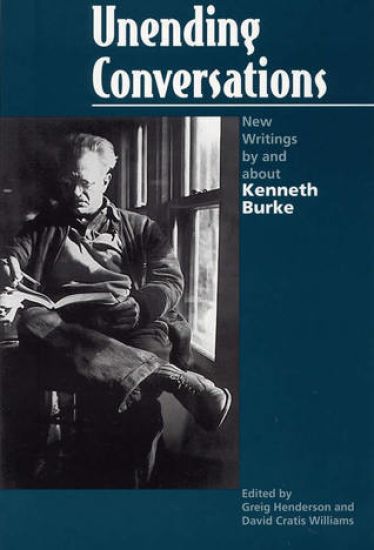
Unending Conversations

Unending Conversations

Kenneth Burke

Southern Illinois University Press
2001
nidottu
Previously unpublished writings by and about Kenneth Burke plus essays by such Burkean luminaries as Wayne C. Booth, William H. Rueckert, Robert Wess, Thomas Carmichael, and Michael Feehan make the publication of Unending Conversations a significant event in the field of Burke studies and in the wider field of literary criticism and theory. Editors Greig Henderson and David Cratis Williams have divided their material into three parts: ""Dialectics of Expression, Communication, and Transcendence,""""Criticism, Symbolicity, and Tropology,"" and ""Transcendence and the Theological Motive."" In the first part, Williams's textual introduction and Rueckert's essay analyze the genesis and composition of Burke's A Symbolic of Motives and Poetics, Dramatistically Considered. Henderson opens part two by showing how these two essays' concerns with literary form hearken back to Burke's first book of criticism, Counter-Statement. Thomas Carmichael discusses Burke's relationship to thinkers such as Paul de Man, Jacques Derrida, Stanley Fish, Fredric Jameson, Jean-Francois Lyotard, and Richard Rorty. Wess analyzes the relation between Burke's dramatistic pentad of act, agent, scene, agency, and purpose and his four master tropes - metaphor, metonymy, synecdoche, and irony. In the third part, Booth mines his unpublished correspondence with Burke to demonstrate that Burke is a coy theologian. Michael Feehan discusses Burke's revelation in a 1983 interview that rather than rebounding from a naive kind of Marxism in Permanence and Change, he was rebounding from what he had ""learned as a Christian Scientist.
On Symbols and Society

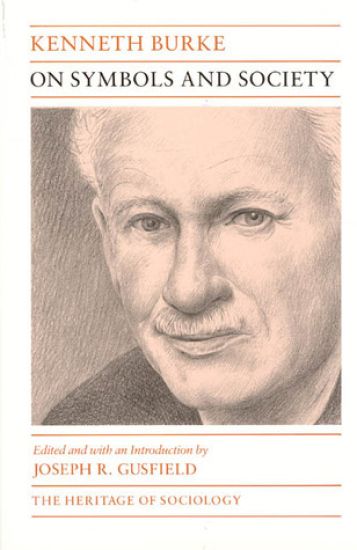
On Symbols and Society

Kenneth Burke

University of Chicago Press
1989
nidottu
Kenneth Burke's innovative use of dramatism and dialectical method have made him a powerful critical force in an extraordinary variety of disciplines—education, philosophy, history, psychology, religion, and others. While most widely acclaimed as a literary critic, Burke has elaborated a perspective toward the study of behavior and society that holds immense significance and rich insights for sociologists. This original anthology brings together for the first time Burke's key writings on symbols and social relations to offer social scientists access to Burke's thought. In his superb introductory essay, Joseph R. Gusfield traces the development of Burke's approach to human action and its relationship to other similar sources of theory and ideas in sociology; he discusses both Burke's influence on sociologists and the limits of his perspective. Burke regards literature as a form of human behavior—and human behavior as embedded in language. His lifework represents a profound attempt to understand the implications for human behavior based on the fact that humans are "symbol-using animals." As this volume demonstrates, the work that Burke produced from the 1930s through the 1960s stands as both precursor and contemporary key to recent intellectual movements such as structuralism, symbolic anthropology, phenomenological and interpretive sociology, critical theory, and the renaissance of symbolic interaction.
Permanence and Change

Permanence and Change

Kenneth Burke

University of California Press
1984
pokkari
Permanence and Change was written and first published in the depths of the Great Depression. Attitudes Toward History followed it two years later. These were revolutionary texts in the theory of communication, and, as classics, they retain their surcharge of energy. Permanence and Change treats human communication in terms of ideal cooperation, whereas Attitudes Towards History characterizes tactics and patterns of conflict typical of actual human associations. It is in Permanence and Change that Burke establishes in path-breaking fashion that form permeates society just as it does poetry and the arts. Hence, his master idea that forms of art are not exclusively aesthetic: the cycles of a storm, the gradations of a sunrise, the stages of an epidemic, the undoing of Prince Hamlet are all instances of progressive form. This new Edition of Permanence and Change reprints Hugh Dalziel Duncan's long sociological introduction and includes a substantial new afterward in which Burke reexamines his early ideas in light of subsequent developments in his own thinking and in social theory.
The Rhetoric of Religion

The Rhetoric of Religion

Kenneth Burke

University of California Press
1970
pokkari
"But the point of Burke's work, and the significance of his achievement, is not that he points out that religion and language affect each other, for this has been said before, but that he proceeds to demonstrate how this is so by reference to a specific symbolic context. After a discussion 'On Words and The Word,' he analysess verbal action in St. Augustine's Confessions. He then discusses the first three chapters of Genesis, and ends with a brilliant and profound 'Prologue in Heaven,' an imaginary dialogue between the Lord and Satan in which he proposes that we begin our study of human motives with complex theories of transcendence,' rather than with terminologies developed in the use of simplified laboratory equipment... Burke now feels, after some forty years of search, that he has created a model of the symbolic act which breaks through the rigidities of the 'sacred-secular' dichotomy, and at the same time shows us how we get from secular and sacred realms of action over the bridge of language... Religious systems are systems of action based on communication in society. They are great social dramas which are played out on earth before an ultimate audience, God. But where theology confronts the developed cosmological drama in the 'grand style,' that is, as a fully developed cosmological drama for its religious content, the 'logologer' can be further studied not directly as knowledge but as anecdotes that help reveal for us the quandaries of human governance." (Hugh Dalziel Duncan from Critical Responses to Kenneth Burke, 1924 - 1966, edited by William H. Rueckert (Minneapolis: University of Minnesota Press, 1969)).
A Grammar of Motives

A Grammar of Motives

Kenneth Burke

University of California Press
1969
pokkari

Halvin toimitettuna 40,90 €

Mr. Burke contributes an introductory and summarizing remark, "What is involved, when we say what people are doing and why they are doing it? An answer to that question is the subject of this book. The book is concerned with the basic forms of through which, in accordance with the nature of the world as all men necessarily experience it, are exemplified in the attributing of motives. These forms of though can be embodied profoundly or trivially, truthfully or falsely. They are equally present in systematically elaborated or metaphysical structures, in legal judgements, in poetry and fiction, in political and scientific works, in news and in bits of gossip offered at random."
A Rhetoric of Motives

A Rhetoric of Motives

Kenneth Burke

University of California Press
1969
pokkari
As critic, Kenneth Burke's preoccupations were at the beginning purely aesthetic and literary; but after "Counter-Statement" (1931), he began to discriminate a 'rhetorical' or persuasive component in literature, and thereupon became a philosopher of language and human conduct. In "A Grammar of Motives" (1945) and "A Rhetoric of Motives" (1950), Burke's conception of 'symbolic action' comes into its own: all human activities - linguistic or extra-linguistic - are modes of symbolizing; man is defined as the symbol-using (and -misusing) animal. The critic's job becomes one of the interpreting human symbolizing wherever he finds it, with the aim of illuminating human motivation. Thus the reach of the literary critic now extends to the social and ethical. "A Grammar of Motives" is a 'methodical meditation' on such complex linguistic forms as plays, stories, poems, theologies, metaphysical systems, political philosophies, and constitutions. "A Rhetoric of Motives" expands the field to human ways of persuasion and identification. Persuasion, as Burke sees it, 'ranges from the bluntest quest of advantage, as in sales promotion or propaganda, through courtship, social etiquette, education, and the sermon, to a 'pure' form that delights in the process of appeal for itself alone, without ulterior purpose. And identification ranges from the politician who, addressing an audience of farmers, says, 'I was a farm boy myself,' through the mysteries of social status, to the mystic's devout identification with the sources of all being.'
Language As Symbolic Action

Language As Symbolic Action

Kenneth Burke

University of California Press
1968
pokkari
From the Preface: The title for this collection was the title of a course in literary criticism that I gave for many years at Bennington College. And much of the material presented here was used in that course. The title should serve well to convey the gist of these various pieces. For all of them are explicitly concerned with the attempt to define and track down the implications of the term "symbolic action," and to show how the marvels of literature and language look when considered form that point of view.
Counter-Statement

Counter-Statement

Kenneth Burke

University of California Press
1968
pokkari
A valuable feature of the second edition (1953) of Counter-Statement was the Curriculum Criticum in which the author placed the book in terms of his later work. For this new paperback edition, Mr. Burke continues his "curve of development" in an Addendum which surveys the course of his though in subsequent books (up to the publication of his Collected Poems, 1915 - 1967) and work-in-progress.