Kirjojen hintavertailu – 12 903 724 kirjaa ja 27 kauppaa

Kirjailija

Kenneth J. Berry

Kirjat ja teokset yhdessä paikassa: 18 kirjaa, julkaisuja vuosilta 2007–2026, suosituimpiin kuuluu Permutation Statistical Methods. Vertaile teosten hintoja ja tarkista saatavuus suomalaisista kirjakaupoista.

18 kirjaa

Kirjojen julkaisuvuodet: 2007–2026.

Permutation Statistical Methods

Permutation Statistical Methods

Janis E Johnston; Kenneth J. Berry; Michael A. Long

Springer Nature Switzerland AG
2026
nidottu
The primary purpose of this book is to introduce the reader to elementary statistical methods as related to tests of differences, such as one-sample tests, tests of two independent samples, tests of two matched samples, and one-way analysis of variance. Throughout the book the emphasis is on permutation statistical methods, although the results of the permutation analyses are always compared and contrasted with the results of conventional statistical analyses. Unlike classical statistical methods, permutation statistical methods do not rely on theoretical distributions, avoid the usual assumptions of normality and homogeneity, depend only on the observed data, and do not require random sampling. The book is designed for an audience with limited statistical background and can easily serve as a supplementary textbook in an undergraduate or graduate course in departments such as statistics, psychology, economics, or biology. In particular, the audience for this book is quantitative undergraduate and graduate students in fields such as psychology, sociology, biology and political science. No statistical training beyond a first course in statistics is required.

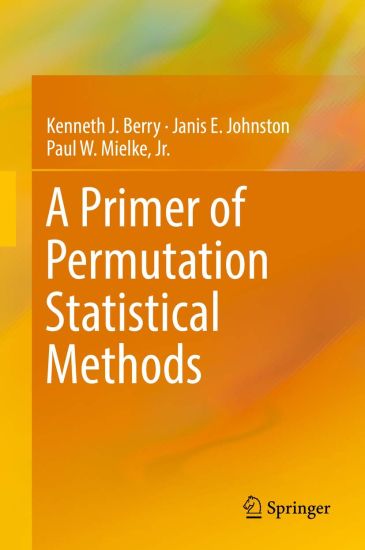
A Primer of Permutation Statistical Methods

A Primer of Permutation Statistical Methods

Kenneth J. Berry; Janis E. Johnston; Jr. Mielke

Springer Nature Switzerland AG
2020
nidottu
The primary purpose of this textbook is to introduce the reader to a wide variety of elementary permutation statistical methods. Permutation methods are optimal for small data sets and non-random samples, and are free of distributional assumptions. The book follows the conventional structure of most introductory books on statistical methods, and features chapters on central tendency and variability, one-sample tests, two-sample tests, matched-pairs tests, one-way fully-randomized analysis of variance, one-way randomized-blocks analysis of variance, simple regression and correlation, and the analysis of contingency tables. In addition, it introduces and describes a comparatively new permutation-based, chance-corrected measure of effect size. Because permutation tests and measures are distribution-free, do not assume normality, and do not rely on squared deviations among sample values, they are currently being applied in a wide variety of disciplines. This book presents permutation alternatives to existing classical statistics, and is intended as a textbook for undergraduate statistics courses or graduate courses in the natural, social, and physical sciences, while assuming only an elementary grasp of statistics.
A Primer of Permutation Statistical Methods

A Primer of Permutation Statistical Methods

Kenneth J. Berry; Janis E. Johnston; Jr. Mielke

Springer Nature Switzerland AG
2019
sidottu
The primary purpose of this textbook is to introduce the reader to a wide variety of elementary permutation statistical methods. Permutation methods are optimal for small data sets and non-random samples, and are free of distributional assumptions. The book follows the conventional structure of most introductory books on statistical methods, and features chapters on central tendency and variability, one-sample tests, two-sample tests, matched-pairs tests, one-way fully-randomized analysis of variance, one-way randomized-blocks analysis of variance, simple regression and correlation, and the analysis of contingency tables. In addition, it introduces and describes a comparatively new permutation-based, chance-corrected measure of effect size. Because permutation tests and measures are distribution-free, do not assume normality, and do not rely on squared deviations among sample values, they are currently being applied in a wide variety of disciplines. This book presents permutation alternatives to existing classical statistics, and is intended as a textbook for undergraduate statistics courses or graduate courses in the natural, social, and physical sciences, while assuming only an elementary grasp of statistics.
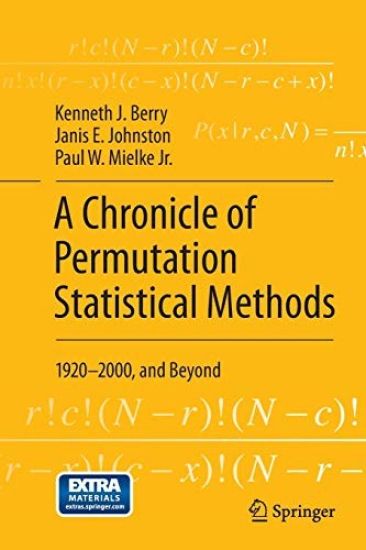
A Chronicle of Permutation Statistical Methods

A Chronicle of Permutation Statistical Methods

Kenneth J. Berry; Janis E. Johnston; Paul W. Mielke Jr.

Springer International Publishing AG
2016
nidottu
The focus of this book is on the birth and historical development of permutation statistical methods from the early 1920s to the near present. Beginning with the seminal contributions of R. A. Fisher, E. J. G. Pitman, and others in the 1920s and 1930s, permutation statistical methods were initially introduced to validate the assumptions of classical statistical methods. Permutation methods have advantages over classical methods in that they are optimal for small data sets and non-random samples, are data-dependent, and are free of distributional assumptions. Permutation probability values may be exact, or estimated via moment- or resampling-approximation procedures. Because permutation methods are inherently computationally-intensive, the evolution of computers and computing technology that made modern permutation methods possible accompanies the historical narrative. Permutation analogs of many well-known statistical tests are presented in a historical context, includingmultiple correlation and regression, analysis of variance, contingency table analysis, and measures of association and agreement. A non-mathematical approach makes the text accessible to readers of all levels.
A Chronicle of Permutation Statistical Methods

A Chronicle of Permutation Statistical Methods

Kenneth J. Berry; Janis E. Johnston; Paul W. Mielke Jr.

Springer International Publishing AG
2014
sidottu
The focus of this book is on the birth and historical development of permutation statistical methods from the early 1920s to the near present. Beginning with the seminal contributions of R. A. Fisher, E. J. G. Pitman, and others in the 1920s and 1930s, permutation statistical methods were initially introduced to validate the assumptions of classical statistical methods. Permutation methods have advantages over classical methods in that they are optimal for small data sets and non-random samples, are data-dependent, and are free of distributional assumptions. Permutation probability values may be exact, or estimated via moment- or resampling-approximation procedures. Because permutation methods are inherently computationally-intensive, the evolution of computers and computing technology that made modern permutation methods possible accompanies the historical narrative. Permutation analogs of many well-known statistical tests are presented in a historical context, includingmultiple correlation and regression, analysis of variance, contingency table analysis, and measures of association and agreement. A non-mathematical approach makes the text accessible to readers of all levels.
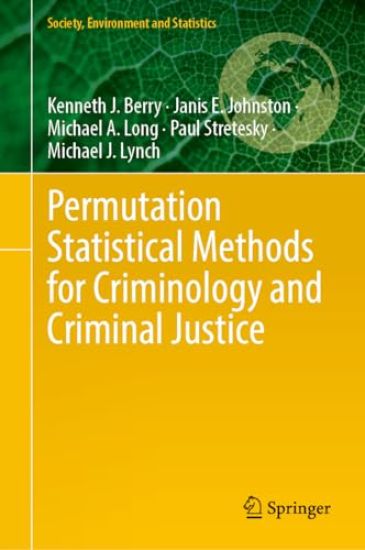
Permutation Statistical Methods for Criminology and Criminal Justice

Permutation Statistical Methods for Criminology and Criminal Justice

Kenneth J. Berry; Janis E. Johnston; Michael A. Long; Paul Stretesky; Michael J. Lynch

Springer International Publishing AG
2025
sidottu
This book takes a unique approach to explaining permutation statistical methods for advanced undergraduate students, graduate students, faculty, researchers, and other professionals interested in the areas of criminology or criminal justice. The book integrates permutation statistical methods with a wide range of classical statistical methods. It opens with a comparison of two models of statistical inference: the classical population model espoused by J. Neyman and E. Pearson and the permutation model first introduced by R. A. Fisher and E. J. G. Pitman. Numerous comparisons of permutation and classical statistical methods are illustrated with examples from criminology and criminal justice and supplemented with a variety of R scripts for ease of computation. The text follows the general outline of an introductory textbook in statistics with chapters on central tendency, variability, one-sample tests, two-sample tests, matched-pairs tests, completely-randomized analysis of variance, randomized-blocks analysis of variance, simple linear regression and correlation, and the analysis of goodness of fit and contingency. Unlike classical statistical methods, permutation statistical methods do not rely on theoretical distributions, avoid the usual assumptions of normality and homogeneity, depend solely on the observed data, and do not require random sampling, making permutation statistical methods ideal for analyzing criminology and criminal justice databases. Permutation methods are relatively new in that it took modern computing power to make them available to those working in criminology and criminal justice research. The book contains detailed examples of permutation analyses. Each analysis is paired with a conventional analysis; for example, a permutation test of the difference between experimental and control groups is contrasted with Student's two-sample $t$ test. An added feature is the inclusion of multiple historical notes on the origin and development of both parametric and conventional tests and measures. Designed for an audience with a basic statistical background and a strong interest in parametric and non-parametric statistics, the book can easily serve as a textbook for undergraduate and graduate students in criminology, criminal justice, or sociology, as well as serving as a research source for faculty, researchers, and other professionals in the area of criminology. No statistical training beyond a first course in statistics is required, but some knowledge of, or interest in, criminology or criminal justice is assumed.
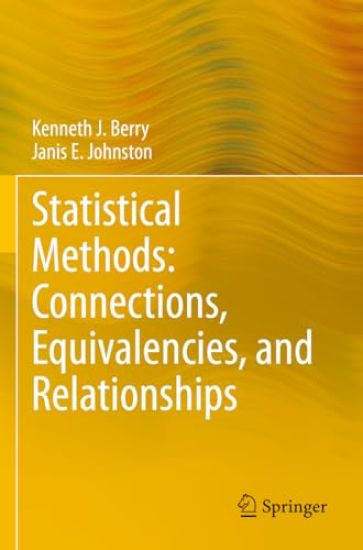
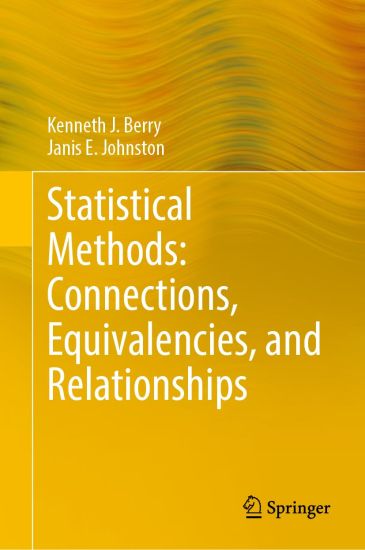
Statistical Methods: Connections, Equivalencies, and Relationships

Statistical Methods: Connections, Equivalencies, and Relationships

Kenneth J. Berry; Janis E. Johnston

Springer International Publishing AG
2024
nidottu
The primary purpose of this book is to introduce the reader to a wide variety of interesting and useful connections, relationships, and equivalencies between and among conventional and permutation statistical methods. There are approximately 320 statistical connections and relationships described in this book. For each connection or connections the tests are described, the connection is explained, and an example analysis illustrates both the tests and the connection(s). The emphasis is more on demonstrations than on proofs, so little mathematical expertise is assumed. While the book is intended as a stand-alone monograph, it can also be used as a supplement to a standard textbook such as might be used in a second- or third-term course in conventional statistical methods. Students, faculty, and researchers in the social, natural, or hard sciences will find an interesting collection of statistical connections and relationships - some well-known, some more obscure, and some presentedhere for the first time.
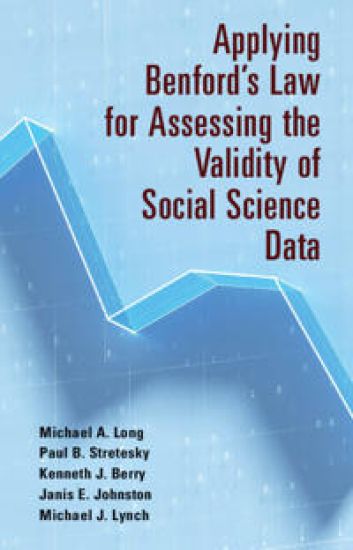
Applying Benford's Law for Assessing the Validity of Social Science Data

Applying Benford's Law for Assessing the Validity of Social Science Data

Michael A. Long; Paul B. Stretesky; Kenneth J. Berry; Janis E. Johnston; Michael J. Lynch

Cambridge University Press
2023
sidottu
Benford's Law is a probability distribution for the likelihood of the leading digit in a set of numbers. This book seeks to improve and systematize the use of Benford's Law in the social sciences to assess the validity of self-reported data. The authors first introduce a new measure of conformity to the Benford distribution that is created using permutation statistical methods and employs the concept of statistical agreement. In a switch from a typical Benford application, this book moves away from using Benford's Law to test whether the data conform to the Benford distribution, to using it to draw conclusions about the validity of the data. The concept of 'Benford validity' is developed, which indicates whether a dataset is valid based on comparisons with the Benford distribution and, in relation to this, diagnostic procedure that assesses the impact of not having Benford validity on data analysis is devised.
Applying Benford's Law for Assessing the Validity of Social Science Data

Applying Benford's Law for Assessing the Validity of Social Science Data

Michael A. Long; Paul B. Stretesky; Kenneth J. Berry; Janis E. Johnston; Michael J. Lynch

Cambridge University Press
2023
pokkari
Benford's Law is a probability distribution for the likelihood of the leading digit in a set of numbers. This book seeks to improve and systematize the use of Benford's Law in the social sciences to assess the validity of self-reported data. The authors first introduce a new measure of conformity to the Benford distribution that is created using permutation statistical methods and employs the concept of statistical agreement. In a switch from a typical Benford application, this book moves away from using Benford's Law to test whether the data conform to the Benford distribution, to using it to draw conclusions about the validity of the data. The concept of 'Benford validity' is developed, which indicates whether a dataset is valid based on comparisons with the Benford distribution and, in relation to this, diagnostic procedure that assesses the impact of not having Benford validity on data analysis is devised.
Statistical Methods: Connections, Equivalencies, and Relationships

Statistical Methods: Connections, Equivalencies, and Relationships

Kenneth J. Berry; Janis E. Johnston

Springer International Publishing AG
2023
sidottu
The primary purpose of this book is to introduce the reader to a wide variety of interesting and useful connections, relationships, and equivalencies between and among conventional and permutation statistical methods. There are approximately 320 statistical connections and relationships described in this book. For each connection or connections the tests are described, the connection is explained, and an example analysis illustrates both the tests and the connection(s). The emphasis is more on demonstrations than on proofs, so little mathematical expertise is assumed. While the book is intended as a stand-alone monograph, it can also be used as a supplement to a standard textbook such as might be used in a second- or third-term course in conventional statistical methods. Students, faculty, and researchers in the social, natural, or hard sciences will find an interesting collection of statistical connections and relationships - some well-known, some more obscure, and some presentedhere for the first time.
Permutation Statistical Methods with R

Permutation Statistical Methods with R

Kenneth J. Berry; Kenneth L. Kvamme; Janis E. Johnston; Jr. Mielke

Springer Nature Switzerland AG
2022
nidottu
This book takes a unique approach to explaining permutation statistics by integrating permutation statistical methods with a wide range of classical statistical methods and associated R programs. It opens by comparing and contrasting two models of statistical inference: the classical population model espoused by J. Neyman and E. S. Pearson and the permutation model first introduced by R. A. Fisher and E. J. G. Pitman. Numerous comparisons of permutation and classical statistical methods are presented, supplemented with a variety of R scripts for ease of computation. The text follows the general outline of an introductory textbook in statistics with chapters on central tendency and variability, one-sample tests, two-sample tests, matched-pairs tests, completely-randomized analysis of variance, randomized-blocks analysis of variance, simple linear regression and correlation, and the analysis of goodness of fit and contingency. Unlike classical statistical methods, permutation statistical methods do not rely on theoretical distributions, avoid the usual assumptions of normality and homogeneity, depend only on the observed data, and do not require random sampling. The methods are relatively new in that it took modern computing power to make them available to those working in mainstream research. Designed for an audience with a limited statistical background, the book can easily serve as a textbook for undergraduate or graduate courses in statistics, psychology, economics, political science or biology. No statistical training beyond a first course in statistics is required, but some knowledge of, or some interest in, the R programming language is assumed.
Permutation Statistical Methods with R

Permutation Statistical Methods with R

Kenneth J. Berry; Kenneth L. Kvamme; Janis E. Johnston; Jr. Mielke

Springer Nature Switzerland AG
2021
sidottu
This book takes a unique approach to explaining permutation statistics by integrating permutation statistical methods with a wide range of classical statistical methods and associated R programs. It opens by comparing and contrasting two models of statistical inference: the classical population model espoused by J. Neyman and E. S. Pearson and the permutation model first introduced by R. A. Fisher and E. J. G. Pitman. Numerous comparisons of permutation and classical statistical methods are presented, supplemented with a variety of R scripts for ease of computation. The text follows the general outline of an introductory textbook in statistics with chapters on central tendency and variability, one-sample tests, two-sample tests, matched-pairs tests, completely-randomized analysis of variance, randomized-blocks analysis of variance, simple linear regression and correlation, and the analysis of goodness of fit and contingency. Unlike classical statistical methods, permutation statistical methods do not rely on theoretical distributions, avoid the usual assumptions of normality and homogeneity, depend only on the observed data, and do not require random sampling. The methods are relatively new in that it took modern computing power to make them available to those working in mainstream research. Designed for an audience with a limited statistical background, the book can easily serve as a textbook for undergraduate or graduate courses in statistics, psychology, economics, political science or biology. No statistical training beyond a first course in statistics is required, but some knowledge of, or some interest in, the R programming language is assumed.
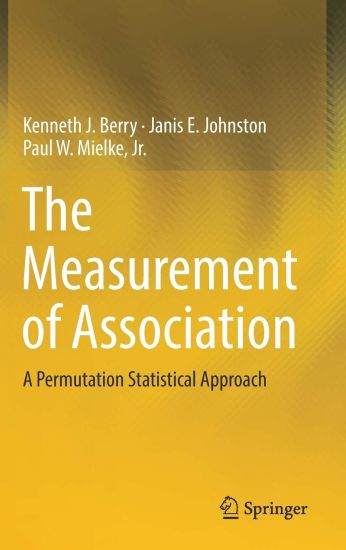
The Measurement of Association

The Measurement of Association

Kenneth J. Berry; Janis E. Johnston; Jr. Mielke

Springer International Publishing AG
2018
sidottu
This research monograph utilizes exact and Monte Carlo permutation statistical methods to generate probability values and measures of effect size for a variety of measures of association. Association is broadly defined to include measures of correlation for two interval-level variables, measures of association for two nominal-level variables or two ordinal-level variables, and measures of agreement for two nominal-level or two ordinal-level variables. Additionally, measures of association for mixtures of the three levels of measurement are considered: nominal-ordinal, nominal-interval, and ordinal-interval measures. Numerous comparisons of permutation and classical statistical methods are presented. Unlike classical statistical methods, permutation statistical methods do not rely on theoretical distributions, avoid the usual assumptions of normality and homogeneity of variance, and depend only on the data at hand. This book takes a unique approach to explaining statistics by integrating a large variety of statistical methods, and establishing the rigor of a topic that to many may seem to be a nascent field. This topic is relatively new in that it took modern computing power to make permutation methods available to those working in mainstream research. Written for a statistically informed audience, it is particularly useful for teachers of statistics, practicing statisticians, applied statisticians, and quantitative graduate students in fields such as psychology, medical research, epidemiology, public health, and biology. It can also serve as a textbook in graduate courses in subjects like statistics, psychology, and biology.
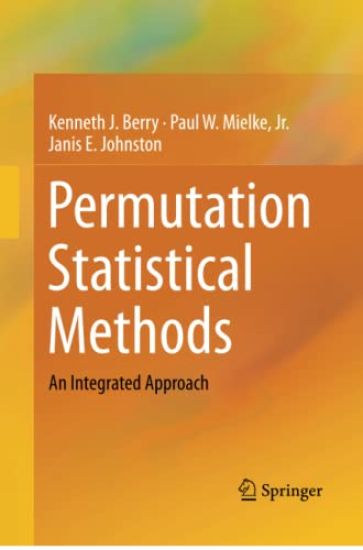
Permutation Statistical Methods

Permutation Statistical Methods

Kenneth J. Berry; Paul W. Mielke Jr.; Janis E. Johnston

Springer International Publishing AG
2018
nidottu
This research monograph provides a synthesis of a number of statistical tests and measures, which, at first consideration, appear disjoint and unrelated. Numerous comparisons of permutation and classical statistical methods are presented, and the two methods are compared via probability values and, where appropriate, measures of effect size. Permutation statistical methods, compared to classical statistical methods, do not rely on theoretical distributions, avoid the usual assumptions of normality and homogeneity of variance, and depend only on the data at hand. This text takes a unique approach to explaining statistics by integrating a large variety of statistical methods, and establishing the rigor of a topic that to many may seem to be a nascent field in statistics. This topic is new in that it took modern computing power to make permutation methods available to people working in the mainstream of research. lly-informed="" audience,="" and="" can="" also="" easily="" serve="" as="" textbook="" in="" graduate="" course="" departments="" such="" statistics,="" psychology,="" or="" biology.="" particular,="" the="" audience="" for="" book="" is="" teachers="" of="" practicing="" statisticians,="" applied="" quantitative="" students="" fields="" medical="" research,="" epidemiology,="" public="" health,="" biology.
Permutation Statistical Methods

Permutation Statistical Methods

Kenneth J. Berry; Paul W. Mielke Jr.; Janis E. Johnston

Springer International Publishing AG
2016
sidottu
This research monograph provides a synthesis of a number of statistical tests and measures, which, at first consideration, appear disjoint and unrelated. Numerous comparisons of permutation and classical statistical methods are presented, and the two methods are compared via probability values and, where appropriate, measures of effect size. Permutation statistical methods, compared to classical statistical methods, do not rely on theoretical distributions, avoid the usual assumptions of normality and homogeneity of variance, and depend only on the data at hand. This text takes a unique approach to explaining statistics by integrating a large variety of statistical methods, and establishing the rigor of a topic that to many may seem to be a nascent field in statistics. This topic is new in that it took modern computing power to make permutation methods available to people working in the mainstream of research. lly-informed="" audience,="" and="" can="" also="" easily="" serve="" as="" textbook="" in="" graduate="" course="" departments="" such="" statistics,="" psychology,="" or="" biology.="" particular,="" the="" audience="" for="" book="" is="" teachers="" of="" practicing="" statisticians,="" applied="" quantitative="" students="" fields="" medical="" research,="" epidemiology,="" public="" health,="" biology.
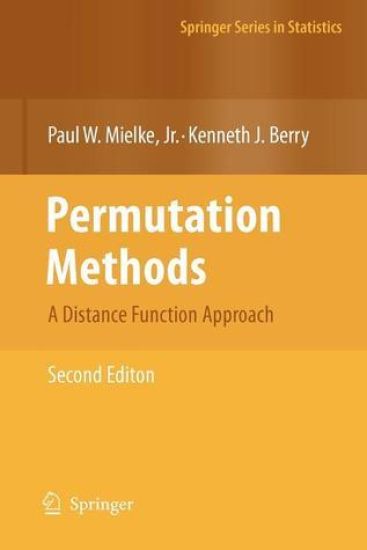
Permutation Methods

Permutation Methods

Paul W. Mielke; Kenneth J. Berry

Springer-Verlag New York Inc.
2010
nidottu
Most commonly-used parametric and permutation statistical tests, such as the matched-pairs t test and analysis of variance, are based on non-metric squared distance functions that have very poor robustness characteristics. This second edition places increased emphasis on the use of alternative permutation statistical tests based on metric Euclidean distance functions that have excellent robustness characteristics. These alternative permutation techniques provide many powerful multivariate tests including multivariate multiple regression analyses. In addition to permutation techniques described in the first edition, this second edition also contains various new permutation statistical methods and studies that include resampling multiple contingency table analyses, analysis concerns involving log-linear models with small samples, an exact discrete analog of Fisher’s continuous method for combining P-values that arise from small data sets, multiple dichotomous response analyses, problems regarding Fisher’s Z transformation for correlation analyses, and multivariate similarity comparisons between corresponding multiple categories of two samples.
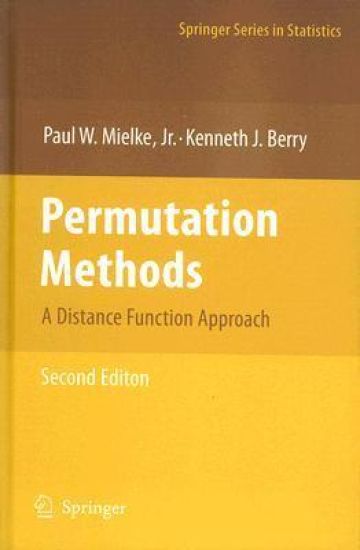
Permutation Methods

Permutation Methods

Paul W. Mielke; Kenneth J. Berry

Springer-Verlag New York Inc.
2007
sidottu
Most commonly-used parametric and permutation statistical tests, such as the matched-pairs t test and analysis of variance, are based on non-metric squared distance functions that have very poor robustness characteristics. This second edition places increased emphasis on the use of alternative permutation statistical tests based on metric Euclidean distance functions that have excellent robustness characteristics. These alternative permutation techniques provide many powerful multivariate tests including multivariate multiple regression analyses. In addition to permutation techniques described in the first edition, this second edition also contains various new permutation statistical methods and studies that include resampling multiple contingency table analyses, analysis concerns involving log-linear models with small samples, an exact discrete analog of Fisher’s continuous method for combining P-values that arise from small data sets, multiple dichotomous response analyses, problems regarding Fisher’s Z transformation for correlation analyses, and multivariate similarity comparisons between corresponding multiple categories of two samples.