Kirjojen hintavertailu – 12 859 818 kirjaa ja 27 kauppaa

Kirjailija

Kenneth Minogue

Kirjat ja teokset yhdessä paikassa: 7 kirjaa, julkaisuja vuosilta 2000–2022, suosituimpiin kuuluu Politik och ideologier : perspektiv från Engelbergsseminariet 2011. Vertaile teosten hintoja ja tarkista saatavuus suomalaisista kirjakaupoista.

7 kirjaa

Kirjojen julkaisuvuodet: 2000–2022.

Politik och ideologier : perspektiv från Engelbergsseminariet 2011

Politik och ideologier : perspektiv från Engelbergsseminariet 2011

Ulrike Ackermann; Scott Atran; James Bartolomew; Michael Bentley; Paul Berman; Vernon Bogdanor; Nick Boles; Robert Cooper; Stephan Eisel; Richard J Evans; Michael Freeden; David Frum; Dick Harrison; Anna Jardfeldt; Oliver Kamm; Robert D Kaplan; John Keane; Johan Lagerkvist; Mark Leonard; John Lloyd; Hisham Melhem; Richard Miles; Kenneth Minogue; Minxin Pei; Malise Ruthven; Roger Scruton; Per Schlingman; Nathan Shachar; Robert J Shapiro; Maria Wetterstrand

Bokförlaget Atlantis
2012
sidottu
Ideologiernas död har förutspåtts ett flertal gånger under åren, men gång på gång har vi också sett gamla ideologier återvända under nya beteckningar. I denna bok behandlar vi både nuet och det förflutna. Vi belyser en del av de politiska idéer och system i historien som fortsätter att utöva inflytande på samtiden. Vi granskar också den auktoritära statskapitalismen, som i fallet Kina, och ställer frågan om den är hållbar. Om så är fallet, hur kommer den att inverka på världen? Kommer den att bli förebilden, precis som liberal demokrati under lång tid har varit det för många människor och nationer? Kommer islamism, främlings- och invandrarfientliga partier och andra rörelser i marginalen av det politiska och ideologiska spektrumet i Europa, USA och den islamiska världen att befästa den rådande ordningen eller undergräva tilltron till den? Vilka är globaliseringens konsekvenser för politik och ideologi? Kommer svaret att bli ett världsparlament, en världsomfattande miljörörelse eller olika strömningar med religion som gemensam nämnare? Eller kommer vi kanske i stället att få se ett annat gammalt spöke återvända: nationalismen? Boken ingår i serien Engelsbergsseminarierna och utges i samarbete med Bokförlaget Atlantis och Axel och Margaret Ax:son Johnsons stiftelse för almännyttiga ändamål.
Liberal Mind

Liberal Mind

Kenneth Minogue

Liberty Fund Inc
2022
nidottu
The Liberal Mind attempts to uncover the philosophy of liberalism and lay bare its implications. What is Man? How does he think and feel? What is the place of Reason in human affairs? How should men live? What is politics, and what is it for? Kenneth Minogue offers a brilliant and provocative exploration of liberalism in the Western world today: its roots and its influences, its present state, and its prospects in the new century. While few - especially in America - embrace the description of liberal, Minogue argues, most Americans and most Europeans behave as liberals. At least they are the heirs of what Minogue describes as "the triumph of an enlarged, flexible, and pragmatic version of liberalism." The past two centuries have been characterised, in the West at least, by "the fury of old ideological battles... such as: A planned economy, or free enterprise? Individual thrift, or social services? Free trade, or protection?" These battles have largely been completed -- and, many would say, have been won by the champions of, respectively, free enterprise, individual thrift, and free trade.
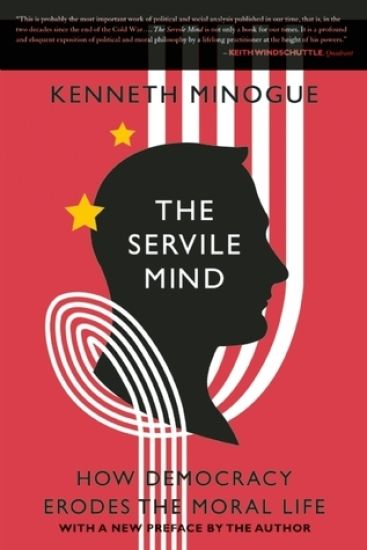
The Servile Mind

The Servile Mind

Kenneth Minogue

Encounter Books,USA
2013
pokkari
One of the grim comedies of the twentieth century was that miserable victims of communist regimes would climb walls, swim rivers, dodge bullets, and find other desperate ways to achieve liberty in the West at the same time that progressive intellectuals would sentimentally proclaim that these very regimes were the wave of the future. A similar tragicomedy is playing out in our century: as the victims of despotism and backwardness from Third World nations pour into Western states, academics and intellectuals present Western life as a nightmare of inequality and oppression. In The Servile Mind: How Democracy Erodes the Moral Life, Kenneth Minogue explores the intelligentsia's love affair with social perfection and reveals how that idealistic dream is destroying exactly what has made the inventive Western world irresistible to the peoples of foreign lands. The Servile Mind looks at how Western morality has evolved into mere "politico-moral" posturing about admired ethical causes--from solving world poverty and creating peace to curing climate change. Today, merely making the correct noises and parading one's essential decency by having the correct opinions has become a substitute for individual moral responsibility. Instead, Minogue argues, we ask that our governments carry the burden of solving our social--and especially moral--problems for us. The irony is that the more we allow the state to determine our moral order, the more we need to be told how to behave and what to think. Such is the servile mind.
The Servile Mind

The Servile Mind

Kenneth Minogue

Encounter Books,USA
2010
sidottu
One of the grim comedies of the twentieth century was the fate of miserable victims of communist regimes who climbed walls, swam rivers, dodged bullets, and found other desperate ways to achieve liberty in the West at the same time as intellectuals in the West sentimentally proclaimed that these very regimes were the wave of the future. A similar tragicomedy is being played out in our century: as the victims of despotism and backwardness from third world nations pour into Western states, the same ivory tower intellectuals assert that Western life is a nightmare of inequality and oppression. In The Servile Mind: How Democracy Erodes the Moral Life, Kenneth Minogue explores the intelligentsia's love affair with social perfection and reveals how that idealistic dream is destroying exactly what has made the inventive Western world irresistible to the peoples of foreign lands. The Servile Mind looks at how Western morality has evolved into mere "politico-moral" posturing about admired ethical causes--from solving world poverty and creating peace to curing climate change. Today, merely making the correct noises and parading one's essential decency by having the correct opinions has became a substitute for individual moral actions. Instead, Minogue posits, we ask that our government carry the burden of solving our social--and especially moral--problems for us. The sad and frightening irony is that as we allow the state to determine our moral order and inner convictions, the more we need to be told how to behave and what to think.
Alien Powers

Alien Powers

Kenneth Minogue

Transaction Publishers
2006
sidottu
The term "ideology" can cover almost any set of ideas, but its power to bewitch political activists results from its strange logic: part philosophy, part science, part spiritual revelation, all tied together in leading to a remarkable paradox--that the modern Western world, beneath its liberal appearance, is actually the most systematically oppressive system of despotism the world has ever seen. Alien Powers: The Pure Theory of Ideology takes this complex intellectual construction apart, analyzing its logical, rhetorical, and psychological devices and thus opening it up to critical analysis. Ideologists assert that our lives are governed by a hidden system. Minogue traces this notion to Karl Marx who taught intellectuals the philosophical, scientific, moral, and religious moves of the ideological game. The believer would find in these ideas an endless source of new liberating discoveries about the meaning of life, and also the grand satisfaction of struggling to overcome oppression. Minogue notes that while the patterns of ideological thought were consistent, there was little agreement on who the oppressor actually was. Marx said it was the bourgeoisie, but others found the oppressor to be males, governments, imperialists, the white race, or the worldwide Jewish conspiracy. Ideological excitement created turmoil in the twentieth century, but the defeat of the more violent and vicious ideologies--Nazism after 1945 and Communism after 1989--left the passion for social perfection as vibrant as ever. Activist intellectuals still seek to "see through" the life we lead. The positive goals of utopia may for the moment have faded, but the ideological hatred of modernity has remained, and much of our intellectual life has degenerated into a muddled and dogmatic skepticism. For Minogue, the complex task of "demystifying" the "demystifiers" requires that we should discover how ideology works. It must join together each of its complex strands of thought in order to understand the remarkable power of the whole.
Politics

Politics

Kenneth Minogue

Oxford University Press
2000
nidottu

Halvin toimitettuna 18,90 €

In this provocative but balanced essay, Kenneth Minogue discusses the development of politics from the ancient world to the twentieth century. He prompts us to consider why political systems evolve, how politics offers both power and order in our society, whether democracy is always a good thing, and what future politics may have in the twenty-first century. ABOUT THE SERIES: The Very Short Introductions series from Oxford University Press contains hundreds of titles in almost every subject area. These pocket-sized books are the perfect way to get ahead in a new subject quickly. Our expert authors combine facts, analysis, perspective, new ideas, and enthusiasm to make interesting and challenging topics highly readable.
Legacy of Friedrich von Hayek DVD, Volume 6
Each of the seven DVDs in this series, represents one of a series of seven lectures sponsored in 1999 by Liberty Fund and the Committee on Social Thought at the University of Chicago in celebration of the hundredth anniversary of Friedrich von Hayek's birth. Approximate running time: 86 minutes.