Kirjojen hintavertailu – 12 859 828 kirjaa ja 27 kauppaa

Kirjailija

Kenneth Rexroth

Kirjat ja teokset yhdessä paikassa: 26 kirjaa, julkaisuja vuosilta 1970–2022, suosituimpiin kuuluu Nights of Love and Laughter. Vertaile teosten hintoja ja tarkista saatavuus suomalaisista kirjakaupoista.

26 kirjaa

Kirjojen julkaisuvuodet: 1970–2022.

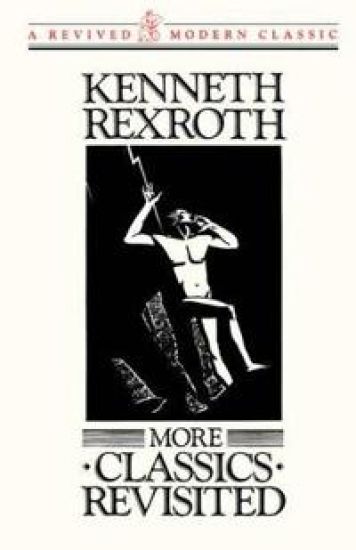
More Classics Revisited

More Classics Revisited

Kenneth Rexroth

NEW DIRECTIONS PUBLISHING CORPORATION
1989
nidottu
More Classics Revisited is the second volume of the late poet and polymath Kenneth Rexroth's brilliant, succinct analyses of some of the key documents in literary history. It presents East and West: from the Bible, the Bhagavad-Gita, and the Tao Te Ching of Lao Tzu to the works of Karl Marx, Charles Baudelaire, and William Carlos Williams. Supplementing the sixty short essays originally published as Classics Revisited in 1969 are forty-one pieces from With Eye and Ear (1970) and The Elastic Retort (1973), both long out of print, as well as various previously uncollected or unpublished essays. Taken together, these hundred and one critiques stand, writes editor Bradford Morrow, "as a primer, or Baedeker, to a whole terrain of thought, to one man's study of imagination and its field of conjuries." The New Directions edition of Classics Revisited was chosen as a Book-of-the-Month Club alternate selection, attesting to the wide appeal of Rexroth's learning and humanity.
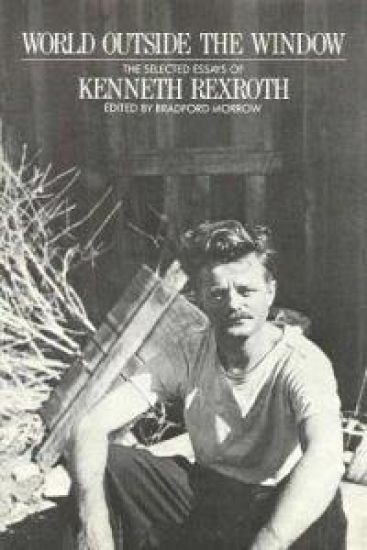
World Outside the Window: Selected Essays

World Outside the Window: Selected Essays

Bradford Morrow; Kenneth Rexroth

New Directions Publishing Corporation
1987
sidottu
World Outside the Window: The Selected Essays of Kenneth Rexroth brings together twenty-seven essays written over a period of more than forty years by the man one of his publishers called “an American cultural monument.” A brilliant self-taught scholar in fields as diverse as Buddhism and modern French poetry, Rexroth was a poet, philosopher, translator, promoter of poets, conscientious objector, political activist, cultural critic, professional curmudgeon, and teacher. More than one critic has suggested that an individual could pursue a complete curriculum in the humanities simply by reading Rexroth’s essays and the works to which they refer. Clear-eyed and clear-headed, Rexroth championed “moral judgment” in the poet and artist from the very first (see “The Function of the Poet in Society,” 1936). And while he dismissed many of his essays as “journalism,” he remains our sanest guide to the cultural upheaval in American society since World War II. Was it because of his trenchant perspicacity that Rexroth’s death in 1982 was widely ignored by the press and cultural establishment, bearing out his own assessment that “When a prophet refuses to go crazy, he becomes quite a problem, crucifixion being as complicated as it is in humanitarian America”? Recently he has been called our “intellectual conscience.” It is time to read Rexroth again. This collection has been compiled and edited by Bradford Morrow, editor of Conjunctions magazine and Rexroth’s literary executor.
Classics Revisited

Classics Revisited

Kenneth Rexroth

New Directions Publishing Corporation
1986
nidottu
An introduction to the world's great literature is presented in sixty critical essays, each of which discusses the theme, summarizes the plot and explores the work's implications.
Selected Poems

Selected Poems

Kenneth Rexroth

New Directions Publishing Corporation
1984
nidottu
He is also one of the most sophisticated. Like William Carlos Williams, he honed his writing to a controlled and direct language. His intellectual complexity matches Wallace Stevens, his polymath erudition Ezra Pound. He is first among our nature poets. His love poems and erotic lyrics are unsurpassed. Rexroth's Selected Poems brings together in a single volume a representative sampling of sixty years' work. Here are substantial passages from his longer poems: The Homestead Called Damascus(1920-1925), begun while the poet was in his teens; the cubist Prolegomenon to a Theodicy (1925-1927); the philosophical masterpiece The Phoenix and the Tortoise (1940-1944) and The Dragon and the Unicorn (1944-1950); and the meditative The Heart's Garden, The Garden's Heart (1967). The shorter poems were originally gathered in In What Hour (1940), The Art of Wordly Wisdom (1949),The Signature of All Things (1950), In Defense of the Earth (1956), Natural Numbers(1964), New Poems (1974), and The Morning Star (1979).
One Hundred Poems from the Chinese

One Hundred Poems from the Chinese

Kenneth Rexroth

New Directions Publishing Corporation
1971
nidottu
The lyric poetry of Tu Fu ranks with the greatest in all world literature. Across the centuries—Tu Fu lived in the T'ang Dynasty (731-770)—his poems come through to us with an immediacy that is breathtaking in Kenneth Rexroth's English versions. They are as simple as they are profound, as delicate as they are beautiful. Thirty-five poems by Tu Fu make up the first part of this volume. The translator then moves on to the Sung Dynasty (10th-12th centuries) to give us a number of poets of that period, much of whose work was not previously available in English. Mei Yao Ch'en, Su Tung P'o, Lu Yu, Chu Hsi, Hsu Chao, and the poetesses Li Ch'iang Chao and Chu Shu Chen. There is a general introduction, biographical and explanatory notes on the poets and poems, and a bibliography of other translations of Chinese poetry.
Collected Longer Poems

Collected Longer Poems

Kenneth Rexroth

New Directions Publishing Corporation
1970
nidottu
This is a companion volume to the Collected Shorter Poems of Kenneth Rexroth which was published in 1967. All of the long poems written over the past forty years are included: The Homestead Called Damascus (1920-25), A Prolegomenon to a Theodicy (1925-27), The Phoenix and the Tortoise (1940-44), The Dragon and the Unicorn (1944-50) and The Heart's Garden, The Garden's Heart (1967-68). As we read the long poems together and in sequence we can see that Rexroth is a philosophical poet of consequence who offers us a comprehensive system of values based on the realization of the ethical mysticism of universal responsibility. He is concerned, above all, with process: the movement from the Dual to the Other. "I have tried," Rexroth writes," to embody in verse the belief that the only valid conservation of value lies in the assumption of unlimited liability, the supernatural identification of the self with the tragic unity of creative process. I hope I have made it clear that the self does not do this by an act of will, by sheer assertion. He who would save his life must lose it."