Kirjojen hintavertailu – 12 859 828 kirjaa ja 27 kauppaa

Kirjailija

Kevin D. Haggerty

Kirjat ja teokset yhdessä paikassa: 5 kirjaa, julkaisuja vuosilta 1997–2015, suosituimpiin kuuluu 57 Ways to Screw Up in Grad School. Vertaile teosten hintoja ja tarkista saatavuus suomalaisista kirjakaupoista.

5 kirjaa

Kirjojen julkaisuvuodet: 1997–2015.

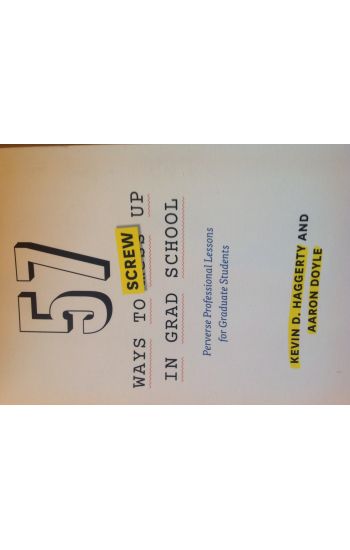
57 Ways to Screw Up in Grad School

57 Ways to Screw Up in Grad School

Kevin D. Haggerty; Aaron Doyle

University of Chicago Press
2015
nidottu
Don't think about why you're applying. Select a topic for entirely strategic reasons. Choose the coolest supervisor. Write only to deadlines. Expect people to hold your hand. Become "that" student. When it comes to a masters or PhD program, most graduate students don't deliberately set out to fail. Yet, of the nearly 500,000 people who start a graduate program each year, up to half will never complete their degree. Books abound on acing the admissions process, but there is little on what to do once the acceptance letter arrives. Veteran graduate directors Kevin D. Haggerty and Aaron Doyle have set out to demystify the world of advanced education. Taking a wry, frank approach, they explain the common mistakes that can trip up a new graduate student and lay out practical advice about how to avoid the pitfalls. Along the way they relate stories from their decades of mentorship and even share some slip-ups from their own grad experiences. The litany of foul-ups is organized by theme and covers the grad school experience from beginning to end: selecting the university and program, interacting with advisors and fellow students, balancing personal and scholarly lives, navigating a thesis, and creating a life after academia. Although the tone is engagingly tongue-in-cheek, the lessons are crucial to anyone attending or contemplating grad school. 57 Ways to Screw Up in Grad School allows you to learn from others' mistakes rather than making them yourself.
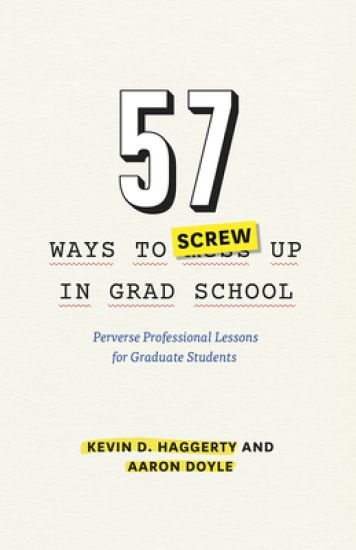
57 Ways to Screw Up in Grad School

57 Ways to Screw Up in Grad School

Kevin D. Haggerty; Aaron Doyle

University of Chicago Press
2015
sidottu
Don't think about why you're applying. Select a topic for entirely strategic reasons. Choose the coolest supervisor. Write only to deadlines. Expect people to hold your hand. Become "that" student. When it comes to a masters or PhD program, most graduate students don't deliberately set out to fail. Yet, of the nearly 500,000 people who start a graduate program each year, up to half will never complete their degree. Books abound on acing the admissions process, but there is little on what to do once the acceptance letter arrives. Veteran graduate directors Kevin D. Haggerty and Aaron Doyle have set out to demystify the world of advanced education. Taking a wry, frank approach, they explain the common mistakes that can trip up a new graduate student and lay out practical advice about how to avoid the pitfalls. Along the way they relate stories from their decades of mentorship and even share some slip-ups from their own grad experiences. The litany of foul-ups is organized by theme and covers the grad school experience from beginning to end: selecting the university and program, interacting with advisors and fellow students, balancing personal and scholarly lives, navigating a thesis, and creating a life after academia. Although the tone is engagingly tongue-in-cheek, the lessons are crucial to anyone attending or contemplating grad school. 57 Ways to Screw Up in Grad School allows you to learn from others' mistakes rather than making them yourself.
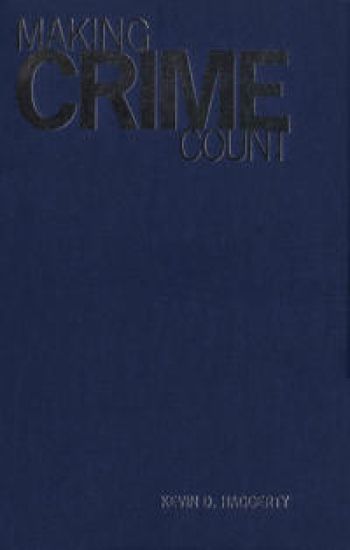
Making Crime Count

Making Crime Count

Kevin D. Haggerty

University of Toronto Press
2001
pokkari
Official statistics are one of the most important sources of knowledge about crime and the criminal justice system. Yet, little is known about the inner workings of the institutions that produce these numbers. In this groundbreaking study, Kevin D. Haggerty sheds light on the process involved in the gathering and disseminating of crime statistics through an empirical examination of the Canadian Centre for Justice Statistics (CCJS), the branch of Statistics Canada responsible for producing data on the criminal justice system. Making Crime Count details how the availability of criminal justice statistics has fostered a distinctive approach to the governance of crime and criminal justice. What has emerged is a form of actuarial justice whereby crime is increasingly understood as a statistical probability, rather than a moral failing. At the same time, statistics render criminal justice organizations amenable to governmental strategies that aim to manage the system itself. Using contemporary work in the sociology of science as a frame, Haggerty explores the means by which the CCJS has been able to produce its statistics. The emphasis is on the extra-scientific factors involved in this process, the complex knowledge networks that must be aligned between assorted elements and institutions, and, specifically, the continual negotiations between CCJS employees and the police over how to secure data for the 'uniform crime report' survey. The conclusions accentuate the need for anyone studying governance to consider the politics and processes of governmental knowledge production.
Policing the Risk Society

Policing the Risk Society

Richard V. Ericson; Kevin D. Haggerty

Clarendon Press
1997
nidottu
In this provocative new book, Richard Ericson and Kevin Haggerty contend that the police have become information brokers to institutions such as insurance companies and health and welfare organizations that operate based on a knowledge of risk. In turn, these institutions influence the ways that police officers think and act. A critical review of existing research reveals the need to study police interaction with institutions as well as individuals. These institutions are part of an emerging "risk society" where knowledge of risk is used to control danger. The authors examine different aspects of police involvement; the use of surveillance technologies and the collection of data on securities, careers and different social, ethnic, age and gender groups. They conclude by looking at how police organizations have been forced to develop new communications rules and technologies to meet external demands for knowledge of risk. This is the first book in this field to include detailed evidence of some of the central tenets of the risk society. It also includes a sophisticated examination of the risk society theory that will advance readers' knowledge considerably. With this book, the authors revolutionize the study of policing, and their work will impact heavily on scholars in criminology, social theory, and communications as well as policing and the public.
Policing the Risk Society

Policing the Risk Society

Richard V. Ericson; Kevin D. Haggerty

Clarendon Press
1997
sidottu
In this provocative new book, Richard Ericson and Kevin Haggerty contend that the police have become information brokers to institutions such as insurance companies and health and welfare organizations that operate based on a knowledge of risk. In turn, these institutions influence the ways that police officers think and act. A critical review of existing research reveals the need to study police interaction with institutions as well as individuals. These institutions are part of an emerging "risk society" where knowledge of risk is used to control danger. The authors examine different aspects of police involvement; the use of surveillance technologies and the collection of data on securities, careers and different social, ethnic, age and gender groups. They conclude by looking at how police organizations have been forced to develop new communications rules and technologies to meet external demands for knowledge of risk. This is the first book in this field to include detailed evidence of some of the central tenets of the risk society. It also includes a sophisticated examination of the risk society theory that will advance readers' knowledge considerably. With this book, the authors revolutionize the study of policing, and their work will impact heavily on scholars in criminology, social theory, and communications as well as policing and the public.