Kirjojen hintavertailu – 12 859 829 kirjaa ja 27 kauppaa

Kirjailija

Kevin H. O'Rourke

Kirjat ja teokset yhdessä paikassa: 6 kirjaa, julkaisuja vuosilta 2001–2010, suosituimpiin kuuluu Globalization and History. Vertaile teosten hintoja ja tarkista saatavuus suomalaisista kirjakaupoista.

6 kirjaa

Kirjojen julkaisuvuodet: 2001–2010.

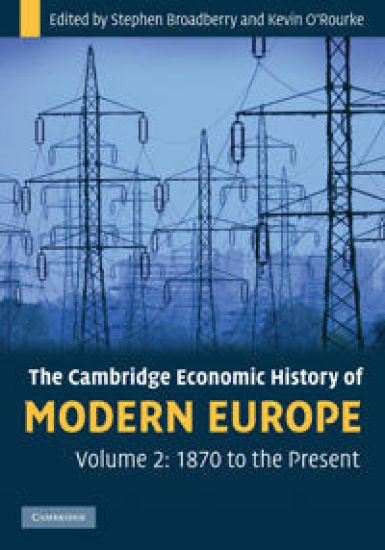
The Cambridge Economic History of Modern Europe: Volume 2, 1870 to the Present

The Cambridge Economic History of Modern Europe: Volume 2, 1870 to the Present

Stephen Broadberry; Kevin H. O'Rourke

Cambridge University Press
2010
sidottu
Unlike most existing textbooks on the economic history of modern Europe, which offer a country-by-country approach, The Cambridge Economic History of Modern Europe rethinks Europe's economic history since 1700 as unified and pan-European, with the material organized by topic rather than by country. This second volume tracks Europe's economic history through three major phases since 1870. The first phase was an age of globalization and of European economic and political dominance that lasted until the First World War. The second, from 1914 to 1945, was one of war, deglobalization, and depression and the third was one of growing integration not only within Europe but also between Europe and the global economy. Leading authors offer comprehensive and accessible introductions to these patterns of globalization and deglobalization as well as to key themes in modern economic history such as economic growth, business cycles, sectoral developments, and population and living standards.
The Cambridge Economic History of Modern Europe: Volume 2, 1870 to the Present

The Cambridge Economic History of Modern Europe: Volume 2, 1870 to the Present

Stephen Broadberry; Kevin H. O'Rourke

Cambridge University Press
2010
pokkari
Unlike most existing textbooks on the economic history of modern Europe, which offer a country-by-country approach, The Cambridge Economic History of Modern Europe rethinks Europe's economic history since 1700 as unified and pan-European, with the material organized by topic rather than by country. This second volume tracks Europe's economic history through three major phases since 1870. The first phase was an age of globalization and of European economic and political dominance that lasted until the First World War. The second, from 1914 to 1945, was one of war, deglobalization, and depression and the third was one of growing integration not only within Europe but also between Europe and the global economy. Leading authors offer comprehensive and accessible introductions to these patterns of globalization and deglobalization as well as to key themes in modern economic history such as economic growth, business cycles, sectoral developments, and population and living standards.
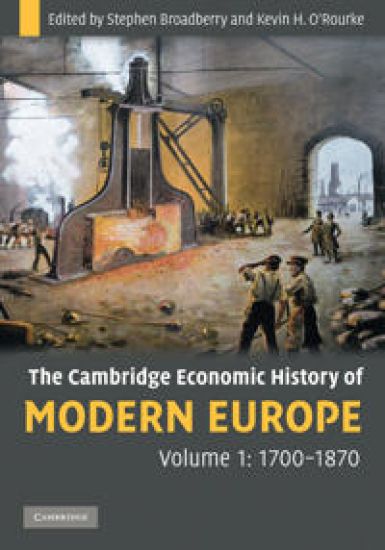
The Cambridge Economic History of Modern Europe: Volume 1, 1700–1870

The Cambridge Economic History of Modern Europe: Volume 1, 1700–1870

Stephen Broadberry; Kevin H. O'Rourke

Cambridge University Press
2010
pokkari
Unlike most existing textbooks on the economic history of modern Europe, which offer a country-by-country approach, The Cambridge Economic History of Modern Europe rethinks Europe's economic history since 1700 as unified and pan-European, with the material organised by topic rather than by country. This first volume is centred on the transition to modern economic growth, which first occurred in Britain before spreading to other parts of western Europe by 1870. Each chapter is written by an international team of authors who cover the three major regions of northern Europe, southern Europe, and central and eastern Europe. The volume covers the major themes of modern economic history, including trade; urbanization; aggregate economic growth; the major sectors of agriculture, industry and services; and the development of living standards, including the distribution of income. The quantitative approach makes use of modern economic analysis in a way that is easy for students to understand.
The Cambridge Economic History of Modern Europe: Volume 1, 1700–1870

The Cambridge Economic History of Modern Europe: Volume 1, 1700–1870

Stephen Broadberry; Kevin H. O'Rourke

Cambridge University Press
2010
sidottu
Unlike most existing textbooks on the economic history of modern Europe, which offer a country-by-country approach, The Cambridge Economic History of Modern Europe rethinks Europe's economic history since 1700 as unified and pan-European, with the material organised by topic rather than by country. This first volume is centred on the transition to modern economic growth, which first occurred in Britain before spreading to other parts of western Europe by 1870. Each chapter is written by an international team of authors who cover the three major regions of northern Europe, southern Europe, and central and eastern Europe. The volume covers the major themes of modern economic history, including trade; urbanization; aggregate economic growth; the major sectors of agriculture, industry and services; and the development of living standards, including the distribution of income. The quantitative approach makes use of modern economic analysis in a way that is easy for students to understand.
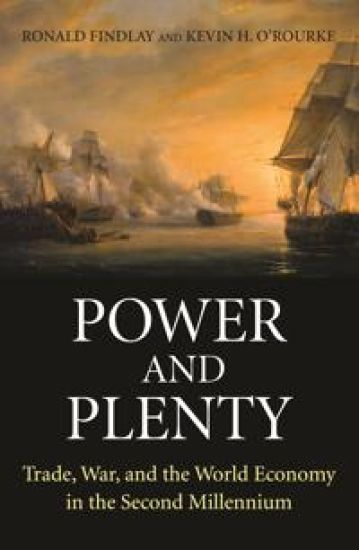
Power and Plenty

Power and Plenty

Ronald Findlay; Kevin H. O'Rourke

Princeton University Press
2009
pokkari

Halvin toimitettuna 47,40 €

International trade has shaped the modern world, yet until now no single book has been available for both economists and general readers that traces the history of the international economy from its earliest beginnings to the present day. Power and Plenty fills this gap, providing the first full account of world trade and development over the course of the last millennium. Ronald Findlay and Kevin O'Rourke examine the successive waves of globalization and "deglobalization" that have occurred during the past thousand years, looking closely at the technological and political causes behind these long-term trends. They show how the expansion and contraction of the world economy has been directly tied to the two-way interplay of trade and geopolitics, and how war and peace have been critical determinants of international trade over the very long run. The story they tell is sweeping in scope, one that links the emergence of the Western economies with economic and political developments throughout Eurasia centuries ago. Drawing extensively upon empirical evidence and informing their systematic analysis with insights from contemporary economic theory, Findlay and O'Rourke demonstrate the close interrelationships of trade and warfare, the mutual interdependence of the world's different regions, and the crucial role these factors have played in explaining modern economic growth. Power and Plenty is a must-read for anyone seeking to understand the origins of today's international economy, the forces that continue to shape it, and the economic and political challenges confronting policymakers in the twenty-first century.
Globalization and History

Globalization and History

Kevin H. O'Rourke; Jeffrey G. Williamson

MIT Press
2001
pokkari
Kevin O'Rourke and Jeffrey Williamson present a coherent picture of trade, migration, and international capital flows in the Atlantic economy in the century prior to 1914-the first great globalization boom, which anticipated the experience of the last fifty years. Globalization is not a new phenomenon, nor is it irreversible. In Gobalization and History, Kevin O'Rourke and Jeffrey Williamson present a coherent picture of trade, migration, and international capital flows in the Atlantic economy in the century prior to 1914-the first great globalization boom, which anticipated the experience of the last fifty years. The authors estimate the extent of globalization and its impact on the participating countries, and discuss the political reactions that it provoked. The book's originality lies in its application of the tools of open-economy economics to this critical historical period-differentiating it from most previous work, which has been based on closed-economy or single-sector models. The authors also keep a close eye on globalization debates of the 1990s, using history to inform the present and vice versa. The book brings together research conducted by the authors over the past decade-work that has profoundly influenced how economic history is now written and that has found audiences in economics and history, as well as in the popular press.