Kirjojen hintavertailu – 12 903 735 kirjaa ja 27 kauppaa

Kirjailija

Kirk A. Randazzo

Kirjat ja teokset yhdessä paikassa: 4 kirjaa, julkaisuja vuosilta 2011–2024, suosituimpiin kuuluu Defenders of Liberty or Champions of Security?. Vertaile teosten hintoja ja tarkista saatavuus suomalaisista kirjakaupoista.

Nimi esiintyy myös muodoissa: Kirk a Randazzo

4 kirjaa

Kirjojen julkaisuvuodet: 2011–2024.

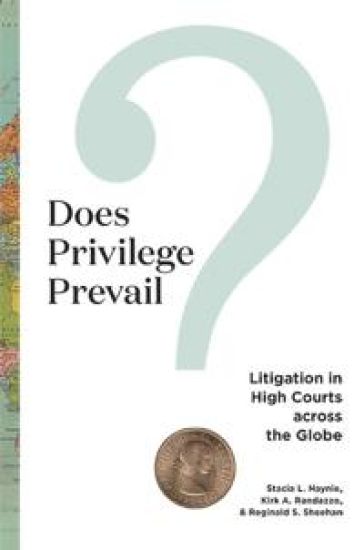
Does Privilege Prevail?

Does Privilege Prevail?

Stacia L Haynie; Kirk a Randazzo; Reginald S Sheehan

UNIVERSITY OF VIRGINIA PRESS
2024
sidottu
The first transnational comparative study of legal party capability theory Justice is supposed to be blind. Cynics will say they know better. But what do the facts say? This groundbreaking study provides objective, data-driven answers to long-standing questions about winners and losers in courtrooms across the world. Does the party with the greater resources, such as money and influence, always prevail—and if so, why? Does Privilege Prevail? is the first book to evaluate these questions using a multi-country approach and, in doing so, assess what legal professionals and political scientists call party capability theory. Stacia Haynie, Kirk Randazzo, and Reginald Sheehan analyze over fifteen thousand litigation outcomes of the high courts of six countries—Australia, Canada, India, the Philippines, South Africa, and the United Kingdom—from 1970 to 2000. This unprecedented trove of data reveals that while the “haves” of society do undoubtedly enjoy certain advantages in the judicial system, a more complex explanation for legal outcomes is required than party capability theory provides—especially when it comes to assessing the role of attorneys and their legal teams or the components of the docket where judges can provide avenues for the “have nots” to succeed.
Does Privilege Prevail?

Does Privilege Prevail?

Stacia L Haynie; Kirk a Randazzo; Reginald S Sheehan

UNIVERSITY OF VIRGINIA PRESS
2024
pokkari
The first transnational comparative study of legal party capability theory Justice is supposed to be blind. Cynics will say they know better. But what do the facts say? This groundbreaking study provides objective, data-driven answers to long-standing questions about winners and losers in courtrooms across the world. Does the party with the greater resources, such as money and influence, always prevail—and if so, why? Does Privilege Prevail? is the first book to evaluate these questions using a multi-country approach and, in doing so, assess what legal professionals and political scientists call party capability theory. Stacia Haynie, Kirk Randazzo, and Reginald Sheehan analyze over fifteen thousand litigation outcomes of the high courts of six countries—Australia, Canada, India, the Philippines, South Africa, and the United Kingdom—from 1970 to 2000. This unprecedented trove of data reveals that while the “haves” of society do undoubtedly enjoy certain advantages in the judicial system, a more complex explanation for legal outcomes is required than party capability theory provides—especially when it comes to assessing the role of attorneys and their legal teams or the components of the docket where judges can provide avenues for the “have nots” to succeed.
Checking the Courts

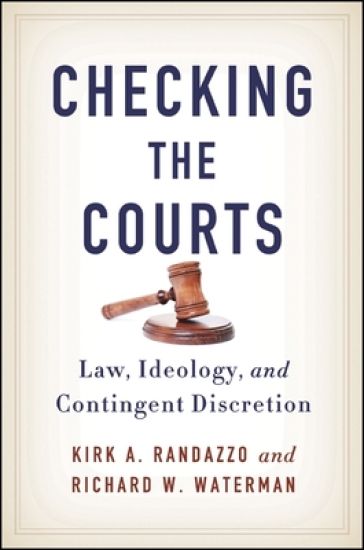
Checking the Courts

Kirk A. Randazzo; Richard W. Waterman

State University of New York Press
2015
pokkari
Examines and measures the extent to which statutory language affects judicial behavior. How does the language of legislative statutes affect judicial behavior? Scholars of the judiciary have rarely studied this question despite statutes being, theoretically, the primary opportunity for legislatures to ensure that those individuals who interpret the law will follow their preferences. In Checking the Courts, Kirk A. Randazzo and Richard W. Waterman offer a model that integrates ideological and legal factors through an empirical measure of statutory discretion. The model is tested across multiple judicial institutions, at both the federal and state levels, and reveals that judges are influenced by the levels of discretion afforded in the legislative statutes. In those cases where lawmakers have clear policy preferences, legislation encourages judges to strictly interpret the plain meaning of the law. Conversely, if policy preferences are unclear, legislation leaves open the possibility that judges will make decisions based on their own ideological policy preferences. Checking the Courts thus provides us with a better understanding of the dynamic interplay between law and ideology.
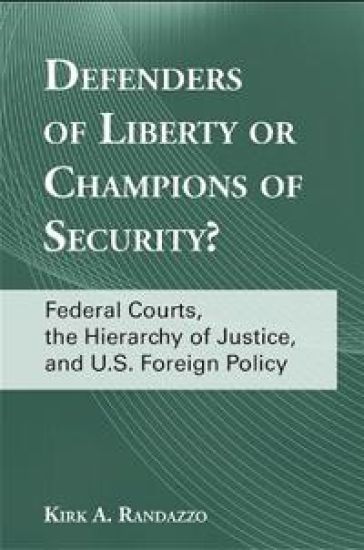
Defenders of Liberty or Champions of Security?

Defenders of Liberty or Champions of Security?

Kirk A. Randazzo

State University of New York Press
2011
pokkari
Examines the critical role assumed by the U. S. judiciary in balancing concerns about national security with the protection of liberty after the terrorist attacks of September 11, 2001. The terrorist attacks of September 11, 2001, and the subsequent responses by the U. S. federal government have raised fundamental questions about civil liberties in both domestic and international laws. As a result, the U. S. judiciary, out of its responsibility for interpreting the Constitution, has assumed a crucial role in defining boundaries of domestic and foreign policy, and in balancing concerns about security with the protection of liberty. Utilizing a sophisticated blend of quantitative and qualitative analysis, Kirk A. Randazzo examines two main questions: To what extent do federal judges defend liberty or champion security when adjudicating disputes? And to what extent does the hierarchal structure of the federal judiciary influence decisions by lower court judges? There are, he argues, disturbing indications that the federal judiciary as a whole are not defenders of liberty. Furthermore, lower court judges strategically anticipate the decisions of higher courts and constrain their behavior to avoid reversal.