Kirjojen hintavertailu – 12 903 735 kirjaa ja 27 kauppaa

Kirjailija

Kitty Calavita

Kirjat ja teokset yhdessä paikassa: 10 kirjaa, julkaisuja vuosilta 1999–2020, suosituimpiin kuuluu U.S. Immigration Law and the Control of Labor. Vertaile teosten hintoja ja tarkista saatavuus suomalaisista kirjakaupoista.

10 kirjaa

Kirjojen julkaisuvuodet: 1999–2020.

U.S. Immigration Law and the Control of Labor

U.S. Immigration Law and the Control of Labor

Kitty Calavita; Susan Bibler Coutin

Quid Pro, LLC
2020
sidottu
Reagan's 1986 immigration reform law offered a composite of contradictory measures: sanctions curtailed employment of undocumented workers while other programs enhanced labor supply. Immigration law today continues the theme of contradictions and unmet goals. But hasn't it always been so? Examining a century of U. S. immigration laws, from the nation's early stages of industrialization to enactment of the quota system, Calavita explores the hypocrisy, subtext, and racism permeating an unrelenting influx of European labor. Now in its second edition, this groundbreaking book offers a materialist theory of the state to explain the zigzagging policies that alternately encouraged and ostensibly were meant to control the influx. The author adds a 2020 Preface to place the historical record into modern relief. Writing in a new Foreword as well, Susan Bibler Coutin is "struck by the relevance of Calavita's analysis to current debates over immigration policy," as this social history "reveals alternatives to the present moment: over much of U. S. history, government officials actively recruited immigrants, even when segments of the public sought restrictions." The aim was not "social justice or human rights, but rather to fuel economic expansion, depress wages, and counter unionization." The book is recommended to a wide audience: "The theoretical discussion is accessible to new students as well as established scholars, and the rich documentary record sheds light on how current dynamics were set in motion." "Calavita lucidly and brilliantly clarifies the linkages among economic structure, ideology, and law making. She effectively depicts the history of U. S. immigration legislation as a series of attempted resolutions to recurring dilemmas rooted in the fiscal and legitimation crises facing the state." -- Marjorie Zatz, Vice Provost, UC-Merced, in International Migration Review (1986)

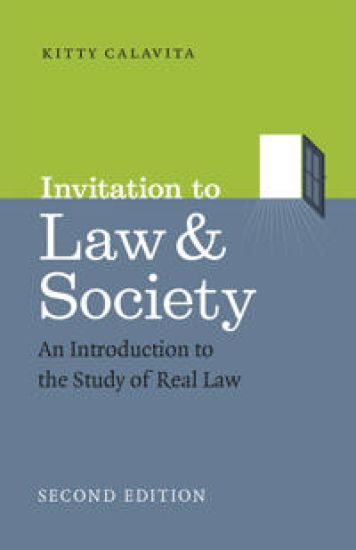
Invitation to Law and Society, Second Edition

Invitation to Law and Society, Second Edition

Kitty Calavita

University of Chicago Press
2016
nidottu
Law and society is a rapidly growing field that turns the conventional view of law as mythical abstraction on its head. Kitty Calavita brilliantly brings to life the ways in which law is found not only in statutes and courtrooms but in our institutions and interactions, while inviting readers into conversations that introduce the field’s dominant themes and most lively disagreements. Deftly interweaving scholarship with familiar examples, Calavita shows how scholars in the discipline are collectively engaged in a subversive exposé of law’s public mythology. While surveying prominent issues and distinctive approaches to both law as it is written and actual legal practices, as well as the law’s potential as a tool for social change, this volume provides a view of law that is more real but just as compelling as its mythic counterpart. With this second edition of Invitation to Law and Society, Calavita brings up to date what is arguably the leading introduction to this exciting, evolving field of inquiry and adds a new chapter on the growing law and cultural studies movement.
Invitation to Law and Society

Invitation to Law and Society

Kitty Calavita

University of Chicago Press
2016
sidottu
Law and society is a rapidly growing field that turns the conventional view of law as mythical abstraction on its head. Kitty Calavita brilliantly brings to life the ways in which law is found not only in statutes and courtrooms but in our institutions and interactions, while inviting readers into conversations that introduce the field's dominant themes and most lively disagreements. Deftly interweaving scholarship with familiar examples, Calavita shows how scholars in the discipline are collectively engaged in a subversive expose of law's public mythology. While surveying prominent issues and distinctive approaches to both law as it is written and actual legal practices, as well as the law's potential as a tool for social change, this volume provides a view of law that is more real but just as compelling as its mythic counterpart. With this second edition of Invitation to Law and Society, Calavita brings up to date what is arguably the leading introduction to this exciting, evolving field of inquiry and adds a new chapter on the growing law and cultural studies movement.
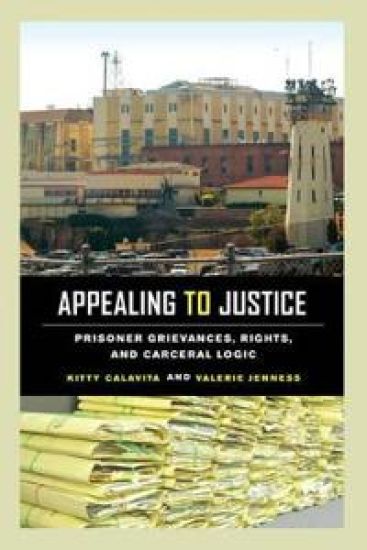
Appealing to Justice

Appealing to Justice

Kitty Calavita; Valerie Jenness

University of California Press
2014
sidottu
Having gained unique access to California prisoners and corrections officials and to thousands of prisoners' written grievances and institutional responses, Kitty Calavita and Valerie Jenness take us inside one of the most significant, yet largely invisible, institutions in the United States. Drawing on sometimes startlingly candid interviews with prisoners and prison staff, as well as on official records, the authors walk us through the byzantine grievance process, which begins with prisoners filing claims and ends after four levels of review, with corrections officials usually denying requests for remedies. Appealing to Justice is both an unprecedented study of disputing in an extremely asymmetrical setting and a rare glimpse of daily life inside this most closed of institutions. Quoting extensively from their interviews with prisoners and officials, the authors give voice to those who are almost never heard from. These voices unsettle conventional wisdoms within the sociological literature for example, about the reluctance of vulnerable and/or stigmatized populations to name injuries and file claims, and about the relentlessly adversarial subjectivities of prisoners and correctional officials and they do so with striking poignancy. Ultimately, Appealing to Justice reveals a system fraught with impediments and dilemmas, which delivers neither justice, nor efficiency, nor constitutional conditions of confinement.
Appealing to Justice

Appealing to Justice

Kitty Calavita; Valerie Jenness

University of California Press
2014
pokkari
Having gained unique access to California prisoners and corrections officials and to thousands of prisoners' written grievances and institutional responses, Kitty Calavita and Valerie Jenness take us inside one of the most significant, yet largely invisible, institutions in the United States. Drawing on sometimes startlingly candid interviews with prisoners and prison staff, as well as on official records, the authors walk us through the byzantine grievance process, which begins with prisoners filing claims and ends after four levels of review, with corrections officials usually denying requests for remedies. Appealing to Justice is both an unprecedented study of disputing in an extremely asymmetrical setting and a rare glimpse of daily life inside this most closed of institutions. Quoting extensively from their interviews with prisoners and officials, the authors give voice to those who are almost never heard from. These voices unsettle conventional wisdoms within the sociological literature for example, about the reluctance of vulnerable and/or stigmatized populations to name injuries and file claims, and about the relentlessly adversarial subjectivities of prisoners and correctional officials and they do so with striking poignancy. Ultimately, Appealing to Justice reveals a system fraught with impediments and dilemmas, which delivers neither justice, nor efficiency, nor constitutional conditions of confinement.
Immigrants at the Margins

Immigrants at the Margins

Kitty Calavita

Cambridge University Press
2005
pokkari
Spain and Italy have recently become countries of large-scale immigration. This provocative book explores immigration law and the immigrant experience in these southern European nations, and exposes the tension between the temporary and contingent legal status of most immigrants, and the government emphasis on integration. This book reveals that while law and the rhetoric of policymakers stress the urgency of integration, not only are they failing in that effort, but law itself plays a role in that failure. In addressing this paradox, the author combines theoretical insights and extensive data from myriad sources collected over more than a decade to demonstrate the connections among immigrants' role as cheap labor - carefully inscribed in law - and their social exclusion, criminalization, and racialization. Extrapolating from this economics of alterité, this book engages more general questions of citizenship, belonging, race and community in this global era.
Immigrants at the Margins

Immigrants at the Margins

Kitty Calavita

Cambridge University Press
2005
sidottu
Spain and Italy have recently become countries of large-scale immigration. This provocative book explores immigration law and the immigrant experience in these southern European nations, and exposes the tension between the temporary and contingent legal status of most immigrants, and the government emphasis on integration. This book reveals that while law and the rhetoric of policymakers stress the urgency of integration, not only are they failing in that effort, but law itself plays a role in that failure. In addressing this paradox, the author combines theoretical insights and extensive data from myriad sources collected over more than a decade to demonstrate the connections among immigrants' role as cheap labor - carefully inscribed in law - and their social exclusion, criminalization, and racialization. Extrapolating from this economics of alterité, this book engages more general questions of citizenship, belonging, race and community in this global era.
Big Money Crime

Big Money Crime

Kitty Calavita; Henry N. Pontell; Robert Tillman

University of California Press
1999
pokkari
At a cost of $500 billion to American taxpayers, the savings and loan debacle of the 1980s was the worst financial crisis of the twentieth century as well as a crime unparalleled in American history. Yet the vast majority of its perpetrators will never be prosecuted, and those who were have received minimal sentences. In the first in-depth scrutiny of the ways and means of this disaster, this groundbreaking book comes to disturbing conclusions about the deliberate nature of this financial fraud, the political collusion involved, and the leniency of the criminal justice system in dealing with these 'Gucci-clad white-collar criminals'. Using material from over one hundred interviews with government officials and industry leaders and recently declassified documents, the authors show how - contrary to previous government and 'expert' explanations that chalked the disaster up to business risks gone awry or adverse economic conditions - S&L leaders engaged in deliberate fraud, stealing from their own corporations to speculate on high-risk ventures. Tempted by the insurance net, perpetrators looted their own institutions in a new kind of white-collar crime the authors dub 'collective embezzlement'. "Big Money Crime" also demonstrates how systematic political collusion - not just policy errors - was a critical ingredient in this unprecedented series of frauds. Bringing together statistics from a variety of government agencies, the authors provide a close reading of the track record of prosecutions and sentencing and find that 'suite crime' receives much more lenient treatment than 'street crime', despite its significantly higher price tag. The book concludes with a number of modest, but no less urgent, policy recommendations to counter the current deregulatory trend and to avert a replay of the S&L debacle in other financial sectors. From the book: 'We built thick walls; we have cameras; we have time clocks on the vaults ...all these controls were to protect against somebody stealing the cash. Well, you can steal far more money, and take it out the back door. The best way to rob a bank is to own one' - House Committee on Government Operations, 1988.